Published July 14, 2026
Longquan celadon identified: the Southern Song glaze colours, how the wares changed through Yuan and Ming, and the foot and weight checks that date one.
Pick up a good piece of Longquan celadon and the first surprise is depth. The glaze is not a coat of green paint over clay; it is a thick, layered, faintly translucent skin that seems to hold light inside it, the way jade does. That jade-like quality was the whole point — and it is still the single most important thing your eye should be judging when you look at a piece today.
This guide covers what Longquan celadon is, how the wares changed from the Song dynasty through the Ming, which types collectors compete for, and the practical checks — glaze, foot, weight, condition — that help you place a piece before you rely on anyone else's label.
What Longquan celadon is
Longquan is a kiln region in the hills of southern Zhejiang province, in southeastern China. Its kilns were producing green-glazed stoneware by the Northern Song dynasty (960–1127), hit their artistic peak under the Southern Song (1127–1279), ran enormous export production through the Yuan (1279–1368) and early Ming, and declined by the late Ming. That arc — refinement first, scale second, decline third — is the skeleton on which all dating hangs.
The glaze is colored by a small amount of iron, fired in a reduction atmosphere (starved of oxygen), which turns the iron green rather than the amber it would give in oxidation. What set Longquan apart from earlier green wares was thickness: potters applied the glaze in multiple layers, sometimes firing between coats, building a deep, unctuous surface unlike the thin, glassy celadons that came before. Where a northern celadon like Yaozhou ware shows its carved decoration crisply through an olive-toned glaze, classic Southern Song Longquan often abandons decoration almost entirely and lets the glaze itself be the subject — the same logic that governs the whole family of Chinese monochrome glazes.
Two Southern Song glaze colors stand at the top of the hierarchy. Fenqing, a soft, cloudy blue-green, and meiziqing, a deeper "plum green," are the shades connoisseurs and auction catalogs single out. Neither is a fixed standard — kiln position and firing luck made every piece slightly different — but when a catalog note lingers on the glaze color, this hierarchy is what it is invoking.
The word "celadon" itself, incidentally, is European: it is commonly traced to a French stage character of the seventeenth century who wore green ribbons. Chinese sources simply call the ware qingci — green porcelain.
The classic types, dynasty by dynasty
Southern Song (1127–1279). The peak. Forms are small, quiet, and perfectly weighted: bowls carved on the outside with lotus petals, small dishes, incense burners on three feet, brush washers, and the mallet-shaped vase — known in Japan as the kinuta type — that many collectors consider the single most desirable Longquan form. Japanese tea-ceremony taste canonized these pieces centuries ago, and examples with old Japanese collections behind them carry that pedigree into the saleroom. Decoration is minimal; the glaze does the work. Bodies are thin relative to the glaze, and the best pieces feel improbably light for their presence.
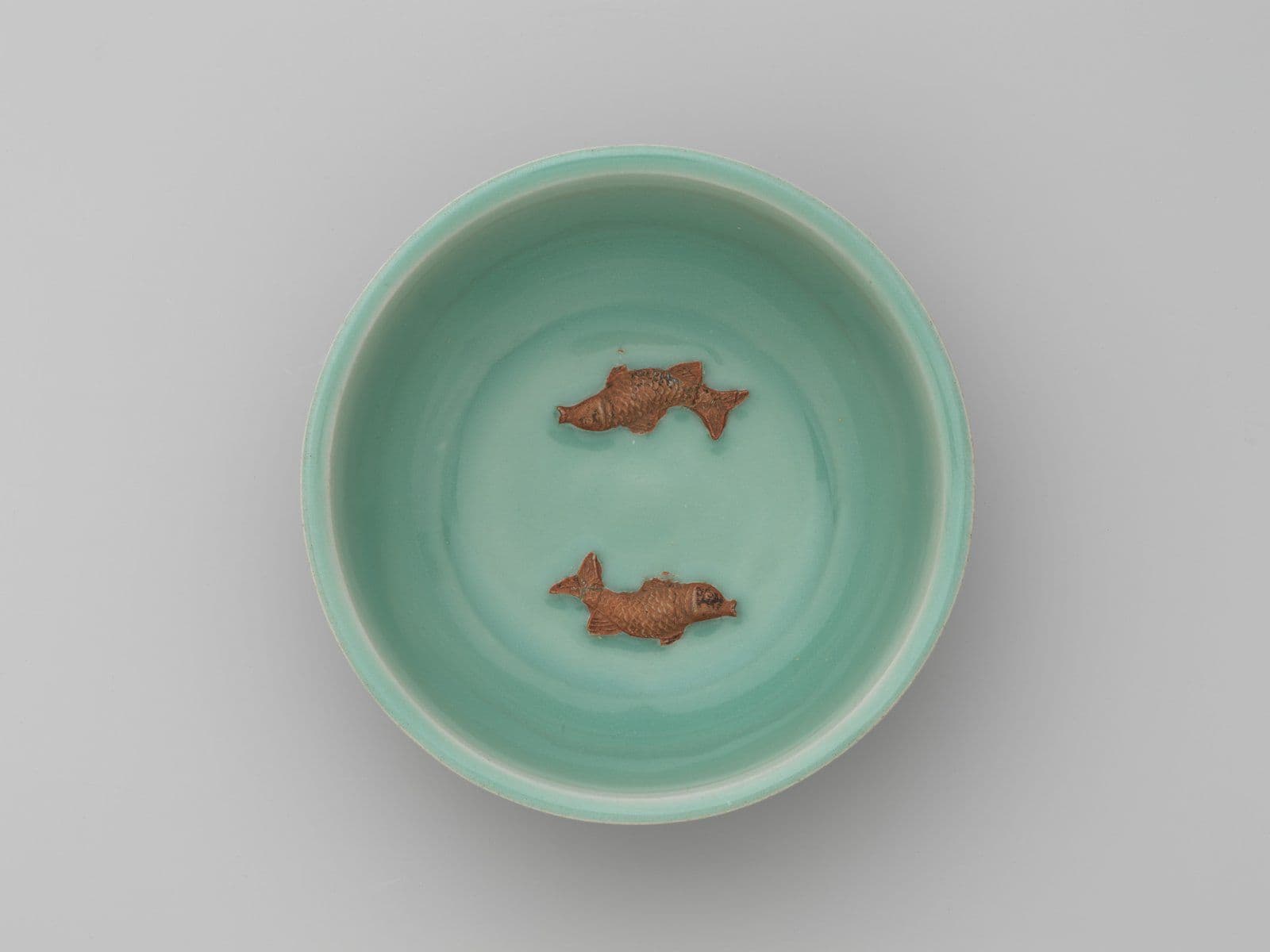
Yuan (1279–1368). Scale arrives. The kilns turned to mass export, and forms grew: large chargers, heavy jars, big bowls built to survive sea freight and to suit dining customs in the Middle East and Southeast Asia. Decoration returns — carved, molded, and appliqué. Twin fish molded in the center of a dish are a classic Yuan type, as are dragons applied in relief; sometimes reliefs were left unglazed to fire orange-brown against the green. A shipwreck discovered off the Korean coast in the 1970s, which sank in the early fourteenth century, carried thousands of Longquan celadons in its cargo — a snapshot of how dominant this trade was.
Ming (1368–1644). Continuation, then fade. Excavations in recent decades have shown that the early Ming court ordered wares from Longquan alongside Jingdezhen, and the best early Ming pieces — large, boldly carved dishes and vases — are imposing objects that have risen in scholarly esteem. But as Jingdezhen's blue-and-white came to dominate both court taste and the export trade (a story told in our history of cobalt), Longquan lost ground. Later Ming production thins out in quality, and by the dynasty's end the great era is over. The tradition was revived in the twentieth century, and the traditional firing technology was inscribed on UNESCO's intangible cultural heritage list in 2009 — which means the market also contains accomplished modern celadon that is honest craft, not antique.
How to read a piece in the hand
Longquan is a connoisseurship ware: it is mostly unmarked (reign marks are essentially a Jingdezhen habit — see our porcelain marks guide), so the object has to date itself. The checks below are where specialists start.
The glaze. Judge depth, texture, and color in natural light. Southern Song glazes look soft and almost matte-deep, with an interior glow; Yuan and Ming glazes tend toward glassier, more transparent green. Classic Longquan is usually uncrackled — a prominent crackle is either a different ware, a sign of burial-induced change, or a later piece imitating Guan-type taste.
The foot and body. The exposed clay at the foot ring typically burns to an orange-red or reddish-brown where the iron-bearing body met kiln air — a warm ring that collectors learn to expect, and one of several reasons the foot rim repays close study. Yuan and Ming pieces often have a broad unglazed ring on the base from stacking in the kiln. Song bodies are finer and grayer; export-era bodies are coarser and heavier.
Weight and potting. A Southern Song bowl feels thin-walled under a thick glaze; a Yuan charger feels frankly heavy. Weight that contradicts the claimed period is a fast red flag.
Condition. Glaze pooling, kiln grit, and minor firing flaws are period-normal and largely forgiven. Rim chips, cracks, and drilled bases are not. Because the glaze is the value, glaze condition matters more here than on painted wares — a polished-down rim or re-glazed repair should reprice a piece dramatically.
What the market rewards
The Longquan market is a pyramid. At the top: Southern Song pieces of classic form with fine fenqing or meiziqing glazes — kinuta vases, incense burners, lotus bowls — especially with old Japanese or well-published Western provenance. These are expensive and keenly contested.
The broad middle: Yuan and early Ming export wares. Large chargers and jars survive in quantity, and handsome examples remain among the most affordable entries into serious six-hundred-year-old Chinese ceramics. Their size makes them satisfying display objects, and their prices reflect supply rather than any lack of quality.
The floor to respect: later imitations and modern revival ware. Longquan glazes have been imitated at Jingdezhen and elsewhere for centuries, and twentieth-century revival pieces are common. Most are honest; some circulate with optimistic labels. When in doubt, buy the documented piece over the beautiful stranger — standard auction diligence is the right defense here.
Common questions
Why is some celadon blue-green and some olive?
Chemistry and atmosphere. The iron in the glaze gives blue-green tones when firing reduction is strong and the glaze recipe is lime-alkali (the Longquan formula), and olive or amber-green tones when there is more oxygen or a different glaze chemistry — typical of northern celadons like Yaozhou. Within Longquan itself, kiln position produced a range on every firing; the prized fenqing blue-green was the lucky center of that range, which is exactly why it is prized.
How can I tell Southern Song Longquan from Yuan?
Start with size and weight: Song forms are small and thin-bodied under thick soft glaze; Yuan pieces are larger, heavier, glassier. Then decoration: minimal carving (lotus petals at most) points Song; molded fish, applied dragons, and busy carving point Yuan. Then the base: broad unglazed stacking rings are an export-era habit. No single check settles it — the combination does.
Does Longquan celadon carry reign marks?
Almost never in the classic period. Marks are a Jingdezhen convention; Longquan wares date by form, glaze, body, and foot rather than by inscription. A Longquan-type piece bearing a neat six-character reign mark is telling you it was made at Jingdezhen in a later period imitating the celadon taste — sometimes a fine thing in itself, but a different collecting category.
Is modern Longquan celadon collectible?
As contemporary craft, yes — the tradition was revived in the twentieth century and its firing technology now has UNESCO intangible-heritage recognition, and leading modern makers have real followings. Just keep the categories straight: modern revival ware should be priced as contemporary ceramics, not as antiques. Problems arise only when one is dressed as the other.
Further reading
- How to Buy Chinese Art at Auction: A First-Time Bidder's Playbook — mechanics and due diligence before you bid on that charger.
- How to Care for Chinese Porcelain — handling, display, and storage rules that protect the glaze that carries the value.
- Chinese Export Porcelain: Kraak, Swatow, and Other Trade Wares — the wider maritime trade that Yuan and Ming Longquan sailed in.
- How to Photograph a Porcelain Mark for Authentication — the record a specialist needs when you ask for an opinion.
Browse the collection
If the marks and glazes here have you looking at Chinese art more widely, our own catalogue runs to paper rather than clay — archival giclée reproductions of the modern ink masters, hand-numbered on rice paper and supplied with a Certificate of Authenticity.
Explore Further