Published August 16, 2026
A guide to Chinese calligraphy couplets (duilian): how to hang them, the composition rules, why the format reveals control, and what to check before buying.
Walk into an old Chinese hall and look at the back wall. There is usually a large painting or a broad sheet of calligraphy in the centre, and flanking it, two narrow vertical scrolls of equal width carrying one line of text each. Those two scrolls are a couplet — duilian (對聯) — and they are not decoration added around the centrepiece. They are a single work in two halves, written to be read together, and in the private market they trade more often than almost any other calligraphy format.
This guide explains what a couplet is, the rules that govern how it is composed, why the format is unusually revealing about a calligrapher's control, and what to check before buying one.
What a couplet is, and how to read it
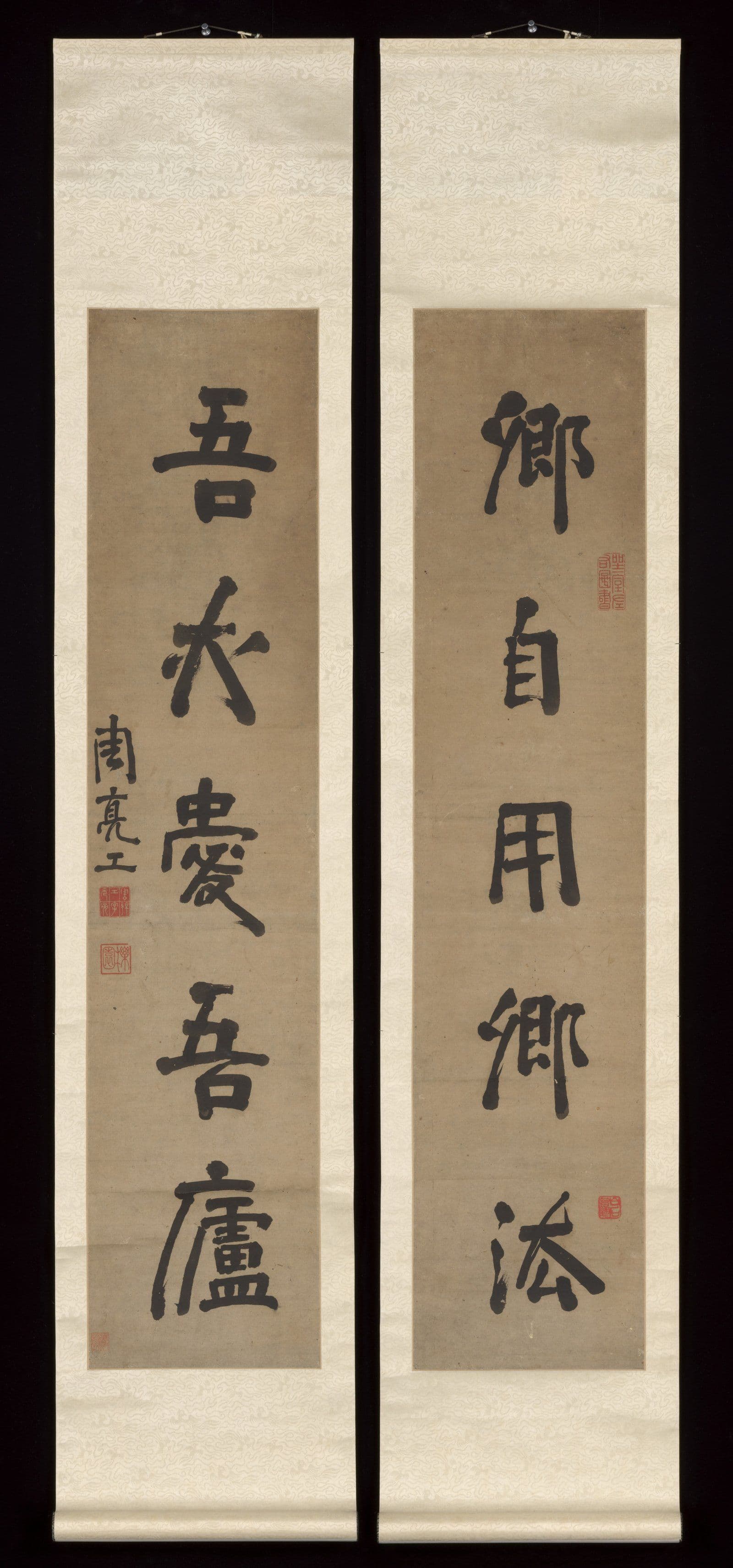
A couplet is two lines of text of identical character count, written on two separate sheets or scrolls, mounted as a matched pair and hung side by side.
The order matters and catches out most first-time buyers. The first line (上聯, shanglian) hangs on the right; the second line (下聯, xialian) hangs on the left. This follows the direction of traditional Chinese reading, right to left. Hang a couplet the Western way round and it reads backwards — an error that is immediately obvious to anyone who reads Chinese, and surprisingly common in Western homes and even in some dealers' photographs.
Two quick tells for which sheet is which, useful when the text itself is hard to parse:
- The signature, date, and artist's seals almost always appear on the left-hand sheet (xialian), at the end of the whole work. A sheet with a long inscription and the artist's seals is the second line.
- The final character of the first line typically lands on an oblique tone (仄), and the final character of the second line on a level tone (平). The pairing gives the couplet its sense of closing, the way a cadence resolves.
Where a couplet flanks a doorway rather than a wall, a short horizontal band (橫批, hengpi) often sits above it, summarising the pair in four characters.
The rules the text has to obey
Couplet composition is a formal discipline, not free verse. The two lines must correspond position by position, and the correspondences are strict:
- Equal length — both lines carry exactly the same character count.
- Grammatical parallelism — noun answers noun, verb answers verb, in the same slot.
- Semantic pairing — categories match: a mountain answers a river, spring answers autumn.
- Tonal contrast — level and oblique tones alternate against each other across the pair.
- No repetition — the same character generally should not fall in the same position twice.
The effect is that a couplet is a small machine of symmetry. Character three of the first line and character three of the second line are doing the same grammatical job on opposite sides of a mirror. Once you know this, you can find the structure even without reading the text: count the characters, and look at where the visual weight falls in each line.
This formal parallelism is why couplets appear everywhere in Chinese life — pasted in red at doorways for the New Year (春聯, chunlian), carved on temple pillars, hung in studios as a statement of intent, and presented as gifts to mark an occasion. A well-chosen couplet says something specific about the recipient, and the giver's calligraphy says something about the giver.
Why the format is brutal on the calligrapher
Here is the reason couplets matter for connoisseurship, and the reason experienced buyers like them.
In a hanging scroll of continuous text, the eye moves down a column and forgives a good deal. Characters vary, the rhythm ebbs, and a weak passage is absorbed into the whole. A couplet removes that cover. The two lines have the same number of characters, in the same size, at the same intervals, hung at the same height, roughly a metre apart. Every character has an exact counterpart sitting beside it at eye level.
That makes the format a direct comparison test:
- Spacing. Do the character intervals in the two lines actually match, or did the writer run out of room and compress the bottom of one line?
- Size consistency. Are corresponding characters the same weight, or does one line drift larger?
- Brush pressure. Does the ink density hold across both sheets, or did the second sheet get written with a tired hand or a drier brush?
- The vertical axis. Does each column hold a true centre line, or does one wander?
A calligrapher who is merely competent can hide inside a long scroll. In a couplet, the flaw is sitting next to its own control sample. This is why couplets were a favoured format for demonstrating skill, and why the great couplet writers are remembered specifically for it — Wu Changshuo among them, whose seal-script couplets carry the density of his stone-carving practice straight into brushwork.
It also gives you, the buyer, a diagnostic no other format provides. Stand in front of a couplet and compare the two lines character by character. You do not need to read Chinese to see whether a hand was in control.
Script, and what it tells you about the piece
Couplets are written in every script, and the choice signals the register of the work.
Regular script (楷書, kaishu) is the formal, legible option — used for presentation pieces, temple and hall couplets, and anything meant to be read at distance by everyone. It is also the least forgiving, since every structural weakness in a character is exposed. Regular script explained covers what good kaishu structure looks like.
Clerical script (隸書, lishu) and seal script (篆書, zhuanshu) carry antiquarian weight and were favoured by nineteenth- and twentieth-century calligraphers drawing on epigraphic sources. Seal-script couplets in particular were a signature of the stele-studying scholars.
Running script (行書, xingshu) appears in more personal, informal couplets — those written for a friend rather than a hall.
Cursive (草書, caoshu) is rare in couplets, and for a structural reason: cursive compresses and abbreviates characters, which makes the strict positional parallelism between the two lines difficult to hold visually. When you do see a cursive couplet, look hard at whether the correspondence survives. If you want to place a piece by its script first, the five scripts at a glance is the fastest route.
What to check before you buy
Couplets carry one risk that other formats do not: they come in pairs, and pairs get separated.
Confirm you are being sold both halves. Over a century of inheritance, division of estates, and dealers selling by the piece, enormous numbers of couplets have been split. A single scroll from a couplet is a fragment — it reads as half a sentence, it cannot be hung as intended, and it is worth far less than half the pair. If a listing shows only one scroll, assume the other is gone until proven otherwise.
Check that the pair is genuinely a pair. Marriages happen — two unrelated scrolls of similar size presented together. Compare paper tone, sheet dimensions to the millimetre, mounting silk, ink colour, and the wear pattern at the top and bottom. A real pair aged in the same room and shows it.
Read the mounting. The two scrolls should have been mounted as a set, in matching silk, with matching rollers and knobs. Remounting is normal and not a defect in itself, but the pair should have been remounted together. Chinese painting mounting (装裱) explains what to look for and why the mount affects value.
Locate the signature and seals. They belong on the left-hand sheet. A couplet where both sheets are signed, or where the signature sits on the right, warrants an explanation.
Measure your wall before anything else. A couplet needs a hanging width of both scrolls plus the gap between them, and it wants a centrepiece or a doorway in the middle. It is a format with an architectural requirement — Chinese hanging scrolls: format, mounting and display covers the practicalities of getting scrolls onto a wall.
Common questions
Can I hang a couplet without a painting in the middle?
Yes, though the composition was designed around a centre. Flanking a doorway, a window, a fireplace, or a piece of furniture all work, because each supplies the central axis the pair needs. What does not work is hanging the two scrolls in isolation with a large blank gap and nothing between them — the eye reads the emptiness as a missing element rather than as space. If you have no centrepiece yet, hang the pair closer together than you think you should.
Is one scroll from a broken pair worth buying?
Only at a price that reflects what it is, and generally only if the calligrapher is significant to you and the text stands on its own. A single scroll cannot be completed later — the chance of locating its partner is effectively zero. Buy it as an example of a hand you admire, hang it as a single vertical scroll, and do not expect it to behave like a couplet in resale.
Do couplets have to be the same colour paper?
The two sheets should match, since they were written as one work on one batch of paper. Across different couplets, colour varies widely: plain white or cream xuan is the default, red is used for New Year and celebratory couplets, and decorated, flecked, or gold-sprinkled papers appear in more elaborate presentation pieces. What matters is internal consistency between the two halves.
How do I know which line is the first if the piece is unsigned?
Read the last character of each line and identify its tone if you can; the first line closes on an oblique tone, the second on a level tone. Failing that, look at the sense of the text — the second line usually completes or answers the first. If the piece is unsigned, unmounted, and you cannot read the text, that combination is itself worth pausing over. Collecting Chinese calligraphy: scripts, formats and value covers how format and signature interact in valuation.
Further reading
- Chinese Hanging Scrolls: Format, Mounting and Display — the format family a couplet belongs to.
- Regular Script (Kaishu): How the Standard Hand Works — the script most formal couplets use.
- Collecting Chinese Calligraphy: Scripts, Formats and Value — where couplets sit in the wider calligraphy market.
- Album Leaves and Fan Paintings: The Affordable Formats — the other formats worth knowing before you commit.
Browse the collection
Couplets are a subject we write about rather than a format we stock. What Kiln & Ink sells is single sheets: limited-edition archival giclée reproductions of the twentieth-century Chinese ink masters, printed on rice (xuan) paper or museum-grade cotton-rag, hand-numbered, and issued with a Certificate of Authenticity, at roughly $300 to $1,200. If it is the calligraphic hand that draws you, Qi Gong is the place on our roster to start.
Explore Further