Published July 17, 2026
The Xuande mark is the most copied early Ming reign mark in Chinese porcelain. Here is what a genuine 1426-35 mark looks like - and how to place the copies.
Turn over almost any Chinese blue-and-white pot in an ordinary auction, and sooner or later you will meet the same six characters: 大明宣德年製 — "Made in the Xuande reign of the Great Ming." The Xuande emperor ruled for just ten years, from 1426 to 1435. The marks bearing his reign name have been applied to porcelain, more or less continuously, for close to six centuries since.
This guide covers what a genuine Xuande mark looks like, what the porcelain around it should be doing, how to place the far more numerous later pieces that carry the mark, and how to think about a Xuande-marked object honestly. It assumes you already know the basics of reading Chinese reign marks; this is the deep dive on one reign.
Why Xuande matters this much
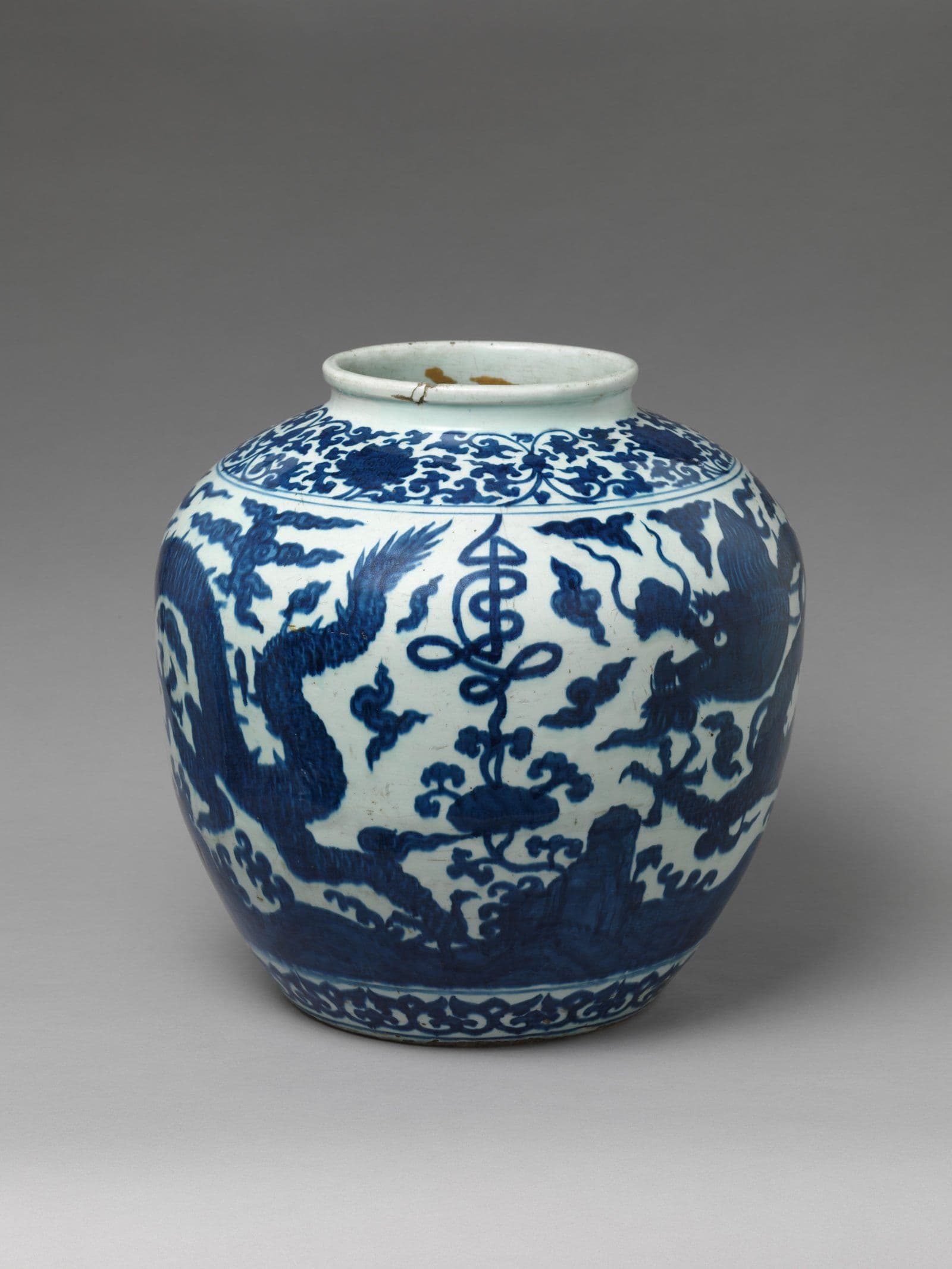
The Xuande decade is, with the Yongle reign before it, the classical moment of Chinese blue-and-white. The imperial kilns at Jingdezhen were producing for the court at an extraordinary level: dragon jars, stem cups, altar vessels for the court's Tibetan Buddhist rites, dishes, and ewers whose shapes and drawing set the standard every later reign measured itself against.
Two further things fixed the reign's reputation. First, Xuande is generally regarded as the point where reign marks became a regular, systematic practice on imperial porcelain — earlier marks exist, but from Xuande onward the marked imperial ware is the norm, which is why the reign anchors every survey of Ming dynasty reign marks. Second, later generations agreed on its supremacy early and loudly. By the sixteenth century, Jingdezhen was already producing respectful Xuande-marked copies, and connoisseurship texts ranked Xuande wares among the highest achievements of the potter's art. Admiration on that scale is exactly what makes a mark dangerous to rely on.
One more wrinkle is unique to this reign: the mark's fame extends beyond ceramics. The bronze incense burners known as Xuande censers — cast, by tradition, in the same reign — became their own centuries-long copying industry, and the four- or six-character Xuande mark on a bronze censer is even less reliable as a date than it is on porcelain. This article stays with the porcelain.
What a genuine Xuande mark looks like
Period Xuande marks are written in underglaze cobalt blue, in kaishu — upright regular script — and the court manner is traditionally associated with the calligraphy of Shen Du, a favored court calligrapher of the era. The writing is confident, evenly weighted, and unfussy: drawn by practiced hands writing the same characters all day, not laboring over a model.
The practical diagnostics:
- Six characters, regular script. 大明宣德年製, read top to bottom, right to left. Two vertical columns of three characters is common, as is a single horizontal line. Four-character versions (宣德年製) exist but are less standard on imperial ware.
- The de 德 test. In period marks the character de is usually written without the horizontal stroke above the heart element 心 at its base. Later copyists, writing the character as they learned it, often put the stroke back in. It is a first check, not a verdict — some genuine writing varies, and good fakers know the trick — but it sorts a surprising amount of material.
- Placement is unpredictable. Later reigns settled the mark firmly on the base. Xuande marks famously wander: on the base, yes, but also on the shoulder of a jar, near the rim of a bowl or dish, on the exterior below the lip. Collectors repeat an old saying to the effect that "Xuande marks are found all over the vessel." A mark in an odd position is therefore not, by itself, a warning sign for this reign — sometimes the opposite.
- Framing varies. Double circles around the mark are common, as on most later reigns, but rectangular frames and unframed marks also occur.
- The cobalt behaves like the reign's cobalt. The blue of the mark should match the blue of the decoration in tone and behavior — which brings us to the body of the pot.
The porcelain around the mark
A reign mark is one sentence of evidence. The vessel is the rest of the paragraph, and Xuande-period porcelain has a strongly marked character.
The cobalt of the period — traditionally described as imported "Sumali" or Islamic cobalt, often blended with local material — is deep, inky, and famously uneven. Where the pigment pooled, it fired to blackish, silvery spots that seem to bite down into the glaze: the "heaped and piled" effect. Later reigns saw that unevenness as a flaw and refined it away; eighteenth-century admirers then imitated it deliberately, adding dark dots with the brush. On period pieces the effect is structural — it sits in the drawing where the brush naturally loaded — while painted-on imitation spotting tends to decorate the outlines rather than inhabit them.
The glaze of the period characteristically shows a fine dimpled texture, the so-called orange-peel surface, rather than the glassy smoothness of later imperial ware. Drawing is vigorous and fluent: Xuande dragons in particular have a muscular, slightly ferocious life that later, more polished renderings rarely match. Shapes are potted with real weight, and the reign's classical repertoire — stem cups, lobed dishes, jars, altar bowls made for Tibetan Buddhist ritual use, some with Tibetan inscriptions — is well documented in museum collections.
None of these traits is individually decisive, and every one of them has been imitated. But they must all agree. A Xuande mark over pale, even, sweetly perfect blue on a mirror-smooth glaze is telling you a coherent story about a later date, whatever the mark says.
Five centuries of Xuande-marked porcelain
Most Xuande-marked pieces a collector will handle fall into a few broad groups, and placing a piece in the right group is the real identification task.
| Group | When | What to look for ||---|---|---|| Mark and period | 1426–1435 | Heaped-and-piled cobalt, orange-peel glaze, vigorous drawing, confident kaishu mark, forms from the imperial repertoire || Late Ming homages | 16th century, especially Jiajing–Wanli | Honest workshop wares wearing an admired mark; cobalt and potting of their own era give them away || Qing apocryphal marks | especially Kangxi through Qianlong | High-quality porcelain carrying Xuande marks as homage, not deception in the modern sense; often beautifully made, collectable in its own right || 19th–20th century copies | late Qing and Republic | Enormously varied; from careless export-grade wares to studied imitations complete with artificial heaping-and-piling || Modern reproductions | 20th–21st century | Everything from tourist ware to laboratory-grade fakes aimed at the top of the market |
The essential mental adjustment: an apocryphal Xuande mark is normal, not scandalous. Chinese potters used earlier reign marks as a form of stylistic quotation for centuries, a practice covered at length in our guide to apocryphal marks on Chinese porcelain. A Kangxi-period dish with a Xuande mark is a genuine, desirable Kangxi dish — mislabeling it a fake wastes a good object, and mislabeling it Xuande wastes your money.
Alongside Chenghua — the other early Ming reign whose marks were endlessly borrowed — Xuande is the most copied reign name of the entire canon. Sheer base rates should set your expectations: of all the Xuande-marked porcelain in circulation, the mark-and-period fraction is a rounding error.
What this means when you are buying
Genuine mark-and-period Xuande blue-and-white is museum-grade material, closely studied, largely accounted for, and priced accordingly when it does appear at the major houses. A piece offered casually with a Xuande attribution and a modest estimate has, in effect, already told you the cataloguer's real opinion.
The productive collecting question is usually not "is it Xuande?" but "when is it, and is it good of its time?" A crisp sixteenth-century homage, or a fine Qing dish wearing the mark, can be an excellent object at a fraction of imperial-Ming money. Read the mark, then set it aside and date the pot — cobalt, glaze, potting, foot — on its own evidence, the same discipline that applies to every reign mark in the book.
Common questions
What does a Xuande mark say?
The standard six-character mark reads 大明宣德年製, "Made in the Xuande reign of the Great Ming," in underglaze blue regular script, arranged either in two vertical columns of three characters or in one horizontal line. A four-character form omitting "Great Ming" also exists. Unusually for reign marks, it may appear almost anywhere on the vessel — base, shoulder, or rim — not only underfoot.
How can I tell a genuine Xuande mark from a later copy?
No single test settles it. Start with the writing: period marks are fluent kaishu, and the character de 德 usually lacks the horizontal stroke above its heart element. Then interrogate the pot: period cobalt shows dark heaped-and-piled spotting that sinks into the glaze, the glaze itself tends to an orange-peel texture, and the drawing is vigorous. All the evidence has to point the same way; a beautiful mark on the wrong porcelain is a later piece.
Are pieces with apocryphal Xuande marks worthless?
Not at all. Sixteenth-century and Qing-dynasty wares bearing Xuande marks were made in admiration of the reign and are collected on their own merits — some Qing examples are superb. The mark simply cannot be used as a date. Value follows what the piece actually is: its period, quality, and condition.
Why are Xuande marks found in so many positions on the vessel?
Marking practice was still young in the 1420s–30s, and the imperial kilns had not yet standardized placement the way later reigns did. Marks were written where the form invited them — base, shoulder, rim. The variability is well documented on period pieces, so position alone should neither alarm nor reassure you.
Further reading
- How to Spot Fake Chinese Porcelain Marks — the general toolkit: writing quality, cobalt behavior, and the tells of modern reproduction.
- Dating Chinese Porcelain by the Foot Rim — the other end of the pot, and often the more honest one.
- Jiajing and Wanli Marks: The Late Ming Reigns — the century that started copying Xuande in earnest.
- Kangxi Reign Marks: Identification Guide — the reign responsible for many of the best Xuande-marked pieces you will meet.
Browse the collection
If the marks and glazes here have you looking at Chinese art more widely, our own catalogue runs to paper rather than clay — archival giclée reproductions of the modern ink masters, hand-numbered on rice paper and supplied with a Certificate of Authenticity.
Explore Further