Published July 26, 2026
Early Ming porcelain rarely carries a reign mark. How to read the rare four-character Yongle mark, sweet-white glaze, and heaped-and-piled cobalt.
Turn over a piece of early Ming porcelain expecting a reign mark, and more often than not you find nothing at all — a bare, glazed footrim where a collector trained on later wares assumes six neat characters should be. That absence is not a flaw or a loss. For the first Ming reigns it is the norm, and learning to read it is the first step in dating anything from this period.
This guide explains why porcelain from the Hongwu and Yongle reigns is so rarely marked, what the one distinctive Yongle mark actually looks like, and how connoisseurs date these wares by glaze, cobalt, and form when the base tells them nothing.
Why the earliest Ming wares carry no mark
The Ming dynasty began in 1368, when Zhu Yuanzhang took the throne as the Hongwu emperor and ruled until 1398. His fourth son seized power a few years later and reigned as the Yongle emperor from 1403 to 1424. Across both reigns — more than half a century — the imperial kilns at Jingdezhen produced porcelain of the highest order, yet the systematic practice of stamping a reign mark (the nianhao, or era name) on imperial ware had not yet settled into custom.
That habit crystallized only in the following generation. Marks became consistent under the Xuande emperor in the late 1420s and 1430s, and it is from Xuande onward that a collector can expect to find a dated inscription on the base of a good imperial piece. Everything before that sits in a marking gap. So a Hongwu dish is dated not by its base but by everything else: its potting, its palette, and the way its decoration is drawn.
If you are working back through the dynasty from the more familiar later reigns, it helps to hold the whole sequence in view — the master guide to Chinese porcelain reign marks lays out how the convention developed, and the overview of Ming-dynasty reign marks shows where the early reigns fall in that arc.
The kiln behind the wares
It helps to picture where these pieces came from. Early in the dynasty the court established official kiln production at Jingdezhen, the porcelain town in Jiangxi that would supply the throne for the next five centuries. Imperial wares were made to order for the palace, held to exacting standards, and — crucially for the collector — produced in far smaller numbers than the export and domestic wares that flowed out of the same town's private kilns.
That scarcity shapes everything about the early Ming market today. Genuine Hongwu and Yongle imperial pieces are rare survivors, concentrated in major museums and a handful of long-established collections. Most of what circulates under these reign names is either later homage ware, export porcelain of the period, or outright reproduction. Knowing that the true imperial output was small keeps expectations honest: a piece offered casually as "Yongle imperial" with no history behind it deserves more skepticism, not less.
Dating Hongwu without a mark
Hongwu porcelain is a study in reading form and pigment. Two decorative traditions dominate the reign: cobalt-blue painting under the glaze, and copper red under the glaze — the far more difficult of the two, since copper is volatile in the kiln and fires to a clean red only within a narrow window. Many Hongwu underglaze-red wares came out of the fire a muddy grey-brown rather than true red, and a well-fired red piece of the period is correspondingly prized.
Scale and drawing help too. The reign is known for large, heavily potted dishes and jars, often decorated with dense, formal foliate scrolls, lotus panels, and everted rims. The cobalt tends to be softer and greyer than the brilliant imported blue that arrives a little later, because Hongwu painters largely relied on domestic cobalt. None of this is as tidy as flipping a piece over to read a date — but taken together, potting weight, palette, and drawing style place a piece in the reign with reasonable confidence.
The one Yongle mark — and what it looks like
Yongle is the exception that proves the rule. It is the first reign for which a genuine imperial reign mark appears at all, but that mark is both rare and unmistakable when it does.
Where later Ming marks run to six characters in standard script (kaishu), the Yongle mark uses just four characters — 永樂年製, "Made in the Yongle reign" — and renders them in an archaic seal script (zhuanshu). It turns up on only a limited group of forms, most famously on monk's-cap ewers, stem cups, and certain fine white wares, usually placed in the interior or center of the piece rather than under the foot. Frequently it is not painted at all but incised or moulded as anhua — "secret" or hidden decoration so faint it reveals itself only when the piece is tilted to the light.
Because the four-character seal-script form is so specific, it is a genuinely useful diagnostic. But it is also, for exactly that reason, one of the most copied marks in Chinese ceramics: later potters admired Yongle wares and reproduced the mark in homage, and forgers followed. A four-character Yongle seal mark tells you the piece is claiming Yongle; it does not, on its own, prove the date. Marks added out of reverence or deception are common enough that connoisseurs treat any reign mark as one line of evidence among several — a point covered in the guide to apocryphal and homage marks on Chinese porcelain.
Sweet white and imported blue: the real dating clues
For Yongle, the strongest evidence usually lies in the body of the ware, not its base.
The reign's signature achievement is tianbai, or "sweet white" — a soft, warm, slightly translucent white glaze on a fine white body, often carrying anhua decoration that surfaces only in raking light. The effect is understated and hard to fake convincingly, and a genuine sweet-white piece is one of the surest markers of the period.
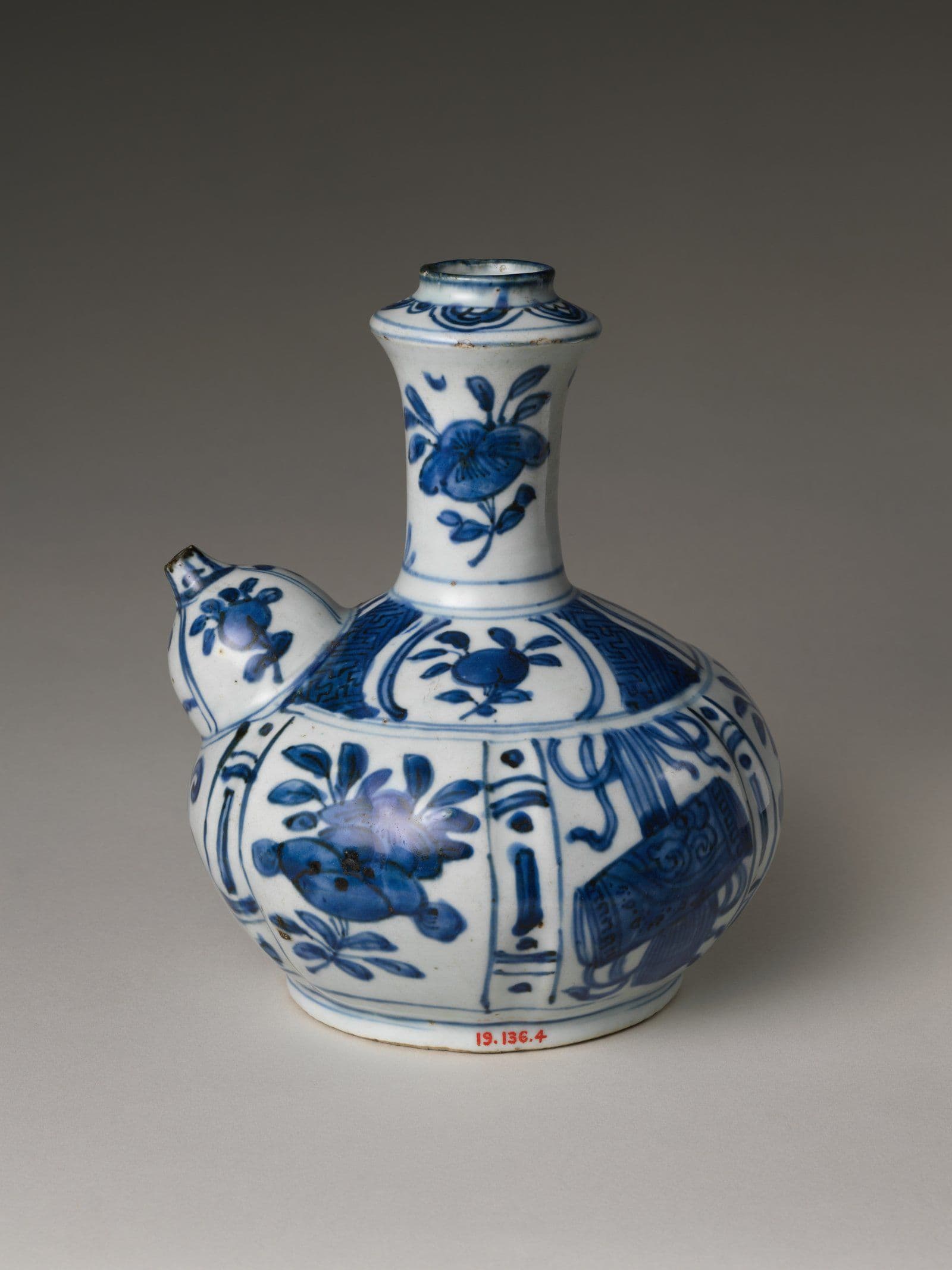
The other clue is cobalt. Yongle blue-and-white, continued into the Xuande reign, was painted with a richly saturated imported cobalt that behaves differently from domestic ore. It fires to a deep, almost violet blue and characteristically "heaps and piles" — pooling into dark concentrations where iron in the pigment breaks through the glaze surface as small blackish spots that sink into, rather than sit on, the glaze. This heaped-and-piled texture, best seen at a raking angle, is one of the period's most reliable fingerprints, and it is the same imported-cobalt effect that connoisseurs look for when they authenticate the closely related Xuande reign wares that follow.
| Reign | Typical marking | Primary way to date it ||---|---|---|| Hongwu (1368–1398) | None | Potting weight, underglaze red vs blue, dense foliate drawing || Yongle (1403–1424) | Rare four-character seal mark, often anhua | Sweet-white glaze; heaped-and-piled imported cobalt || Xuande (1426–1435) | Six-character mark, now consistent | Reign mark plus imported-cobalt blue-and-white |
What this means when you handle an early Ming piece
Put the pieces of evidence in order. On an early Ming ware, the base is the last place to look for a date, not the first. Start with the body: how heavily is it potted, how does the glaze sit, and — if it is white — does raking light bring up hidden decoration? Move to the palette: is the blue a soft domestic grey or a saturated imported blue that pools and heaps? Only then consider any mark, and treat it as corroboration rather than proof.
The commonest mistake is to reverse that sequence — to see a four-character Yongle seal mark, feel a jolt of excitement, and read every other feature as confirmation. Trained eyes work the other way, letting the material tell the story and using the mark to check it. For a piece of this importance and rarity, that discipline is not optional, and a documented history of ownership does more to secure an attribution than any single feature on the object itself.
Common questions
Why is early Ming porcelain so rarely marked?
The convention of inscribing an imperial reign mark on porcelain had not yet become standard practice in the Hongwu and Yongle reigns. It settles into consistent use only from the Xuande period in the late 1420s onward. So the absence of a mark on an early Ming piece is expected, not suspicious — such wares are dated instead by their potting, glaze, palette, and decorative drawing rather than by any inscription on the base.
What does a genuine Yongle reign mark look like?
It has four characters — 永樂年製 — rather than the six of most later Ming marks, and it is written in an archaic seal script rather than standard script. It appears on only a small range of forms and is often incised or moulded as faint anhua decoration inside the piece rather than painted under the foot. Because it is so distinctive, it has also been copied extensively in later centuries, so the mark supports a Yongle attribution but never settles it alone.
Can I date a Yongle piece if it has no mark at all?
Yes, and in practice most Yongle wares are dated this way. The two strongest clues are the glaze and the cobalt: a soft "sweet white" (tianbai) glaze with hidden anhua decoration, and — on blue-and-white — a deeply saturated imported cobalt that "heaps and piles" into dark spots breaking through the glaze surface. These material signatures are harder to imitate than a written mark and carry more weight in a careful attribution.
Further reading
Hongzhi and Zhengde: reading mid-Ming reign marks — how the marking convention matured after Xuande.
Jiajing and Wanli: the late Ming reign marks — the busier, later end of the Ming sequence.
How to spot fake Chinese porcelain marks — why a period-looking mark is never proof on its own.
Browse our porcelain
Modern hand-finished porcelain in the classical tradition, each piece honestly described and clearly attributed, is in our Chinese porcelain collection — a grounded place to begin if the restraint of early Ming wares is what draws you.
Explore Further