Published July 21, 2026
Blue-and-white porcelain began under the Yuan dynasty at Jingdezhen, painted in Persian cobalt largely for export. What defines a Yuan piece, why the David Vases matter, and how to read the auction records.
Pick up almost any piece of blue-and-white porcelain — a Ming bowl, a Kangxi vase, a Delft plate, a willow-pattern dish — and you are holding a descendant of a single experiment: cobalt painted under a clear glaze at Jingdezhen in the fourteenth century, during the Yuan dynasty (1271–1368). The style that now stands for Chinese porcelain in most Western minds did not begin as an imperial taste at all. It began as an export product, made largely for buyers thousands of miles away.
This guide covers what Yuan blue-and-white is, why it looks the way it does, how the famous dated David Vases anchor the whole field, and what a collector should understand before taking the auction records at face value.
A new ware from an old kiln town
Jingdezhen was already an established porcelain center long before blue-and-white appeared. Through the Song dynasty its kilns were known for qingbai — a thin-walled white ware under a glaze tinted faintly blue — and in the Yuan period for the so-called shufu ware, a thicker opaque-glazed white porcelain associated with orders for the Privy Council. The town, in other words, had mastered the white canvas long before anyone painted on it.
What changed in the fourteenth century was the paint. Potters began decorating that white body with cobalt oxide, painted directly onto the unfired clay and sealed under a transparent glaze — underglaze blue. Fired once at high temperature, the decoration became permanent, sandwiched under glass. Unlike overglaze enamels, it could not wear off; unlike carved decoration, it could carry pictures, inscriptions, and dense ornament.
The critical ingredient was imported. The cobalt used on the finest Yuan pieces came from Persia — later Chinese texts call it huihui qing, "Mohammedan blue." Persian cobalt is high in iron and low in manganese, which produces the deep, inky, slightly blackish blue of the best fourteenth-century wares, often with darker spots where the pigment pooled — the "heaped and piled" effect that Ming potters would later imitate deliberately. The full pigment story, from Persian mines through Ming reformulations, is told in our article on cobalt in blue-and-white porcelain; this article stays with the dynasty that first put it to work.
Made for export: why the dishes are so big
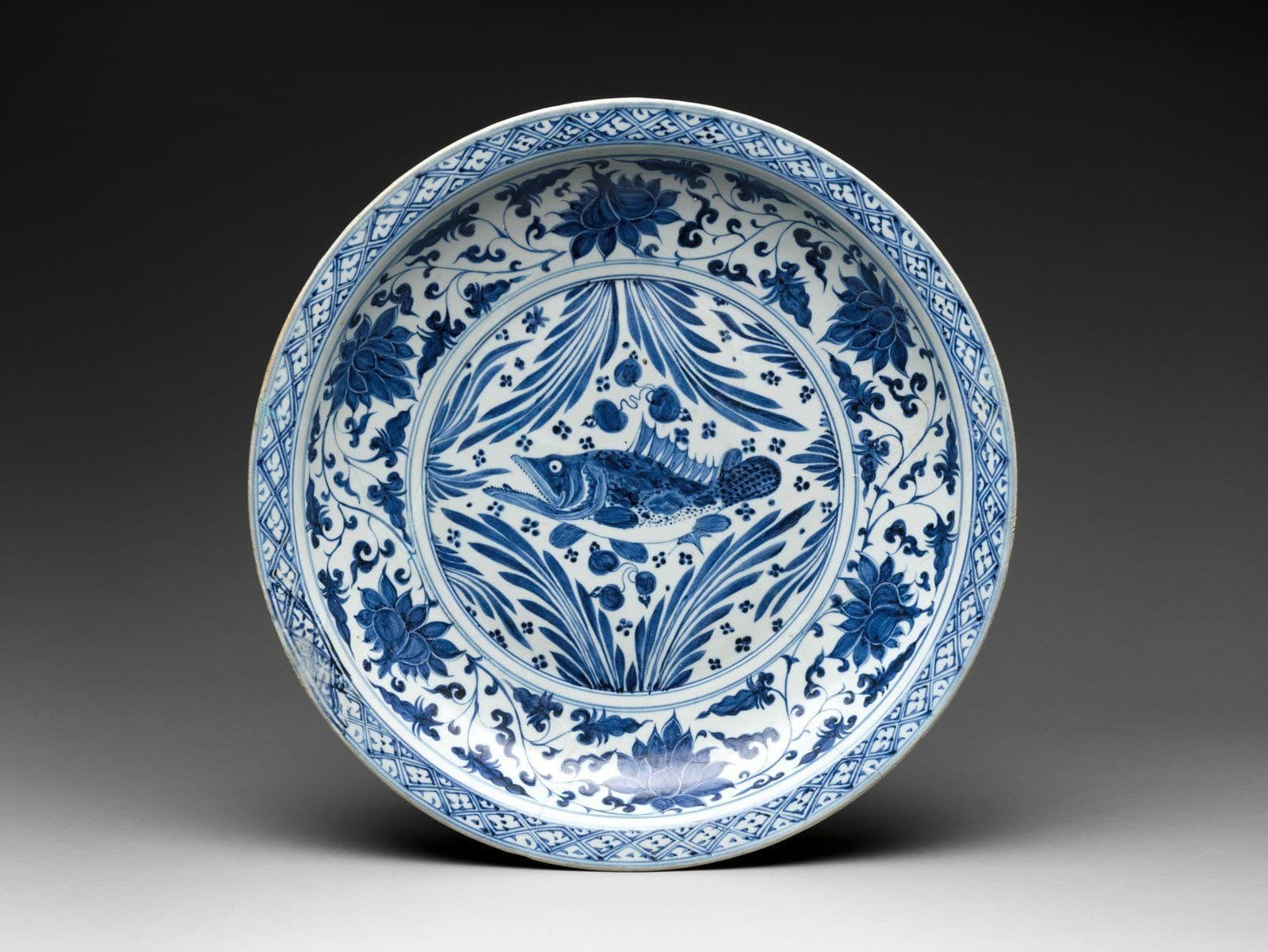
The most striking thing about much Yuan blue-and-white is its scale. Great chargers over forty centimeters across, heavy jars, massive vases — these were not made for the Chinese scholar's table. Chinese dining of the period did not call for enormous communal platters. Middle Eastern dining did.
The trade routes of the Mongol empire connected Jingdezhen's kilns to Islamic markets that had prized cobalt-decorated ceramics for centuries but lacked porcelain's white, vitrified body. Yuan potters effectively combined a Persian palette and Middle Eastern taste for dense surface ornament with Chinese material superiority. The results traveled west in quantity. To this day, the two greatest concentrations of early blue-and-white outside China are the Topkapı Palace collection in Istanbul and the group associated with the Ardabil Shrine in Iran — royal accumulations that preserved these wares while Chinese connoisseurs largely ignored them.
That last point deserves emphasis. Classical Chinese taste long ranked the monochrome glazes of the Song — the quiet celadons and pale blues — above painted decoration, and some early commentators dismissed blue-and-white as commercial and gaudy. Collectors who want the counter-tradition can read our Longquan celadon guide to see what Yuan blue-and-white was competing against inside China even as it conquered the markets outside.
Reading a Yuan piece: body, glaze, and decoration
A few physical habits distinguish fourteenth-century blue-and-white, and they are worth knowing even if you never expect to handle one outside a museum.
Potting. Yuan pieces are generally heavily potted. Large dishes and jars were built in sections and luted together; you can sometimes feel or see the join lines inside a jar's neck or body.
Base. Bases are typically unglazed, showing a dense, fine white body that often fired to an orange or rusty tinge where exposed to the kiln atmosphere — the so-called fire-red patches. A completely clean, glazed, mark-bearing base points away from the Yuan.
Glaze. The transparent glaze usually carries a faint blue or green-blue cast, pooling to a duck-egg tone in recesses, rather than the colorless glassiness of later centuries.
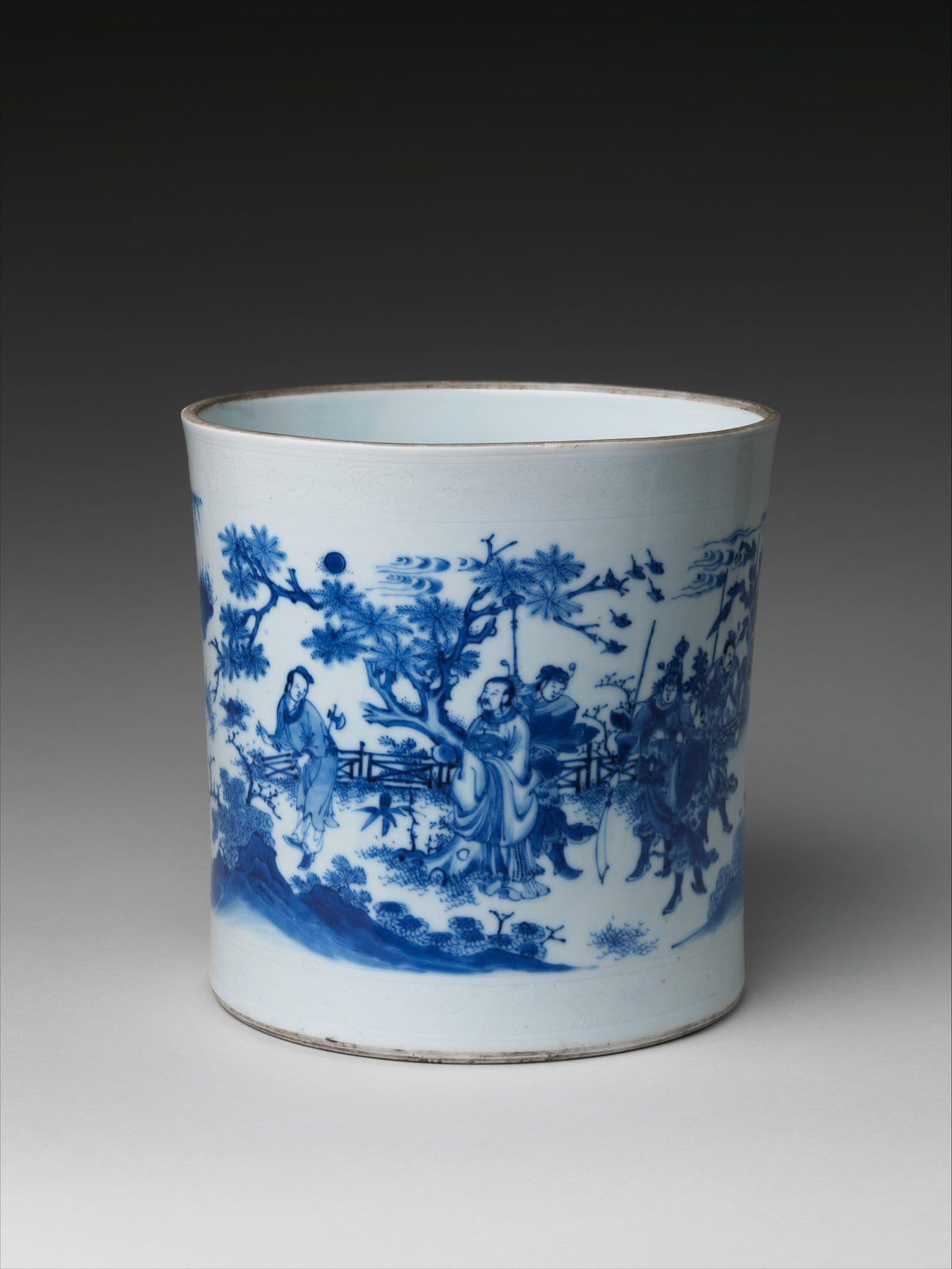
Decoration. Yuan decorators organized surfaces into horizontal registers — bands of petal panels, classic scroll, waves, and diaper patterns framing a main zone. Favorite subjects include dragons with small heads and long, snaky bodies; fish among waterweed; peony and lotus scrolls; and, on the most ambitious pieces, narrative scenes lifted from the world of woodblock-illustrated drama — generals, strategists, and courtiers set among garden rocks and clouds.
No reign marks. With vanishingly rare exceptions, Yuan blue-and-white is unmarked. The six-character imperial reign mark is essentially a Ming invention, systematized in the early fifteenth century. If a "Yuan" piece carries a neat reign mark, something is wrong. Our guide to Chinese porcelain marks explains what marks can and cannot tell you; the absence of marks is one reason Yuan attribution leans so heavily on physical evidence instead.
The David Vases: the date that organized a field
Attribution needs an anchor, and for Yuan blue-and-white the anchor is a pair of temple vases in the British Museum, known after the collector Sir Percival David. Each carries a long dedicatory inscription recording a donor named Zhang Wenjin presenting them to a temple, with a date corresponding to 1351.
The importance of that inscription is hard to overstate. It proves that fully mature blue-and-white — confident drawing, elephant-head handles, dense registers of dragon, phoenix, and scroll ornament — existed by 1351. In the 1950s the American scholar John Alexander Pope used the vases as a fixed point to isolate a "fourteenth-century" group among the hundreds of early blue-and-white pieces preserved at Ardabil and the Topkapı, and the modern study of Yuan porcelain grew from that comparison. One dated object reorganized an entire category — a pattern collectors will recognize from other corners of Chinese art, where dated inscriptions and reign marks do similar anchoring work. The Xuande reign that later perfected the style has its own well-documented mark tradition, covered in our Xuande mark guide.
The market: records, rarity, and realism
Yuan blue-and-white sits near the top of the Chinese art market. The famous example: in 2005, a fourteenth-century jar painted with the strategist Guiguzi descending the mountain in a cart drawn by a tiger and a leopard sold at auction in London for about £15.7 million — at the time a record price for any Asian work of art. The jar combined everything the market wants: narrative decoration of the rarest class, imposing scale, and a published exhibition history.
For collectors, three notes of realism. First, genuine Yuan blue-and-white is rare — surviving pieces number in the hundreds, not thousands, and most are in museums or old institutional collections. Second, precisely because the profile is so high, copies are abundant, ranging from honest Jingdezhen reproductions to aged fakes aimed at the unwary; the physical habits described above are necessary but not sufficient, and serious purchases need laboratory and provenance work. Third, the auction headlines describe the extreme peak of the category, not its typical trade. Most collectors engage with the Yuan aesthetic through later wares that inherited it — early Ming imperial porcelain, or the export lines that carried blue-and-white to Europe.
Common questions
Was blue-and-white porcelain invented in the Yuan dynasty?
The mature tradition was established then. There are earlier experiments with cobalt decoration — Tang-period wares decorated with cobalt are documented — but the continuous tradition of underglaze-blue porcelain at Jingdezhen, with fine white bodies and confident painted decoration, coalesced in the fourteenth century under the Yuan. Everything later, from Ming imperial ware to European chinoiserie, descends from that Jingdezhen synthesis.
Why did the best cobalt come from Persia?
Chemistry. Persian cobalt ores are rich in iron and poor in manganese, firing to a deep, saturated blue with characteristic dark speckling. Native Chinese cobalt, mined later in quantity, carries more manganese and fires to a softer, grayer blue. Yuan and early Ming painters prized the imported material; later dynasties blended the two. The difference in tone is one of the working tools for dating blue-and-white by eye.
How can I tell a Yuan piece from a later copy?
Weigh the whole object, not one feature. Genuine pieces show sectional construction, an unglazed base with a fine dense body and natural fire-red flashes, a faintly blue-tinted glaze, period-consistent drawing, and Persian-cobalt behavior — none of which is individually decisive, since skilled copyists study the same list. Provenance that predates the modern market for Yuan wares, plus technical analysis, carries more weight than connoisseurship alone. Treat any unprovenanced "Yuan" piece offered cheaply as a reproduction by default.
Are there reign marks on Yuan porcelain?
Effectively no. Reign-marked porcelain is a Ming and Qing convention. Yuan pieces are identified by inscription (rarely), physical characteristics, and comparison with anchor objects like the 1351 David Vases — not by marks.
Further reading
- Jingdezhen: China's Porcelain Capital — the kiln city where the blue-and-white tradition was built.
- Blue-and-White Porcelain: A Collector's Guide — the full sweep of the tradition the Yuan began.
- Kraak and Chinese Export Porcelain Marks — how the export story continued into the Ming and beyond.
- How to Buy Chinese Art at Auction — the mechanics behind the record prices this category generates.
Browse the collection
Porcelain is a subject we write about rather than one we stock. What Kiln & Ink sells is paper: limited-edition archival giclée reproductions of the twentieth-century Chinese ink masters, each one hand-numbered and issued with a Certificate of Authenticity.
Explore Further