Published August 1, 2026
Wu Hufan explained: the Shanghai traditionalist painter and connoisseur, his blue-and-green landscapes, his students, and how to buy his work safely.
Some time in the 1930s, a painting fragment reached Wu Hufan's studio in Shanghai — a damaged, unassuming stretch of landscape that had been separated from the rest of its handscroll for centuries. He recognised it. The fragment was the surviving opening section of Huang Gongwang's Dwelling in the Fuchun Mountains, one of the most famous handscrolls in Chinese art, which had been burned and broken apart in the seventeenth century. He acquired it, and the identification held. That piece is now in a Chinese public collection, and the episode tells you most of what you need to know about Wu Hufan: he painted, but what made him formidable was his eye.
This article looks at who Wu Hufan was, how his collecting shaped his painting, why two of the twentieth century's greatest authenticators came out of his studio, and what a collector should understand about his market — where a signature is worth less than a provenance trail.
A painter born inside a collection
Wu Hufan was born in Suzhou in 1894 and spent his working life in Shanghai, where he died in 1968. He came from the collecting class rather than into it. His grandfather was Wu Dacheng, a late-Qing official, epigrapher and serious collector of bronzes, jades and paintings; his marriage to Pan Jingshu joined him to another established Suzhou collecting family. The point is not the pedigree but the material consequence: he grew up handling authentic old objects, at a time when most students of Chinese painting learned from copies.
His studio names record that inheritance. He is best known by the studio name Meijing Shuwu, and by a second name commemorating four early rubbings of Ouyang Xun's stele calligraphy that came to him through his wife's family — an epigrapher's household detail, and a reminder of how much of the connoisseurship of that generation was built on stone-inscription study as much as on painting.
Contemporaries grouped him with the other leading traditionalist painters of Shanghai in a catchphrase of the day, "Three Wus and One Feng", alongside Wu Daiqiu, Wu Zishen and Feng Chaoran. It is a useful label because it places him precisely: not among the reformers who were absorbing Western technique, but among the painters who believed the answer lay in going further back into the Chinese tradition than their immediate predecessors had.
What his painting actually looks like
Wu Hufan's landscapes are the opposite of dramatic. They are dense, controlled, atmospheric, and very finished. He worked in the orthodox lineage that runs through the Qing masters back to Dong Qichang, but he reached past it into Song and Yuan painting, which he could study directly because he owned or handled it.
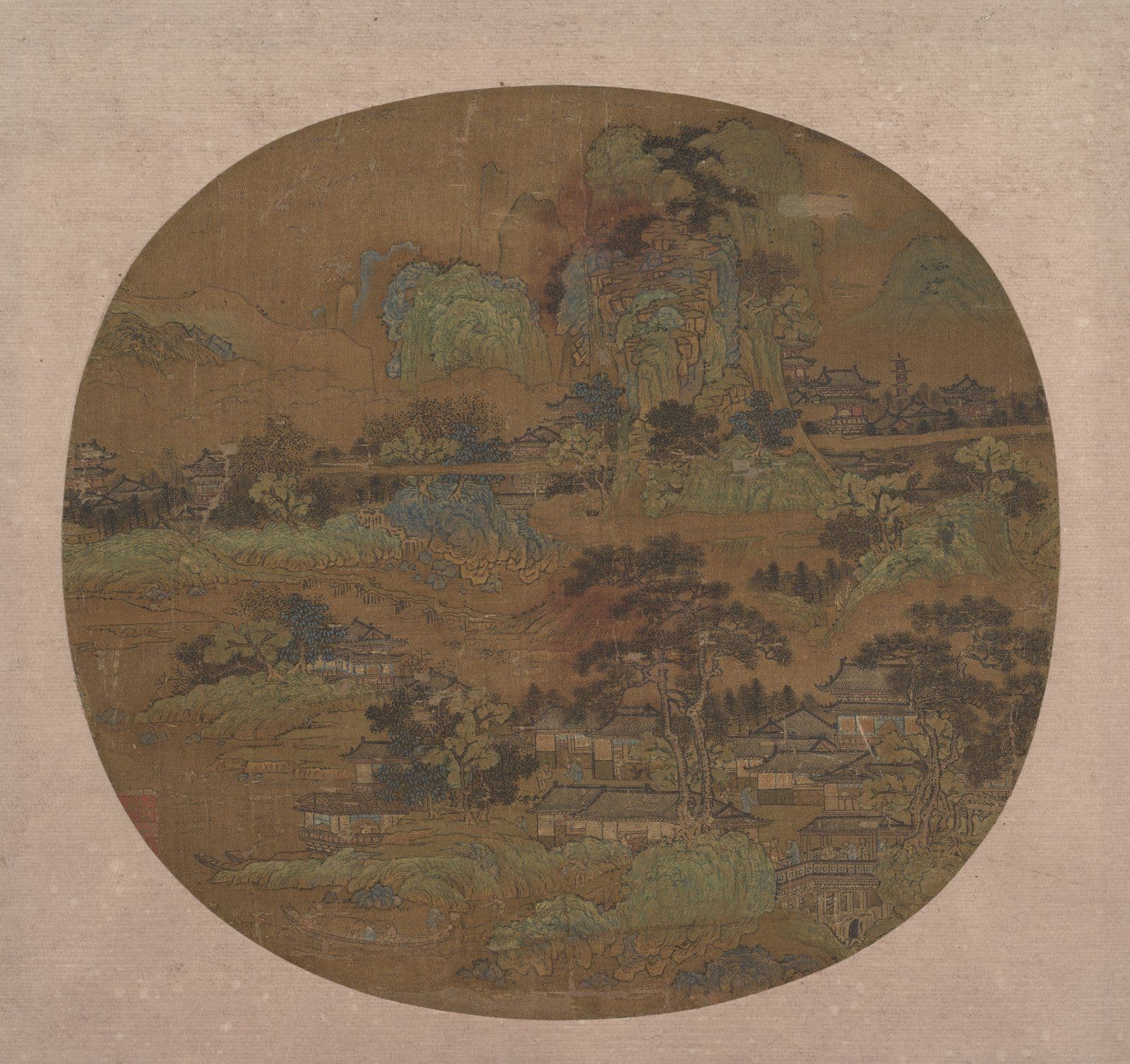
Two features are characteristic. The first is his handling of cloud and mist — soft, banked, layered, dissolving the middle distance so that the eye moves through the picture rather than across it. The second is his revival of the blue-and-green manner: a Tang and Song idiom in which landscape is built up in mineral azurite and malachite over ink, producing jewel-like blues and greens that sit on the surface rather than sinking into it. That palette is expensive, slow, and unforgiving. Anyone assessing a blue-green landscape attributed to him should understand how the mineral pigments used in Chinese painting behave, because their granular body and characteristic ageing are hard to imitate with modern colours.
His painting sits firmly on the literati side of the old divide, but with a courtly polish that complicates the category — worth keeping in mind when reading the distinction between literati and court painting, which he moves between more freely than the textbook version allows.
He also made the copying tradition part of his practice. Working through the old masters by copying them was normal for a painter of his formation, and in his case it was inseparable from authentication: you learn what a hand can and cannot do by trying to reproduce it. The Chinese tradition of copying as study rather than deception is essential context for his generation, and for the confusion that surrounds their output today.
The connoisseur, and what he taught
Wu Hufan became one of the most trusted authenticators of his generation. Museums, dealers and collectors brought him paintings; his opinion moved objects and prices. In the 1950s he was attached to the state painting academy in Shanghai, and his authority carried into the institutional world that was then assembling China's public collections.
Two of his students matter enormously to anyone buying Chinese painting today. Xu Bangda became the leading authenticator of Chinese painting in the People's Republic, and much of the modern consensus on attributions in Chinese museum collections passed through his judgement. Wang Jiqian — known in the West as C. C. Wang — moved to New York and became the single most influential figure in the formation of American collections of Chinese painting, as collector, dealer and adviser.
That is an unusual legacy for a painter. It means Wu Hufan's real influence on the market is not the supply of his own pictures but the method: sustained comparison against known works, attention to seals and colophons, and a refusal to let a signature settle the question. Anyone working through how experts authenticate Chinese paintings is using a framework that this lineage did much to formalise.
His own marks are part of that framework in a second way. Wu Hufan collected, and like all serious Chinese collectors he stamped and inscribed what passed through his hands. A genuine Wu Hufan collection seal or colophon on an older painting is a provenance asset in its own right — evidence that a demanding eye examined the work and accepted it. Reading those marks correctly requires the standard vocabulary of collectors' seals and studio marks, and it is precisely because such marks add value that they are also forged.
What this means for buying
Wu Hufan's market has three features a collector should hold in mind.
Forgery is heavy, in both directions. Works are forged under his name, and his seals and colophons are forged onto other people's paintings. A picture that is "signed Wu Hufan" and a picture that is "inscribed by Wu Hufan" carry two different risks, and both need checking.
Finish is a diagnostic. His genuine work is patient. Thin, hasty, loosely brushed landscapes signed with his name deserve scepticism; the labour is part of the identity, particularly in the blue-green pictures where pigment is built up in layers.
Documentation carries disproportionate weight. For a twentieth-century artist whose circle was intensely documented — exhibited, published, photographed, catalogued — the absence of any paper trail is itself information. Publication history, exhibition records, and a coherent ownership chain are the practical defence, and they are worth more than a confident opinion offered without them.
A last point of context. Wu Hufan's later years fell in a period of political persecution, and he died in 1968 during the Cultural Revolution. Collections were dispersed, damaged and destroyed in those years across the whole Chinese art world. When you encounter a gap in the provenance of a mid-century Chinese painting, that history is often the reason — which is not a licence to accept unverified claims, but is a reason to weigh a broken chain differently than you would for a Western picture of the same date.
Common questions
Was Wu Hufan a painter or a collector?
Both, and the two are not separable in his case. He trained and worked as a painter in the traditionalist Shanghai milieu, and he inherited and built a significant collection of earlier Chinese art. The collection fed the painting — he learned Song and Yuan technique from originals — and the painting sharpened the connoisseurship, because copying a master teaches you what that master's hand could actually do. His contemporaries valued him for both, and today his authentications arguably carry as much weight as his pictures.
What is a blue-and-green landscape?
It is a Chinese landscape idiom in which mineral pigments — azurite blue and malachite green — are laid over an ink structure, producing strong, opaque colour rather than transparent wash. The manner is associated with Tang and early Song painting and was revived at various points afterwards, including by Wu Hufan. It is slow and materially expensive to execute properly, and the pigments age in ways that are difficult to fake, which makes the technique useful in assessing attributions.
Does a Wu Hufan seal on an old painting make it authentic?
No, but it is meaningful evidence when the seal itself is genuine. A collector's seal records that a work passed through a particular pair of hands, and Wu Hufan's hands were demanding ones, so his mark strengthens a case. The problem is circular: because his endorsement adds value, his seals and colophons are among the more frequently forged. Treat the seal as a claim to be verified against published impressions, not as a conclusion.
Who were his most important students?
Xu Bangda and Wang Jiqian, better known in the West as C. C. Wang, are the two whose influence extended furthest. Xu Bangda became the leading authenticator of Chinese painting within China's museum system; C. C. Wang shaped American collecting of Chinese painting over several decades from New York. Between them they carried Wu Hufan's method of comparative connoisseurship into the two institutional worlds where most surviving early Chinese painting now sits.
Further reading
- Collectors' Seals and Marks on Chinese Paintings — how to read the marks a collector like Wu Hufan left behind.
- Provenance Documents for Chinese Art — the paper trail that carries most of the weight in this market.
- Zhang Daqian's Dunhuang Period — a contemporary whose relationship with the old masters ran in a very different direction.
- Lin Fengmian, Modern Master — the reformist alternative to Wu Hufan's traditionalism.
Browse the collection
If you would rather live with these images than only read about them, the Kiln & Ink collection holds limited-edition archival giclée reproductions of the twentieth-century Chinese ink masters — hand-numbered, printed on rice paper, and issued with a Certificate of Authenticity.
Explore Further