Published August 4, 2026
A collector's guide to Wu Guanzhong: the Hangzhou and Paris training, the Jiangnan water towns, how to read a picture in front of you, and where the risk sits.
Look at a Wu Guanzhong water town and count the black marks. There are fewer than you expect — a tile ridge, a doorway, a boat's shadow — and everything else is white wall and reflected water. He spent decades reducing a village to the smallest number of strokes that still read as a village, and the discipline is what makes the pictures feel modern rather than nostalgic.
This guide covers what he actually painted across a sixty-year career, how the oil paintings and the ink paintings relate to each other, what his signature and inscriptions look like, and what a buyer should check before committing to anything sold under his name.
Two trainings, one problem
Wu Guanzhong was born in 1919 in Yixing, in Jiangsu province, and trained at the National Academy of Art in Hangzhou — the school where Lin Fengmian was director and Pan Tianshou taught ink painting. That combination matters. Students there were exposed to European modernism and to classical Chinese brushwork in the same corridor, and were expected to take both seriously.
In 1947 he went to Paris on a government scholarship and studied at the École nationale supérieure des Beaux-Arts, spending roughly three years in France before returning to China in 1950. He came back to a country whose official art policy had little use for what he had learned. For much of the following three decades he taught, painted in the countryside when he could, and worked at small scale on portable boards — the practical response of a painter who needed to keep working while the political weather changed.
The problem he set himself is easy to state and hard to solve: make a picture that a Western viewer reads as a modern painting and a Chinese viewer reads as belonging to their own tradition. He worked on it in oil and in ink simultaneously, which is why his output looks like two bodies of work by the same hand rather than one artist changing medium.
The oils and the inks are not two careers
Collectors sometimes treat the oils and the inks as separate markets. In practice the same compositional thinking runs through both.
In oil, he built texture — thick, dragged, scraped paint for foliage, water, and rock; the surface carries information. In ink and colour on paper, he used the medium's speed instead: a wet line that swells and thins, dots of colour dropped in like punctuation, and large areas of untouched paper doing the work that white wall does in the oils. If you look at a water-town oil and a water-town ink from the same decade, the placement of the black marks is often nearly identical. The medium changed; the design did not.
His most quoted idea is the "kite with an unbroken string" — abstraction should be free to fly, but the string back to observed reality should never snap. It is a useful test when you are looking at a picture attributed to him. His abstractions almost always keep a thread to something seen: a vine, a bridge, a cluster of roofs. Work that floats free of any subject is worth extra scrutiny.
From the late 1970s he also argued publicly for "formal beauty" — that line, colour, and composition have value independent of narrative content. This was contentious at the time and it explains the shift you see in his work from around 1980 onward, when the compositions become flatter, the colour more arbitrary, and the line more calligraphic.
Motifs worth knowing
- Jiangnan water villages. White walls, black roof lines, a canal, sometimes a single figure. The most recognisable body of work and the one most often imitated. Our longer piece on Wu Guanzhong's Jiangnan water village paintings goes into how the compositions are built.
- Trees and vines. Banyans, old pines, wisteria — subjects that let him run a tangle of line across the whole sheet and then place a few colour dots inside it.
- Lu Xun's hometown and Shaoxing. Literary subject matter treated architecturally.
- Coastal and mountain landscapes, including work made on travels through Guizhou, Sichuan and the Yangtze gorges.
- Late near-abstractions, where the village or vine has been reduced to rhythm.
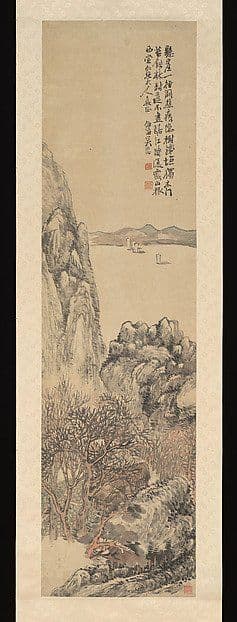
You can see the same reductive instinct in Wu Guanzhong, A Small View of Jiangnan — a handful of dark accents carrying an entire landscape.
How to read one in front of you
Most buyers meet a Wu Guanzhong on a wall or a screen with limited time and no laboratory. There is a practical looking sequence that will not authenticate a picture but will tell you quickly whether it is worth pursuing.
Start with the black. Count the darkest marks and ask what each one is doing. In a strong picture, they are unevenly distributed, and the distribution is the composition: a dense cluster somewhere, then long stretches of nothing. Weak imitations spread the black evenly, because the imitator is copying an appearance rather than making a decision.
Then look at the white. Untouched paper or bare canvas is load-bearing in his work — it reads as wall, water, mist or air depending on what is placed against it. If every area is filled, something is wrong. If the white areas have been tinted a general pale grey to look atmospheric, that is a different painter's habit.
Check the line for speed. His brush line swells and thins along its length because it was laid down in one movement. A line drawn slowly, or retouched, has a uniform width and small hesitations at the changes of direction. Under raking light on an oil, the same test applies to the impasto: dragged and scraped passages were made in one pass and have directional texture.
Look at the colour dots last. In the mature ink works the small red, yellow, green and blue accents are placed, not scattered — often marking the point where the eye should stop. Excessive dotting, or dots used to fill dull areas, is a common tell in imitations.
Finally, look at the whole thing from across the room. His compositions are built to resolve at distance into a few legible shapes. If a picture only works close up, it is probably not by a painter who spent forty years reducing villages to five marks.
None of this is proof. It is triage — a way of deciding whether to spend money on the real checks.
Signatures, seals and inscriptions
He commonly signed with the character 荼 (tu), his art name, often with a year, and used seals in red. Signatures appear in both Chinese characters and, on some oils, a Latin-letter form. There is no single "correct" signature: the placement and the weight of the brush change with the picture, which is exactly why signature alone proves nothing.
Treat the signature as one data point among several. Seals in particular are easy to reproduce — the impression tells you the design of a seal, not who pressed it. If you want the fuller method, our guide to reading seals and collectors' marks on Chinese paintings explains what a seal can and cannot establish.
What the market values, and where the risk sits
Wu Guanzhong is one of the most valuable modern Chinese artists at auction. The strongest results have gone to large oil paintings of Jiangnan subjects from his mature period, with major ink works close behind. Small ink sheets, late works, and prints occupy a much broader and more accessible band.
Two structural facts shape supply. First, he donated substantial groups of works to public museums in China, Hong Kong and Singapore during his lifetime, which permanently removed a significant amount of his best material from circulation. Second, he destroyed paintings he considered failures. Both effects push demand onto a smaller pool of surviving pictures.
That is also why forgery is a live problem. When a name carries high prices and a recognisable visual formula — white wall, black tile, a few colour dots — imitation is easy at the level of appearance. What imitators tend to miss is the economy: fakes usually have too many marks, evenly distributed, with no clear decision about where the eye should rest.
Before committing to any work sold as his, run the checks in our piece on how experts authenticate Chinese paintings, and expect documented ownership history rather than an attribution supported only by a signature and a seal. The same discipline applies across the modern masters — the approach we outline in the Zhang Daqian collector's guide transfers directly.
A separate category worth understanding is the authorised printed edition. Reproductive prints of modern masters are a legitimate part of the Chinese art trade with their own long history, and they are sold as prints rather than as paintings. Problems only arise when the distinction is blurred. If a listing is vague about whether you are buying a unique work or an edition, that vagueness is the finding.
Common questions
Are Wu Guanzhong's oils or his ink paintings the better buy?
They serve different collections. The oils are physically substantial, hold a wall on their own, and sit at the top of his market. The inks are lighter, more intimate, and closer to the Chinese painting tradition in materials and mounting. If you already collect Chinese painting, the ink works integrate more naturally; if you are hanging in a contemporary Western interior, the oils tend to do more work. Neither is a shortcut to value — condition, period and documentation matter more than medium.
How do I tell a mature work from an early one?
Broadly, earlier work is more descriptive: more modelling, more literal architecture, more tonal transitions. From around 1980 the pictures flatten, the line becomes more independent of the object it describes, and colour is used as accent rather than local description. That is a guide, not a rule — he returned to representational subjects throughout his life.
What difference does the medium make to care and display?
Considerable. Oil on canvas or board tolerates normal room conditions with sensible light control. Ink and colour on paper is far more sensitive to light, humidity swings and acidic mounts, and should be framed with conservation-grade materials and kept out of direct sun. If you are unsure how a work on paper differs from a painting in a Western sense, our comparison of Chinese ink painting and watercolour covers the materials.
Is a signed certificate meaningful?
Rarely, on its own. Certificates issued by unnamed bodies, or by the seller, carry no independent weight. What carries weight is a chain: named prior owners, exhibition or publication references, and dated invoices from established dealers or auction houses. Where that chain is absent, price should reflect the uncertainty.
Further reading
- Wu Guanzhong's Jiangnan Water Village Paintings — how the water-town compositions are constructed.
- Lin Fengmian: Modern Master — the teacher whose synthesis shaped the Hangzhou generation.
- Zhang Daqian: A Collector's Guide — the same checks applied to a very different career.
- How Experts Authenticate Chinese Paintings — the method behind the attribution questions above.
Browse our collection
See more of the artist on the Wu Guanzhong artist page, or browse the wider Kiln & Ink collection of modern Chinese master prints.
Explore Further