Published July 28, 2026
Transitional and Shunzhi porcelain rarely carries a reign mark. Here's what appears on the base instead, and how to date these early Qing wares.
When you turn over a piece of mid-seventeenth-century Jingdezhen porcelain expecting a six-character reign mark, the base often tells you nothing at all. You may find a leaf, a censer, an auspicious phrase, a pair of concentric blue rings, or simply an empty glazed foot. For the Ming-to-Qing transition, that absence is not a defect or a sign of forgery — it is the single most reliable clue to when and how the piece was made.
This article helps you place a Transitional or Shunzhi-period piece in its moment: why reign marks nearly vanish in these decades, what appears in their place, and how collectors and cataloguers date these wares when the base stays silent.
Why the reign mark disappears
The Ming dynasty fell in 1644, and the Qing was established the same year under the Shunzhi reign, which ran until roughly 1661. But the ceramic story does not break cleanly on that date. Ceramic historians use the term Transitional period for a longer stretch — broadly the 1620s through the 1680s — spanning the last troubled Ming reigns of Tianqi and Chongzhen and continuing into Shunzhi and early Kangxi.
The through-line of the whole period is a lapse in imperial control. The Ming court's supervision of the Jingdezhen kilns weakened badly in its final decades, and the dynastic collapse severed it entirely. For a generation, the potters worked without a functioning imperial kiln system dictating what to make and how to mark it. Production shifted toward the domestic literati market and a booming export trade, especially with the Dutch. Without a court demanding formally marked imperial wares, the six-character reign mark — the standard imperial signature of the high Ming — largely fell out of use.
That is why you should not expect a Shunzhi mark on a Shunzhi piece. Genuine reign-marked Shunzhi porcelain exists, but it is uncommon. Most wares of these years were never marked with a reign at all, which is exactly why the period rewards a collector who can read the object itself rather than the base.
For the broader system that reign marks belong to — how the six characters are arranged, read, and faked — the master guide to Chinese porcelain marks is the place to start, and this period is best understood as the gap in that sequence.
What appears instead of a reign mark
When the base of a Transitional or Shunzhi piece does carry something, it usually falls into one of a few families. None of them names an emperor.
Symbol marks. Small emblems drawn in underglaze blue — an artemisia leaf, a lingzhi fungus, a censer, an incense burner, a conch, or another of the auspicious motifs. These stand in for a formal mark and carry good-luck meaning rather than a date.
Commendation and hall marks. Short auspicious phrases or studio-style inscriptions, sometimes naming a hall or wishing the owner fortune and long life. These continue a late-Ming habit and tell you about intended use or patronage, not the reign.
Double rings, empty. A pair of concentric blue circles on the base with nothing inside — a frame that would later often hold a mark, here left blank. This is common enough to be a period signature in itself.
Cyclical (ganzhi) dates. Occasionally a piece carries a sixty-year cyclical date inscription rather than a reign name. These are valuable when present but need careful reading, since the same cyclical pair recurs every sixty years.
A base carrying one of these — rather than a crisp six-character reign — is consistent with the Transitional window, and it is a reason to look harder at the object, not to dismiss it. Pieces that instead bear a confident, tidy reign mark of an earlier emperor are a separate problem: retrospective and apocryphal marks were applied to later wares as homage or misdirection, and they cluster around exactly the famous reigns a Transitional piece would not claim.
Dating the piece by the object, not the base
Because the base so often withholds a date, connoisseurship of this period leans on style, potting, and painting. The Transitional aesthetic is distinctive enough that experienced eyes can place a good piece within a decade or two without any mark.
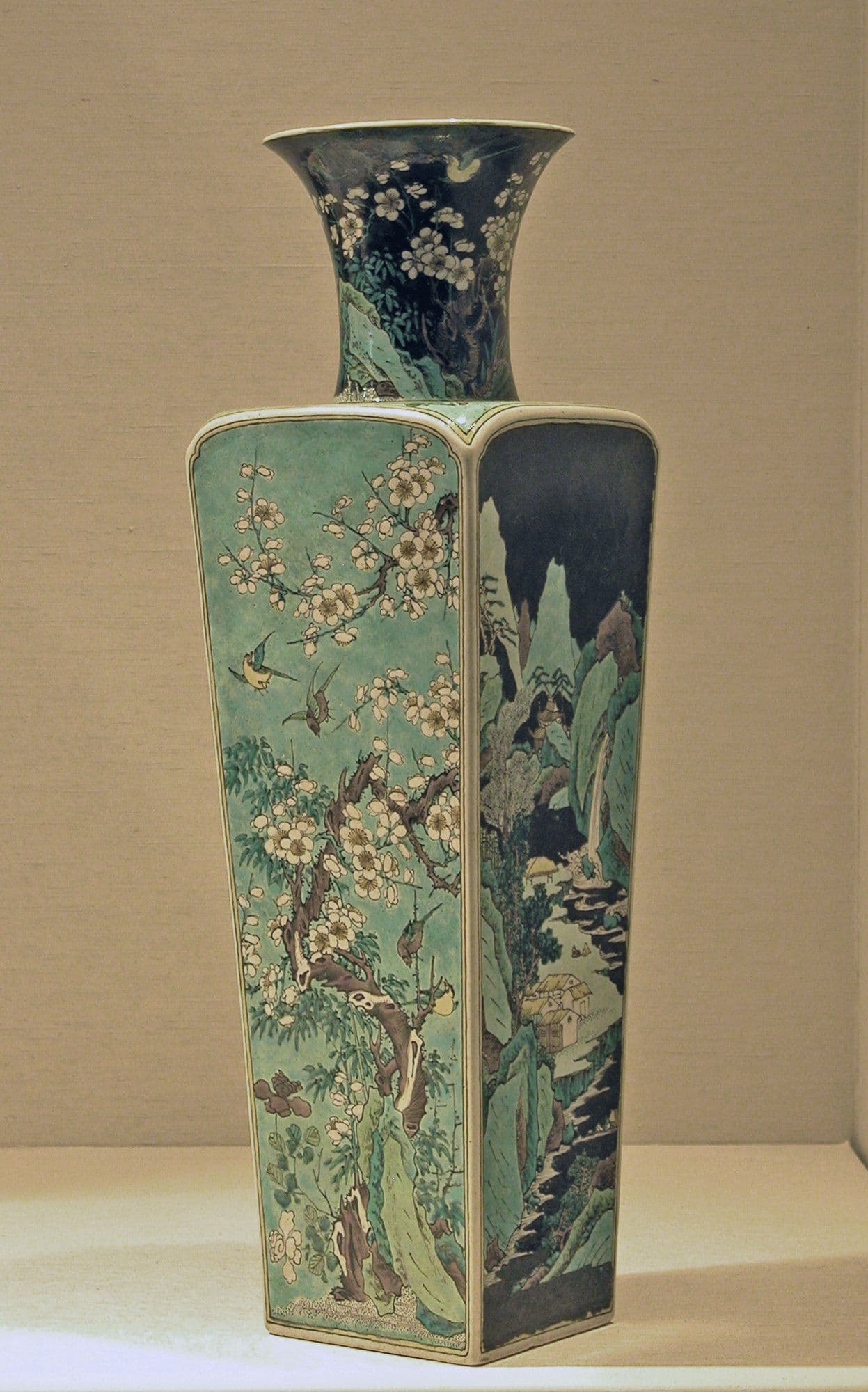
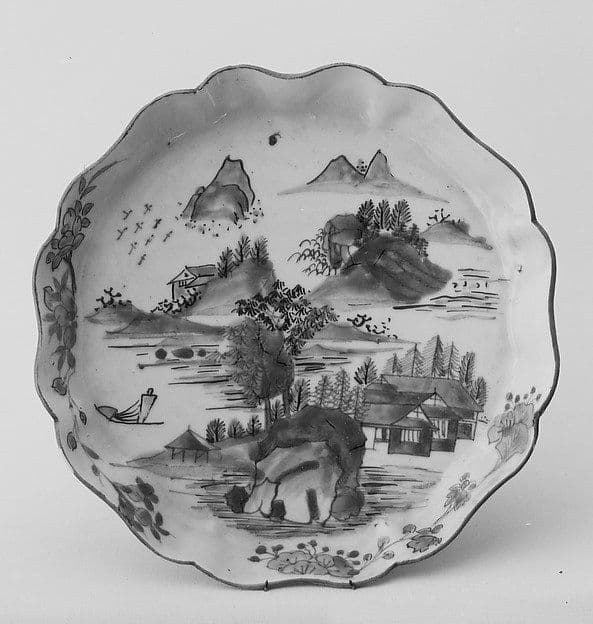
Look first at form. Tall cylindrical sleeve vases (sometimes called rolwagen after the Dutch), brush pots, and rounded jars are characteristic shapes. Look next at the cobalt: the best Transitional blue is a clear, saturated tone that painters used with real tonal range, giving landscapes depth rather than flatness. Above all, look at the painting. The period is famous for continuous narrative and landscape scenes — scholars in mountain settings, figures from drama and legend, and a rocky, layered landscape manner that decorators handled with unusual freedom now that no imperial template constrained them.
The physical base matters too. The way the foot rim is finished, glazed, and fired shifts across the seventeenth century, and reading those tells is a skill worth building on its own; the guide to dating porcelain by the foot rim covers what to watch for. Taken together — shape, cobalt quality, painting style, and foot treatment — these give a far more secure date than a base that was never meant to be marked.
Shunzhi, early Kangxi, and the return of the mark
Within the Transitional span, the Shunzhi reign is the true early-Qing core, and it sits between two better-known neighbours. On one side are the late Ming reigns of Jiajing and Wanli, whose marked imperial wares are the last consistent reign marks before the gap. On the other side is the long Kangxi reign that follows.
The mark does eventually come back — but slowly. When Kangxi re-established firmer imperial supervision at Jingdezhen later in the seventeenth century, formal reign marks returned to the finest wares. Even then, a well-known reticence lingered: for a stretch of the early Kangxi reign, many pieces deliberately avoided the emperor's reign mark, using symbols, hall marks, or blank double rings instead, so that a mark bearing the emperor's era name would not end up broken or discarded. The result is that early Kangxi and late Shunzhi wares can look very similar on the base — both often unmarked or symbol-marked — which is precisely why style-based dating remains essential across the whole transition. For the marked wares of the mature reign that follows, see the guide to Kangxi reign marks.
Kraak, export, and the marks the trade left behind
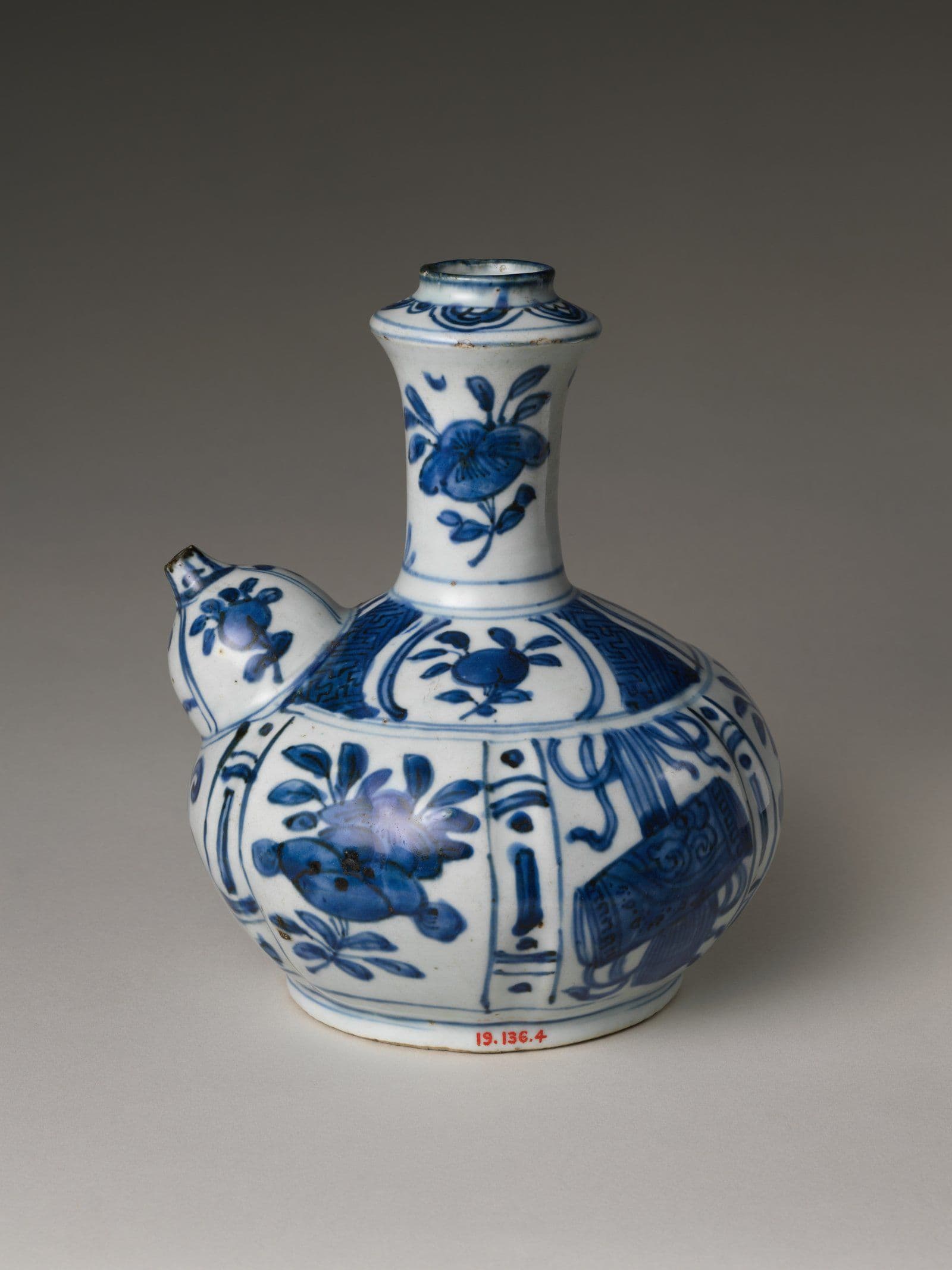
The other engine of the period was the export trade, and it shaped what you find on the base. As Ming imperial demand collapsed, the Jingdezhen kilns turned hard toward foreign buyers, above all the Dutch East India Company. The thin, panelled blue-and-white known as kraak porcelain — plates and bowls with radiating borders of alternating panels — carried straight through the transition and into the early Qing, and it was made in enormous quantity for Europe and Southeast Asia.
Export wares broaden the range of marks still further. Alongside the symbol and hall marks used for the domestic market, trade pieces might carry commendation symbols, shop marks, or simply nothing, because a European merchant cared about the decoration and the shape, not an imperial reign name. The conventions of this trade porcelain are their own study; the guide to export porcelain and kraak marks covers what does and does not appear on the base of wares made for the ships. For the collector, the practical takeaway is the same as for the domestic pieces: in this period, an unmarked or symbol-marked base is the norm across both markets, so the object's shape, painting, and potting remain the real evidence of date.
Common questions
Why is my Shunzhi-period piece not marked with a reign?
Because most porcelain of these years never was. The collapse of Ming imperial kiln supervision, and the slow rebuilding of it under the early Qing, meant the six-character reign mark largely fell out of use for a generation. An unmarked or symbol-marked base is normal for the Transitional period and is a clue to its date rather than a sign that something is wrong.
Are symbol marks and blank double rings signs of a fake?
No. Leaf and censer symbols, auspicious phrases, and empty concentric rings are genuine features of Transitional and early-Qing bases. What deserves more scrutiny is the opposite case — a later piece carrying a crisp, confident reign mark of a famous earlier emperor, which is far more often a retrospective tribute mark than a contemporary one.
How do experts date a piece with no reign mark?
By reading the object: the vessel shape, the tone and handling of the cobalt blue, the painting style, and the potting and foot-rim finish. The Transitional aesthetic — sleeve vases, layered landscapes, figures from drama, and a saturated clear blue — is distinctive enough to place a good piece within a decade or two on style alone.
Does an unmarked piece hold value?
Yes. In this period, the absence of a reign mark is expected and does not depress a piece the way it might for an imperial ware of a later, marked reign. Quality of potting, painting, and condition drive value here far more than the presence of a mark.
Further reading
The master guide to Chinese porcelain marks — how the whole reign-mark system works, and where this gap fits.
Jiajing and Wanli late Ming marks — the last consistent reign marks before the transition.
Kangxi reign marks — how the mark returns in the reign that follows.
Dating porcelain by the foot rim — reading date from potting when the base gives no name.
Browse our porcelain
Modern hand-painted homages in the Jingdezhen tradition, all faithfully marked and honestly described. — pieces that wear their attribution plainly, so you always know what you are holding.
Explore Further