Published September 16, 2026
Transitional porcelain of the Tianqi and Chongzhen reigns: the shapes, clouds, rocks and bare unglazed feet that date a piece when no reign mark does.
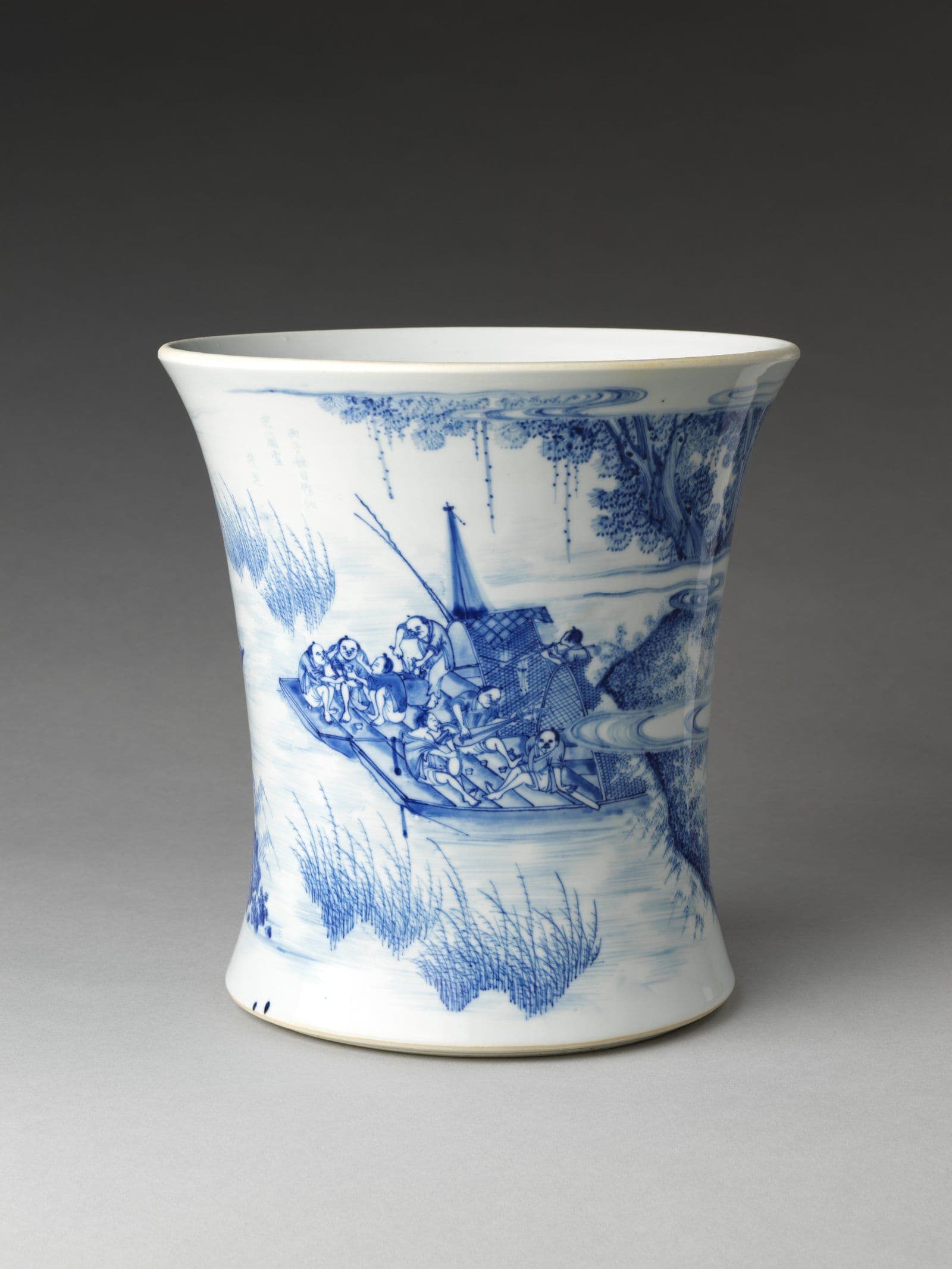
Pick up a cylindrical brush pot of the 1630s and turn it in the light. The blue is clean and silvery, painted with a loaded brush that shades from near-black in the rock crevices to a pale wash across the sky. There is no reign mark under the base — only a flat, unglazed ring of body burned orange where it met the sand of the kiln. A scholar stands under a pine, his servant a few paces behind, and the ground beneath them is a row of short vertical grass strokes, as regular as stitching. Nothing about the piece announces a dynasty, and that is precisely the problem it sets you.
This guide walks you through the porcelain made at Jingdezhen between the death of the Wanli emperor and the founding of the Qing: what the Tianqi and Chongzhen reigns actually produced, why the imperial kilns fell silent, how to recognise the shapes and painting habits that appear in these decades and almost nowhere else, what the bases and marks will and will not tell you, and what to check before you buy.
What "transitional" means, and what it does not
Dealers use "transitional" loosely, and the looseness causes trouble. In its narrow sense the term covers the wares made at Jingdezhen from roughly 1620, when Wanli died and imperial ordering lapsed, to the resumption of court supervision at the kilns under the Kangxi emperor in the 1680s. That span crosses a dynastic boundary: the Tianqi reign (1621–1627) and the Chongzhen reign (1628–1644) fall in the Ming, while the Shunzhi reign that follows is already Qing.
The reigns matter less than the market does. What defines the period is not who sat on the throne but who was buying: private kilns working for domestic scholars, for Japanese tea merchants and for the traders on the coast, with no palace requisition dictating shape or subject. Learn the period as a stylistic run rather than as a list of emperors and the later pieces stop confusing you.
Why the imperial kilns went quiet
The court's demands on Jingdezhen in the late Ming had been enormous, and enormously badly paid. Levies arrived in tens of thousands of pieces, the supervising eunuchs squeezed the potters, and by the last decades of Wanli's reign the system was breaking down. When the emperor died in 1620 the orders effectively stopped, and the imperial kilns ceased to set the standard.
What filled the gap was the private sector of the same town. The best painters at Jingdezhen now worked for merchants rather than for the palace, and they worked to a domestic taste formed by books rather than by court ritual. That break is visible in the wares themselves, and it is the reason the period looks less like a continuation of the Jiajing and Wanli output than like a fresh start.
Shapes that belong to these decades
Several forms are so characteristic that shape alone narrows the date.
- The brush pot, bitong. A straight cylinder, sometimes with a slightly recessed base and a broad unglazed foot ring. Scholars' furniture, made for the desks of the men who were also buying illustrated novels.
- The sleeve vase, rolwagen. A tall cylindrical body rising to a narrow, flared neck, the Dutch name taken from the sleeve of a coat. Made in quantity for export and rarely seen before about 1630.
- Bottle and beaker vases. Often decorated in a single continuous scene without a separated neck panel, itself a transitional habit.
- Domed-cover jars, three-footed censers and stem cups. The censers frequently carry moulded lion masks and an unglazed base.
- European-shaped oddities. Mustard pots, candlesticks, ewers with metal-derived profiles, made to wooden models sent out with the ships.
A shape that carries a separated register of panelled borders around the rim and cavetto is more likely to belong to the earlier kraak export tradition, which runs alongside and then gives way to these wares.
Reading the painting
The decoration of the period has a vocabulary you can learn in an afternoon, and it does more dating work than any mark.
- The continuous narrative scene. Figures from plays, novels and illustrated woodblock editions, wrapped all the way round the vessel with no panel divisions. The compositions frequently derive from printed book illustration, and the debt shows in the outline-and-wash handling.
- Stylised clouds. Long, banded scrolls with blunt ends, often described as comma or dumbbell clouds, floating horizontally across the sky to separate one part of the scene from another.
- V-shaped rocks and cliff faces. Rocks drawn as angular slabs, shaded with parallel strokes on one side only, rising in stacked wedges.
- Grass tufts and plantain. Short vertical strokes for ground cover, and broad plantain leaves whose ribs are drawn as parallel lines rather than modelled.
- Incised borders. On many Chongzhen pieces a band of unpainted incised scrollwork runs above and below the main scene, catching the glaze in a faint shadow. Tilt the piece to the light and you will see it.
Cobalt, glaze and body
The cobalt of the period is well refined, and at its best it fires to a bright silvery blue with a violet cast, quite different from the greyish and often heaped-and-piled blue of earlier Ming wares. Painters exploited that refinement: you will see graded washes within a single leaf, a technique that becomes standard in the Kangxi reign but appears here first in quantity.
The glaze is usually thin, even and faintly bluish where it pools, with a fine orange-peel surface under raking light. Bodies are white and well levigated. Where the base is unglazed, the exposed porcelain often fires to a pale orange or buff, and you will frequently find fine chatter marks left by the trimming tool. The foot rim is worth a long look: a broad, neatly bevelled and unglazed ring, sometimes with a shallow groove inside it, is a period habit rather than an accident.
Marks: absence is the norm
Most transitional wares carry no reign mark at all, and a piece with no mark is not thereby suspect. What you do find falls into three groups.
- Genuine Tianqi marks. "Da Ming Tianqi nian zhi" occurs, usually in underglaze blue in a double circle, and most often on small wares made for the Japanese market. Chongzhen reign marks are markedly rarer.
- Marks of earlier reigns. Chenghua and Xuande marks are written on wares of these decades as a gesture of respect and of taste, not as fraud. Apocryphal marks of this kind are a normal feature of Chinese porcelain and do not condemn a piece.
- Symbols in a double circle. An artemisia leaf, a conch, a lingzhi fungus, an incense burner, a hare or a simple flower head. These belong to the period and to the decades either side of it.
The corollary matters when you are buying. If a dealer dates a piece to Chongzhen because of a six-character mark, ask what else supports the date. Marks are the last evidence to consult, not the first, and a fluent modern hand can produce any of them. Learning how the fakes are written is a separate discipline from learning the period.
Made for Japan: ko-sometsuke and shonzui
A substantial share of Tianqi-period output went to Japan, where tea practitioners wanted wares the Chinese domestic market would have rejected. Ko-sometsuke, "old blue and white", is the Japanese name for this group: dishes and small vessels, often deliberately irregular, painted with a quick and sometimes wilfully clumsy brush. The diagnostic is mushikui, insect nibbling, where the glaze has shrunk back from the rim during firing and flaked away, leaving a bitten edge. Japanese buyers valued the flaw.
Shonzui wares are the refined cousin: dense geometric brocade grounds reserved with panels, tightly potted, made to order for the tea ceremony. Because both groups were made in China for Japan, they sit awkwardly in the middle of a question collectors meet constantly, which is how to tell Japanese ceramics from Chinese ones.
Dating a piece in sequence
Work through the evidence in this order, and do not let a later step overturn an earlier one.
- Shape. Is it a form the period made? A sleeve vase or a straight brush pot puts you in the right decades before you look at anything else.
- Composition. Continuous scene or panelled border? Narrative figures or a floral sprig?
- Cloud and rock vocabulary. Banded comma clouds and wedge-stacked rocks are the strongest single indicator.
- Base and foot. Unglazed, bevelled, orange-toned, chatter-marked.
- Glaze quality and wear. Genuine wear sits where the piece was handled and where it stood, not scattered evenly across the belly.
- Mark, last. Use it to confirm, never to convict.
A piece that passes the first four tests and carries no mark is a better prospect than one that fails them and carries a crisp Chongzhen six-character inscription.
The market and what to check
Transitional wares have a settled collector base. Value tracks painting quality above all: a vase with a crowded, confidently drawn narrative and clean silvery cobalt sits far above one with a perfunctory landscape, even when the shapes match. Condition does the rest. Check for restored necks and rim chips on sleeve vases, check covers, which are missing far more often than present, and run an ultraviolet lamp over the piece before you commit.
Provenance from the mid-twentieth century or earlier matters here, as does wreck material: cargoes lost in the 1640s have given the period dated benchmarks that most Chinese ceramics lack.
Common questions
Is transitional porcelain Ming or Qing?
Both, depending on the year. The Tianqi and Chongzhen reigns are Ming and end in 1644; the Shunzhi reign that follows is Qing. Because the kilns, the painters and the customers did not change at the dynastic boundary, the wares run straight across it, which is why the stylistic label is more useful than the political one. A dealer who says "transitional, about 1640" is making a stylistic claim, and it is a reasonable one.
Why do so many pieces have no reign mark?
Because no one was requisitioning them for the court. Imperial ordering at Jingdezhen lapsed after 1620, and private kilns had no obligation and little incentive to put an emperor's name on a brush pot bound for a scholar's desk or a ship's hold. Marking became normal again once court supervision resumed under Kangxi.
How do I tell transitional blue and white from Kangxi blue and white?
Look at the sky and the rocks. Kangxi painters organise landscape into receding planes with a wider tonal range and use a harder, more brilliant blue; transitional painters band the sky with comma clouds and stack rocks in wedges. Kangxi bases are usually glazed and often marked or carry a double circle; transitional bases are frequently unglazed and bare.
Are transitional wares a good place to start collecting?
They are, if you like painting more than you like marks. Prices for modest but honest pieces remain reachable, the visual vocabulary is learnable, and the near-absence of reign marks forces the habits that serve a collector everywhere else. Start by handling as many bases as you can.
Further reading
- Shunzhi transitional porcelain marks — the reign that continues this story on the Qing side of 1644.
- Ming dynasty reign marks guide — the full sequence these two reigns close.
- Blue and white porcelain and the history of cobalt — why the blue of the 1630s looks different from the blue of the 1530s.
- Kangxi era porcelain collecting guide — where the painters of the transition end up.
Browse the collection
Transitional porcelain is a subject we write about rather than one we stock. Kiln & Ink publishes limited-edition archival giclée reproductions of the twentieth-century Chinese ink masters, hand-numbered and issued with a Certificate of Authenticity — a different medium, but the same habit of looking that this period rewards. The painters of the 1630s took woodblock book illustration and turned it into brushwork on a curved surface, and that translation between print and painting is worth following forward. Browse the collections to see where the line arrives three centuries later.
Explore Further