Published September 15, 2026
How to tell Chinese porcelain from Japanese: the foot, the body, the cobalt, the palettes, and why a Ming reign mark proves nothing about country.
Turn the dish over. That is where the argument is usually settled, long before you reach the mark: how the foot ring was cut, whether grit from the kiln floor is still stuck to it, how white the paste reads in the unglazed band where the glaze stops. A Jingdezhen dish and an Arita dish can carry the same blue peony, the same fence-and-rock border and the same six-character Ming reign mark, and still have been made two centuries and a sea apart.
This guide walks you through the physical tells that separate Chinese porcelain from Japanese porcelain: the base and foot, the body and glaze in transmitted light, the colour of the cobalt, the logic behind the decoration, the enamel palettes each tradition owns, and the marks — including the Chinese reign marks that Japanese kilns used freely. By the end you should be able to place most blue-and-white and enamelled wares from the back of the piece alone, and know which cases cannot honestly be settled that way.
Why the two traditions are so easy to confuse
China had been making porcelain for centuries before Japan made any. Japanese porcelain begins in the 1610s in Hizen province on Kyushu, after a workable kaolin deposit was found at Izumiyama near Arita; the technology arrived with potters from the Korean peninsula.
Then politics did the rest. The collapse of the Ming and the wars that followed disrupted Jingdezhen's export production for decades in the middle of the seventeenth century, and the Dutch East India Company, needing to keep its ships full, turned to Arita. For roughly half a century Japanese porcelain filled the European market that Chinese porcelain had owned.
When Jingdezhen recovered under the Kangxi emperor, it did the obvious commercial thing: it copied the Japanese patterns that European buyers had grown used to. So the copying runs in both directions, which is why style alone is never enough. The body, the foot and the firing scars are harder to fake than a pattern.
Start at the foot
The base tells you more per second of looking than anything else on the piece.
- Kiln grit on the foot rim. Japanese wares of the seventeenth and eighteenth centuries were commonly fired standing in sand, and coarse grey-brown grains are often still fused to the unglazed foot. Chinese export wares are usually cleaner underfoot. Grit is not proof on its own, but a rim studded with adhering sand points firmly towards Hizen.
- The cut of the ring. Jingdezhen foot rings tend to be neatly turned, with the glaze stopping in a decisive line and the inner and outer walls of the ring cleanly chamfered. Arita feet are more often thicker, squarer in section and more casually finished.
- Spur scars. Small unglazed scars inside the foot or on the base, left by the supports a piece rested on, appear on a good deal of Japanese and Korean porcelain and much less on Chinese export ware.
- The comb-tooth foot. Fine Nabeshima dishes carry a row of short blue strokes painted round the outside of the tall foot ring, the comb-tooth foot or kushi kodai. Nothing in the Chinese repertoire looks like it.
- Body colour at the rim. Where the paste is exposed, Chinese porcelain often fires to a warm orange-brown where iron in the clay has oxidised. It is a habit of the material, not a defect.
If you want to go deeper on how the foot itself changes across reigns, the sequence is set out in our guide to dating Chinese porcelain by the foot rim.
The body and the glaze
Hold the piece against a window, or put a torch behind it.
Mature Jingdezhen porcelain reads dense and cool: a blue-white or faintly grey-white translucency, a tight glaze that clings to the form, and thin, even walls that ring when tapped. Early Arita porcelain is generally a shade greyer and less refined, with more firing specks, and the glaze often pools a watery green-blue in the recesses and inside the foot.
The exception is the one that matters. Kakiemon workshops developed a warm milky-white body known as nigoshide, deliberately left largely undecorated so the whiteness itself is the point. It reads warmer than Chinese white, closer to milk than to snow, and it is the single most reliable body in Japanese porcelain to recognise by eye.
Potting weight helps too. Seventeenth-century Arita dishes are frequently heavier and thicker in the wall than a Chinese dish of the same diameter. That comparison only works if you have handled both, which is the argument for picking things up at previews rather than only looking at photographs.
Read the cobalt
Chinese blue-and-white at its best is tonal. Kangxi painters worked the refined cobalt in graded washes within firm outlines, so a single rock or robe can carry several distinct depths of blue, bright and slightly violet in tone. The history of that pigment and how its colour shifts by period is worth reading in full in our account of cobalt in blue-and-white porcelain.
Japanese cobalt of the same decades is often greyer and inkier, with a tendency to blur softly into the glaze rather than hold a crisp edge. Outlines are drawn more heavily and filled more flatly, with less of the graded washing.
Treat this as a supporting test rather than a decisive one. Later Japanese blue can be perfectly clean, and provincial Chinese blue can be muddy. A grey, bleeding blue on a heavy dish with a gritty foot is a coherent case; a grey blue on its own is not.
How the decoration is arranged
This is the test that works from across a room.
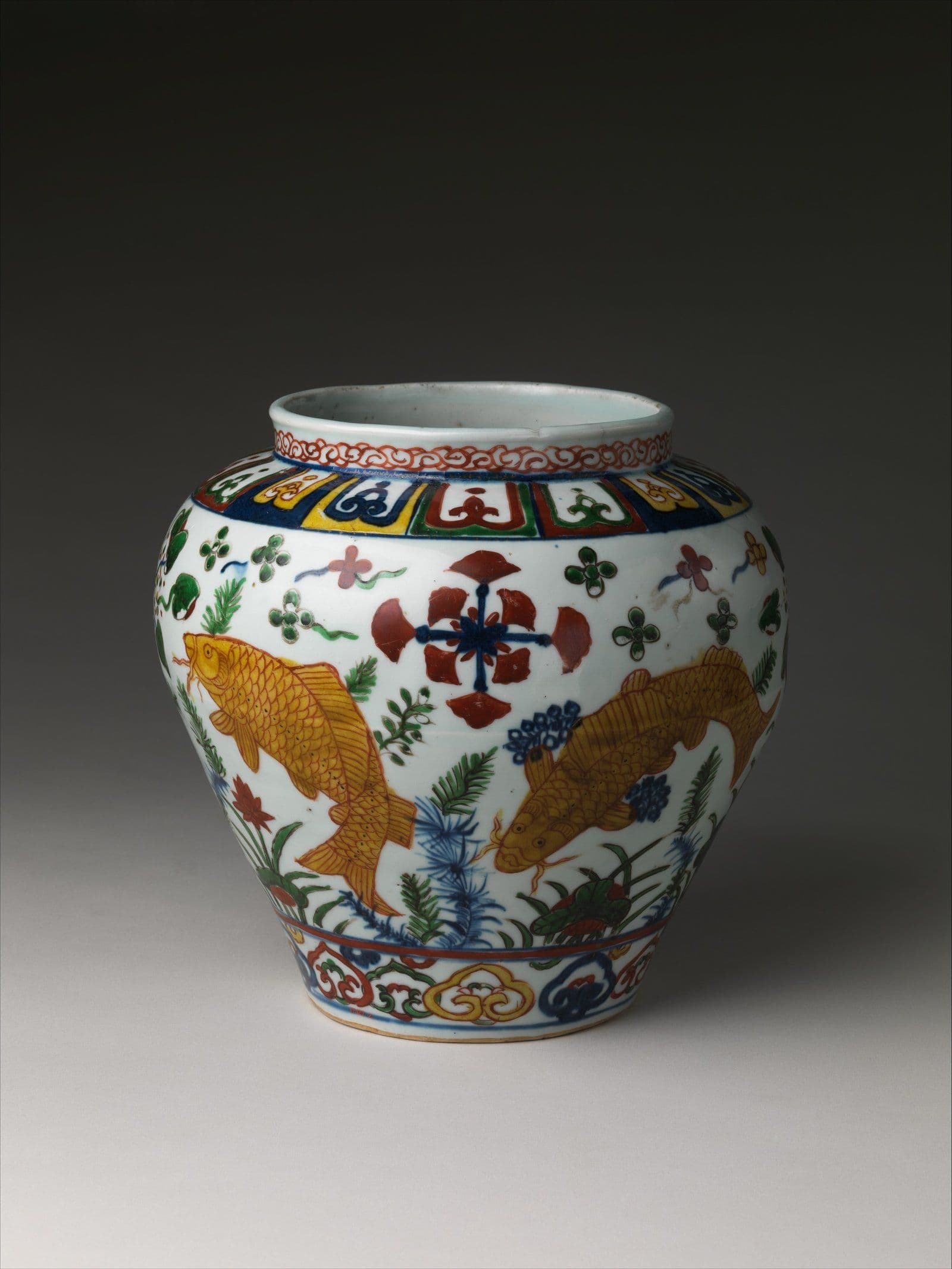
Chinese decoration is organised around a centre. Borders run continuously, panels are balanced in pairs or fours, and the motif sits square in the well of the dish. The repertoire is formal and emblematic: lotus scrolls, dragons among clouds, figures in a garden, the scholar's antiques. Our decoder of bird and flower symbolism covers what those motifs are actually saying.
Japanese decoration is happy to be off-centre. Motifs run off the edge of the field, a spray of autumn grasses occupies one corner and leaves the rest empty, and blank ground is used as an active part of the design rather than as background. Dense Imari brocade patterning borrows directly from textiles, and the reverse of a Japanese dish is often decorated with three sparse sprigs where a Chinese dish would carry a continuous scrolling band.
The enamel palettes
- Japanese Imari. Underglaze blue, overglaze iron red and gold, packed into brocade panels. The gold is applied generously and tends to wear to a soft matte.
- Kakiemon. Sparse, asymmetric enamelling on the milky nigoshide body, in soft blue, iron red, turquoise-green and yellow, with wide areas left plain.
- Chinese Imari. Jingdezhen's answer to the above, made for the same European buyers: whiter and thinner in the body, cleaner and more purple-toned in the blue, and more sparing with the gilding.
- Famille rose. The opaque pink derived from gold, with its white opacifier allowing shaded, blended enamel painting, belongs to eighteenth-century China. A dense, tonally shaded rose palette is a Chinese argument.
- Famille verte. The Kangxi palette built on translucent green, iron red, yellow, aubergine and black outlines, again Chinese.
Marks are the last thing to look at, not the first
Japanese kilns used Chinese marks. Arita wares carry apocryphal Ming reign marks, most often Chenghua and Xuande, as well as auspicious marks such as fuku, "good fortune", usually written inside a square outline. A Ming reign mark on a piece that is plainly not Ming is normal in both countries, and our guide to apocryphal marks on Chinese porcelain explains why the practice was a form of homage rather than fraud.
What the mark does tell you is how it is written and framed. Chinese reign marks are conventionally six or four characters in two or three columns, in regular script or seal script, enclosed in a double circle or a double square. Japanese marks are more variable, more often a single character or a short auspicious phrase, and the brushwork is frequently looser than a Jingdezhen hand would allow.
An English word changes everything. United States tariff legislation of 1891 required imported goods to be marked with their country of origin in English. Japanese export porcelain was marked Nippon until about 1921 and Japan or Made in Japan afterwards; Chinese export wares were marked China. If the base carries one of those words, the question of country is already answered and you are only dating the piece. The earlier story of export marks is covered in our guide to kraak and export porcelain marks.
What to check before you buy
- Handle the base first. Grit, spur scars, the cut of the ring and the colour of the exposed paste, in that order.
- Look for a repair before a mark. Rim chips ground down, a restored foot or a resprayed rim will change what the base can tell you.
- Match the shape to the tradition. Mukozuke serving cups, sake bottles and foliate dishes are Japanese forms; meiping, gu beakers and archaistic vessel shapes follow Chinese bronze prototypes.
- Be wary of a clean answer from one test. Two independent tests agreeing is worth more than any single feature, including the mark.
- Accept the undecidable cases. Late nineteenth-century wares made for export, and twentieth-century pieces copying both traditions, sometimes cannot be placed without laboratory analysis. Say so rather than guessing.
Common questions
Is Imari Chinese or Japanese?
Both, and the word describes a style rather than a place of manufacture. Imari is named for the Japanese port from which Arita wares were shipped, and the original blue, red and gold brocade wares are Japanese. Jingdezhen then produced its own versions for the European market, known in the trade as Chinese Imari. The Chinese version is generally whiter and thinner in the body, cleaner in the blue and more restrained in the gilding, and it lacks the gritty foot.
Does a Chinese reign mark mean the piece is Chinese?
No. Japanese kilns used Ming reign marks freely, and Chinese kilns applied earlier reign marks to later wares as a matter of course. A reign mark tells you what tradition the decorator was invoking, not when or where the piece was made. Judge the body, the foot and the glaze first, then let the mark add or subtract confidence.
Why does my plate have sand stuck to the foot?
Because it was fired standing in sand rather than on a clean setter or a supporting ring. The practice is strongly associated with Japanese porcelain of the seventeenth and eighteenth centuries, though it is not exclusive to it. Fused grey-brown grains on an otherwise unglazed foot rim are a genuine clue; loose sand that brushes off is just dirt.
Can I tell Chinese from Japanese porcelain by weight alone?
Not reliably, but weight is useful in combination. Early Arita wares are often thicker in the wall and heavier for their size than Chinese equivalents, and the difference is noticeable once you have handled a few of each. On late wares from either country the distinction largely disappears, so use weight to support a reading of the foot and the body rather than to make one.
Further reading
- Chinese Porcelain Marks: A Collector's Guide — how reign marks are structured, read and dated.
- The Porcelain Mark Shape Decoder — what the circle, square and cartouche around a mark actually indicate.
- The Porcelain Authentication Checklist — the order to work through a piece in, from base to rim.
- Imperial and Provincial Kilns — why quality varies so widely within Chinese porcelain itself.
Browse the collection
Porcelain is a subject we write about rather than one we stock. Kiln and Ink publishes limited-edition archival giclee reproductions of the twentieth-century Chinese ink masters, each hand-numbered and issued with a Certificate of Authenticity, and the habits of looking described above transfer directly to paper: judge the support before the signature, the brush before the seal. You can see the current editions in the collection.
Explore Further