Published August 17, 2026
A collector's guide to Pan Tianshou: his monumental compositions, finger painting (zhimo), the subjects he returned to, and what to check before buying.
Pan Tianshou painted some of his most forceful passages without a brush. He would ink a fingertip, the edge of his palm, sometimes a fingernail, and pull the pigment across the paper in a line no brush quite reproduces — blunt where it starts, breaking into dry granulation where the skin lifted away. People who have stood in front of his large paintings tend to remember that quality of mark before they remember the subject.
This guide is for the collector trying to place Pan Tianshou (1897–1971) accurately: what he was arguing for, how his pictures are actually constructed, what finger painting changes on the paper, and what to examine before committing to a work or a reproduction.
The painter who argued for distance
Pan belongs to the generation of Chinese painters who had to decide, in public, what Chinese painting was going to be in a century dominated by Western art education. Several of his contemporaries answered by absorbing Western practice directly. Xu Beihong built a teaching programme on European draughtsmanship. Lin Fengmian looked to modern European painting for colour and form.
Pan took the opposite position and stated it plainly: Chinese and Western painting should keep their distance from one another. He argued that the two traditions were each complete systems, and that blending them casually would weaken both rather than enrich either. This was not conservatism for its own sake — he was not rejecting the modern world. He was making a claim about how a tradition survives: by pushing its own internal logic further, not by borrowing someone else's.
He spent much of his career teaching, eventually leading the academy in Hangzhou that is now the China Academy of Art. That matters for collectors, because his thinking runs through several later generations of Chinese ink painters, and because the work was made by someone who approached painting structurally, as a teacher does.
In his twenties he came into the orbit of Wu Changshuo in Shanghai and absorbed the seal-script-driven brushwork that the older master had made central to late literati painting. What is instructive is what he did next. Rather than settle into that manner, he deliberately moved away from it, hardening the line and reorganising the picture space. The debt is visible in his work, but so is the departure.
How a Pan Tianshou composition is built
Pan's pictures are built like structures, and once you see the method it is difficult to unsee.
A few habits recur:
- Weight pushed to the edges. Where a more conventional composition settles its mass near the centre, Pan frequently shoves a boulder, a branch or a bird hard against the margin, leaving a large charged emptiness in the middle of the sheet.
- Angular, architectural rock. His rocks are drawn with long straight or near-straight contours meeting at sharp corners. They read as constructed rather than eroded.
- Deliberate precariousness. Compositions are often balanced at the point where they look as though they should topple, then held by a single counterweight — a small bird, a spray of leaves, a block of seal red.
- Few elements, large scale. He reduced the number of things in a picture and increased their size, which is why his work photographs poorly and rewards standing in front of it.
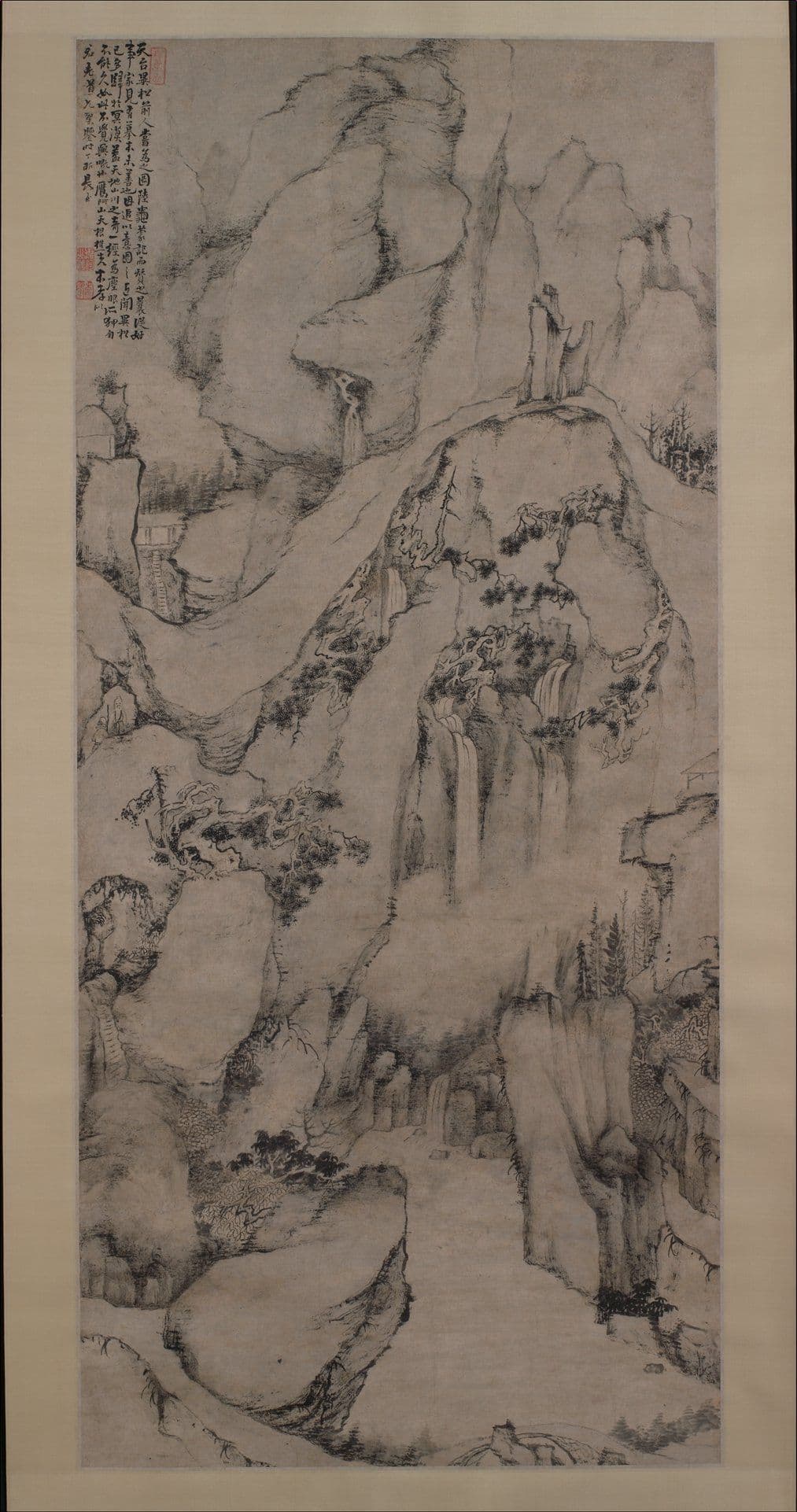
The monumental bird-and-rock paintings are where these habits converge, and they are where his reputation now rests. A Corner of Lingyan Stream shows the compositional instinct clearly: an ordinary fragment of stream bank, treated at a scale and with a frontality normally reserved for a grand vista. Nothing in the subject asks for monumentality. He supplies it through structure alone.
Two further devices are worth naming, because they are easy to miss and hard to fake.
The first is his treatment of empty paper as an active element rather than a background. In much traditional composition, void reads as mist, water or distance — it is atmosphere. In Pan's pictures the void is structural: it carries tension between the loaded edges, and if you covered part of it the picture would collapse rather than simply lose air.
The second is his use of a single concentrated accent, usually the seal red or a small area of colour, placed where the composition needs to be pinned. He was economical with colour generally, and the restraint is what gives the one accent its force.
This is a different proposition from the small, intimate, allusive album leaf of the older scholarly tradition. Pan's relationship to that inheritance — what he kept and what he discarded — is worth understanding on its own terms.
Finger painting, and what it does to a line
Finger painting — zhimo, ink applied with fingers, nails and palm — was not Pan's invention. The practice has Qing-dynasty precedent, most familiarly in the work of Gao Qipei. What Pan did was treat it as a serious technique capable of carrying major paintings rather than as a curiosity.
The technique matters because of what the hand cannot do. A brush holds a reservoir of ink and releases it continuously. A finger holds very little and runs dry fast. The result is a line that begins saturated and blunt, then fragments. You cannot taper elegantly, and you cannot sustain a long even stroke. What you can produce is a mark with a particular kind of resistance in it — one that reads as pressed into the paper rather than drawn across it.
Two practical points follow for collectors.
First, finger-painted passages usually sit alongside brushwork rather than replacing it. Inscriptions, fine detail and much of the foliage remain brush-drawn. A work claimed as entirely finger-painted deserves more scrutiny, not less.
Second, the blunt, broken quality is genuinely difficult to imitate, because a brush pretending to be a finger tends to produce a smooth broken line. Dryness alone is not the tell. The abruptness at the start of the stroke is, along with the way the mark loses ink unevenly rather than tapering.
Subjects, seals and the practical checks
Pan's subject range is narrow by design. Rocks and the birds that perch on them — eagles and vultures especially — recur constantly, along with lotus, pine and flowering plants handled with the same structural severity. He was not a portraitist or a narrative painter, and works attributed to him well outside this range deserve caution.
Some things worth doing before you commit:
- Read the inscription as part of the picture. Pan placed calligraphy structurally, using the column of characters as a compositional block that holds a corner. An inscription that sits awkwardly, or that could be removed without the composition collapsing, is out of character. His command of the brush as a writing instrument is inseparable from his command of it as a drawing one — the standards behind both are the old critical ones.
- Look at the seal impressions, not only the seals. Position, pressure and paste colour are part of how he finished a picture.
- Be careful with dating. His career was interrupted; he was persecuted during the Cultural Revolution and died in 1971. Confident dates on individual works should come from documentation, not from style alone.
- Ask what the paper has been through. Large works on paper are frequently remounted, and remounting can flatten precisely the dry, granular passages that make his mark distinctive.
For anyone building a picture of twentieth-century Chinese ink painting more broadly, it helps to read Pan against a contemporary working in an entirely different register. Qi Baishi's warmth and humour make Pan's severity much easier to see for what it is — a deliberate choice, not a temperament.
Common questions
Why is Pan Tianshou considered a major twentieth-century master?
Because he answered the central question of his generation — what should Chinese painting do now — with a coherent position and a body of work that demonstrates it. His compositions extended the formal vocabulary of ink painting rather than importing a foreign one, and he did this at a scale the tradition had rarely attempted. His long teaching career then transmitted that thinking to the painters who followed him.
What is finger painting, and did Pan Tianshou invent it?
Finger painting is the application of ink with the fingers, fingernails and palm instead of a brush. Pan did not invent it; the practice has Qing-dynasty precedent. What he did was treat it as a technique capable of carrying serious work, exploiting the blunt, quickly-drying, fragmenting mark that a finger makes and a brush cannot.
How do I tell a Pan Tianshou composition from a general modern ink painting?
Look for structure rather than atmosphere: angular, architectural rock contours; mass pushed hard to the edge of the sheet; a large active emptiness; very few elements at large scale; and an inscription placed as a structural block rather than tucked into a corner. Softness, crowding and centred mass all point away from him.
Are original works by Pan Tianshou realistically available to new collectors?
Paintings by the major twentieth-century Chinese masters trade in a specialised market and are not a normal entry point. Most people meet these painters first through museum collections, exhibition catalogues and good reproductions, and build the eye well before they build the collection.
Further reading
- Pan Tianshou's Monumental Bird and Rock Paintings — a closer look at the pictures his reputation rests on.
- The Six Principles of Chinese Ink Painting — the critical framework his brushwork is still judged against.
- Literati Painting vs Court Painting — the older division he inherited and reorganised.
- Qi Baishi: A Collector's Guide — the contemporary whose warmth throws Pan's severity into relief.
Browse the collection
Kiln & Ink issues limited-edition archival giclée reproductions of the twentieth-century Chinese ink masters, printed on rice (xuan) paper or museum-grade cotton rag, each one hand-numbered and supplied with a Certificate of Authenticity, from about $300 to $1,200.
Explore Further