Published September 27, 2026
Huang Zhou's donkeys and Xinjiang figures explained: where the subjects came from, how to read his multiple-line drawing, and what forgeries get wrong.
Stand close to a Huang Zhou donkey and the animal is not drawn once. The line along the back has been laid three or four times, each pass slightly beside the last, and the painter has left every attempt on the paper rather than choosing one and hiding the others. Step back two metres and the multiple contours resolve into a single shaggy edge that reads as hair, weight and forward motion at once. That habit, carried from the sketchbook into finished ink, is the whole signature of his work.
This guide walks you through who Huang Zhou was and where his two famous subjects came from, why the donkey became his animal in the way the shrimp became Qi Baishi's, what the Xinjiang figure paintings actually depict, how to read his multiple-line drawing and tell it from an imitator's single confident stroke, and what the market pays attention to when these paintings come up.
The painter and the road
Huang Zhou (1925-1997) came out of a tradition of drawing from life rather than from painting manuals. His teacher was Zhao Wangyun, a painter committed to the idea that Chinese ink should be pointed at what was in front of the artist, and Huang Zhou took that instruction further than almost anyone of his generation.
Military service sent him into the northwest, and the journeys through Xinjiang that followed gave him a subject he worked for the rest of his career: the herders, dancers, market crowds and animals of the Uyghur and Kazakh regions. He drew constantly and in volume, filling sketchbooks in the field, and the finished paintings were built out of that accumulated looking rather than invented in the studio.
Later in life he founded the Yanhuang Art Museum in Beijing. His reputation, though, rests on two subjects, and collectors encounter them far more often than anything else he painted.
Why donkeys
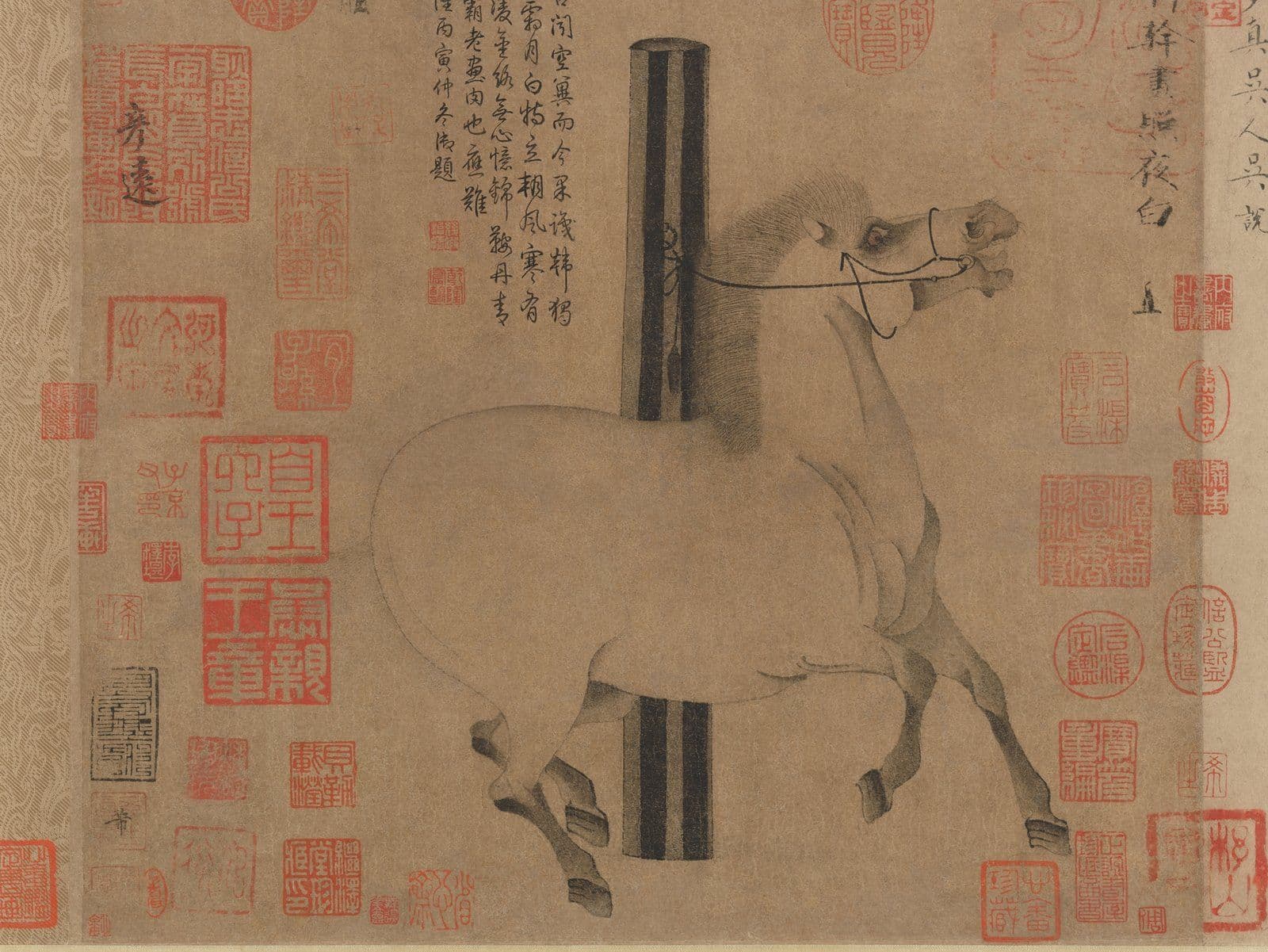
The donkey is a working animal, unheroic and slightly comic, and that is precisely why it suited him. The twentieth-century masters each acquired an animal that became shorthand for their brush: horses for one, shrimp for another, eagles for a third. Huang Zhou took the one nobody had claimed.
Practically, the donkey is a good subject for the kind of line he drew. It has a heavy simple silhouette, a short neck, an oversized head and long ears that give the composition its accents, and a coat that suits the dry repeated contour. There is no elegant anatomy to get right and no classical precedent demanding respect, so the drawing can stay rough.
He painted donkeys singly, in pairs, and in strings of five or six crossing the paper, sometimes loaded with panniers, sometimes with a child riding, sometimes as the only motif on an otherwise empty sheet. The comparison worth making is with Xu Beihong's galloping horses, where the animal carries national and symbolic weight. Huang Zhou's donkeys carry sacks.
What the Xinjiang figures show
The figure paintings are more varied than the donkeys and more often misread.
- Dance subjects. Groups of Uyghur dancers, usually women, with raised arms, wide skirts caught mid-turn, and a tambourine or drum. The bodies are drawn in long sweeping contours; the drapery takes most of the colour.
- Herders and riders. Kazakh and Uyghur figures with horses, donkeys, sheep and sometimes camels, set against almost no background. Space is suggested by the placement of figures on blank paper, not by landscape.
- Market and family groups. Crowded compositions with children, baskets and animals packed into the picture, often with figures cropped by the edge of the sheet.
- Single seated figures. Quieter works, closer to portrait drawing, where the multiple-line method is easiest to see because there is less going on around it.
The costume detail is specific, drawn from observation rather than assembled from stereotype, and the patterning of the textiles is often the most carefully handled part of the painting. Colour is applied in flat areas within the ink drawing rather than modelled, which places the work firmly in the expressive tradition rather than the meticulous one. If that distinction is unfamiliar, our guide to xieyi and gongbi painting sets out what each demands.
Reading the line
This is the part that matters for connoisseurship, and it is learnable in an afternoon with a few good reproductions.
- Look for repeated contours. A single edge drawn two to four times, the passes not quite parallel, none of them erased. Genuine work shows this constantly, at every scale, including in places where it was not needed.
- Check that the repetition is searching, not decorative. In real Huang Zhou the extra lines converge where the form is certain and spread where it is not. An imitator draws a confident line and then adds a second line beside it for effect, so the pairs stay evenly spaced.
- Watch the ink loading. He worked fast with a fairly dry brush, so the strokes show dragged fibre and skipped paper. A smooth wet line of even tone is a warning sign.
- Find the anchor darks. Eyes, nostrils, hooves, the shadow under a jaw, the edge of a hat: a few small very dark accents hold the whole drawing together. Imitations tend to distribute dark tone more evenly and lose the snap.
- Look at the hands and feet. Hands are where a figure painter's drawing is exposed. His are summary but structurally right, with the wrist and knuckles in credible relation. Forgeries soften into mittens.
The underlying discipline here is drawing from life, which was a programme for his whole generation rather than a personal quirk. Li Keran's sketching journeys of the 1950s show the same conviction applied to landscape instead of figures.
From sketchbook to finished sheet
Huang Zhou's finished paintings keep the appearance of speed, and buyers sometimes take that to mean they were improvised. They were not, in the ordinary sense.
The sketching supplied a stock of understood forms, so that by the time a donkey or a dancer appeared on good paper the painter was not solving the drawing problem, he was performing a solution he already held. That is why the line can be fast and still land. It also explains a feature that puzzles people: close variants of the same composition, with the same figures in nearly the same arrangement, recurring across years. Repetition of a worked-out motif was normal practice, not evidence of copying.
What it does mean is that a plausible composition proves nothing on its own. Composition is the easiest thing for a forger to borrow and the line is the hardest.
The market and what to check
Huang Zhou is among the most heavily forged Chinese painters of the twentieth century, for the same reasons that make him popular: the subjects are recognisable, the manner looks reproducible, and there is a large legitimate body of work of uneven quality, which gives fakes somewhere to hide.
- Provenance before connoisseurship. With a painter this widely faked, documented history is worth more than a good eye applied to a bare sheet. Our guide to how experts authenticate Chinese paintings sets out the order of the checks.
- Beware of the too-finished donkey. Overworked fur, tidy outlines and a fully described background all pull away from his practice.
- Match subject to period sensibly. The Xinjiang material is the backbone of the career; an unusual subject with an unusual manner needs more support, not less.
- Read the inscription as drawing. The calligraphy should show the same dry rapid hand as the picture. A careful inscription on a rapid painting is a mismatch worth pursuing.
- Condition matters more than usual. Dry fast strokes sit high on the paper and abrade; flattened, fuzzy line edges often mean a sheet has been remounted repeatedly.
For the career in full, including seals and the shape of the market, see our Huang Zhou collector's guide.
Common questions
Why did Huang Zhou paint so many donkeys?
The donkey suited both his technique and his temperament. Its heavy, simple silhouette and shaggy coat take the dry repeated contour he drew naturally, and its long ears give a composition easy accents. It was also an unclaimed subject at a time when other masters were identified with horses, shrimp and eagles, and an unpretentious one, which fitted a painter whose whole method was built on drawing ordinary working life from observation.
Are Huang Zhou's Xinjiang paintings portraits of real people?
They come from drawings of real people but they are not portraits in the Western sense. He sketched herders, dancers and market crowds in the field and then built finished compositions from that material, combining and adjusting figures. The costume and the physical types are observed rather than invented, which is why the textile patterning is often so specific, but a named sitter is rarely the point.
How do you tell a genuine Huang Zhou from a copy?
Look at the line rather than the subject. Genuine work shows contours drawn several times over, with the passes converging where the form is certain and spreading where it is not, in a dry brush that skips across the paper. Copies usually produce a single confident outline, or evenly spaced parallel lines added for effect, and they lose the few very dark accents at eyes, hooves and hat edges that hold the drawing together.
Why do the same compositions appear more than once?
Repeating a resolved motif was normal studio practice for his generation. Once a donkey string or a dancing figure had been worked out through sketching, the painter used it again, with variations, over a period of years. Close variants are therefore expected rather than suspicious, and their existence is a reason to judge a sheet on its drawing and its provenance rather than on the novelty of its design.
Further reading
- Qi Baishi's shrimp and why they became iconic — how a single animal subject comes to stand for a painter's whole brush.
- Li Kuchan's eagle paintings — another twentieth-century master identified with one creature, worked in a heavier ink.
- How to read a Chinese painting inscription — what the characters beside the image tell you about date, occasion and recipient.
Browse the collection
Kiln & Ink publishes limited-edition archival giclée reproductions of the twentieth-century Chinese ink masters, hand-numbered and issued with a Certificate of Authenticity. Huang Zhou is among the painters we work with, and his drawing rewards reproduction at size, because the multiple contours that read as one edge across a room only separate when you can stand close. Browse the Huang Zhou editions or the wider collection.
Explore Further