Published August 14, 2026
A collector's guide to Daoguang porcelain (1821-1850): the seal-script reign mark, Shendetang hall wares, imperial versus commercial output, and what to check.
Pick up a piece of Daoguang porcelain and tilt the glazed surface against the light. On a great many examples the reflection will not run smooth — it ripples, in faint parallel waves across the body, as though the glaze had been poured and had set slightly out of level. Collectors call this the wave glaze, and while it is not a certificate of authenticity on its own, it is one of the first things an experienced eye registers on wares of this period.
This guide covers what the Daoguang reign produced, how its marks work, where the quality sits relative to the reigns on either side, and what to check before buying.
The reign in one paragraph
The Daoguang reign ran from 1821 to 1850 — thirty years that took the Qing court from a still-functioning imperial system into the aftermath of the First Opium War. The imperial kilns at Jingdezhen continued to operate throughout, but under real financial pressure, and the period is generally understood as one of consolidation rather than innovation. Forms, palettes and decorative schemes inherited from Jiaqing and, before that, from Qianlong were repeated with competence. The technical high-water marks of the eighteenth century were not attempted again.
That is the standard account and it is broadly right, but it is worth holding lightly. The best Daoguang imperial wares — particularly those made for the emperor's own use — are very fine indeed, and the reign's reputation as a decline story has kept prices more reasonable than the quality of the top pieces warrants.
The mark
The reign mark reads Da Qing Daoguang nian zhi, "made in the Daoguang reign of the Great Qing". Two features of it matter.
First, it is normally in seal script, not the regular script used in earlier Qing reigns. By the Jiaqing and Daoguang period the seal-script mark had become the imperial standard, and a Daoguang mark written in regular script is unusual enough to warrant a closer look at everything else about the piece.
Second, it is usually six characters in three columns of two, written either in underglaze blue or in iron red, depending on the ware. Iron-red marks are especially associated with the famille rose enamelled wares of the period.
The mark alone never settles the question. Daoguang marks appear on Republic-period copies, on twentieth-century commercial wares and on modern reproductions, and — as with every Qing reign — on pieces made in later reigns as homage rather than deception. Our guide to apocryphal marks on Chinese porcelain sets out how that convention worked and why an "incorrect" mark is not automatically a forgery. For the shape and stroke detail of the Daoguang mark specifically, alongside its neighbours, see our guide to Jiaqing, Daoguang and Xianfeng marks; the wider system is laid out in our guide to reading Chinese porcelain marks.
Hall marks, and the one worth knowing
Alongside reign marks, Daoguang wares carry tangming — hall marks, naming a studio, residence or hall rather than a reign.
The one every collector of this period learns is Shendetang, "Hall of Prudent Virtue", associated with the Daoguang emperor's own residence. Wares marked Shendetang zhi, usually in iron red, were made for the emperor's personal use, and they represent the top of the reign's output: careful potting, well-controlled enamels, restrained decoration. When Daoguang porcelain is described as underrated, Shendetang pieces are usually the argument.
Hall marks in general are a large and only partly documented subject — some name imperial studios, many name private commissioners, and a good number cannot be traced to anyone at all. Our guide to studio marks and hall marks covers how to approach them.
What the kilns were making
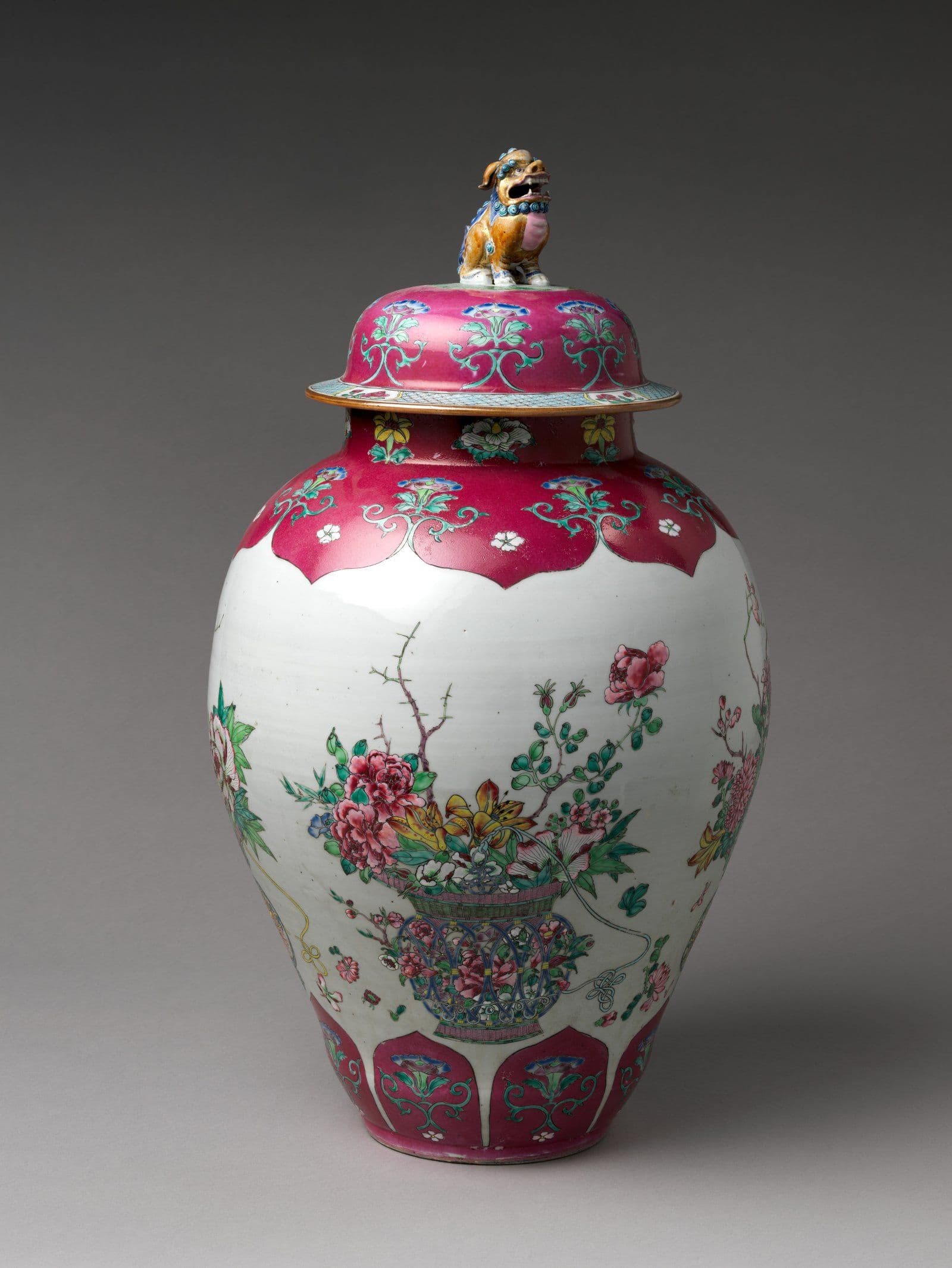
| Ware type | Character in this reign ||---|---|| Famille rose (fencai) | The dominant category. Dense floral and figural enamelling, often on a coloured or incised ground || Underglaze blue | Continued in quantity; the blue tends toward a slightly greyer, flatter tone than eighteenth-century wares || Monochromes | Continued, competent, generally without the depth of Yongzheng and Qianlong glazes || Sgraffito grounds | Enamel grounds incised with fine scrolling before firing — inherited from Qianlong, still executed well || Blue-and-white with iron-red | Common on smaller pieces, dishes and bowls |
Shape vocabulary is conservative: bowls, dishes, brush washers, vases in established forms. Where the reign is genuinely strong is in small, well-made table and desk objects, which is also where a collector is most likely to find something good at a sane price.
What to check
- Weigh it in the hand. Daoguang potting is generally a little heavier and less crisply finished than eighteenth-century work. This is a period characteristic, not a fault, and a piece that feels unusually light and thin for a Daoguang form is worth a second look.
- Look along the glaze. The rippled surface described at the top of this guide is common on the period's wares. Its absence proves nothing; its presence is a mild point in favour.
- Check the foot rim. The unglazed edge should show a fine, dense, white body. Coarse or greyish paste, or a foot rim finished too sharply and evenly, points away from an imperial piece.
- Read the enamels against the drawing. Good famille rose of this period is drawn with a confident outline that the enamel sits inside. Enamel running past its outline, or outlines that wobble, indicate commercial rather than imperial production.
- Compare the mark to a known example, not to a description. Mark forgery is competent enough that verbal descriptions do not discriminate. Side-by-side photographic comparison does.
Late Qing wares as a whole are a field where careful looking pays more than rules do; our step-by-step guide to identifying late Qing porcelain walks the sequence in order.
Imperial or commercial?
Most Daoguang porcelain offered for sale was never made for the court. Jingdezhen was a large commercial centre producing for the domestic market, for export and for private commissions at the same time as it filled imperial orders, and separating those streams is the practical work of collecting this period.
The imperial orders were specified in advance — form, size, decoration and quantity all set by the court — and the resulting wares are consistent in a way commercial production is not. Two dishes from the same imperial order will match closely in profile, foot finish and enamel palette. Two dishes from a workshop selling into the general market will not, because there was no reason for them to.
Four things separate the streams in practice:
- Finish on the unseen surfaces. Turn a piece over. Imperial wares are finished where nobody looks: the inside of the foot ring is smoothed, the glaze meets the unglazed edge cleanly, the base is as considered as the face. Commercial wares save effort exactly there.
- Discipline in the drawing. Imperial enamel painting keeps to its outlines and repeats motifs at consistent scale across a set. Commercial painting is looser, faster and more variable — which is not the same as worse, and some of it is livelier than the court work.
- Body quality. The imperial kilns had first call on the best refined clay. A slightly grey, coarse or gritty body visible at the foot rim points away from court production regardless of what the mark says.
- What the mark is doing. A reign mark on a commercial piece is a reference to the reign, not a claim of imperial manufacture, and that convention was well understood at the time.
None of this makes commercial Daoguang wares a lesser thing to own. They are simply a different market with different prices, and the mistake worth avoiding is paying an imperial price for one.
Where Daoguang sits in the market
Between the eighteenth-century reigns and the collapse of the imperial system, Daoguang occupies an awkward middle position. It is not Qianlong, and it does not carry the scarcity premium of the short Xianfeng and Tongzhi reigns that followed. For a collector, that awkwardness is the opportunity: reign-marked imperial wares of genuine quality remain accessible here in a way they are not for the eighteenth century.
The corresponding risk is that the same middle position attracted a great deal of copying. Republic-period workshops reproduced Daoguang wares and marks in quantity, and those copies are now themselves a century old, with a century of honest wear. Distinguishing a good Republic copy from a modest Daoguang original is a real difficulty, and our guide to Republic-period porcelain marks covers what that later material looks like.
Common questions
Is Daoguang porcelain a good place to start collecting Qing wares?
It is one of the better ones, for two reasons. Prices for reign-marked imperial pieces are lower than for the eighteenth-century reigns, so mistakes cost less. And because the period is conservative, its shapes and palettes repeat, which means a collector sees the same forms often enough to build a comparative eye quickly. The caution is that the copying problem is substantial, so buy from sellers who accept returns and put a condition report in writing.
Why does the glaze look uneven?
The rippled or wavy glaze surface found on many Daoguang wares reflects how the glaze was applied and fired in this period. It is a recognised period characteristic rather than a defect, and dealers describe it as such. It should not be confused with crazing, which is a network of fine cracks in the glaze, or with pitting, which shows as small holes.
Are Shendetang pieces always imperial?
Marked pieces are associated with the emperor's own residence and represent the top of the reign's production, which is exactly why the mark has been reproduced ever since. Treat the mark as a claim to be verified against potting, glaze, enamelling and provenance — never as the verification itself. On genuine examples the quality is visible without reading the mark at all, which is the most useful test available.
Does the Opium War show up in the porcelain?
Not directly, and be sceptical of anyone who says otherwise. What the period's disruption produced was pressure on imperial kiln budgets and output rather than any change in what was depicted. Decoration stayed within the established repertoire of flowers, figures, landscapes and auspicious emblems throughout.
Further reading
- Reading Chinese Porcelain Marks — the master guide to the mark system.
- Jiaqing, Daoguang and Xianfeng Marks — the three reigns compared side by side.
- Qing Dynasty Reign Marks Chart — every Qing reign mark in one reference.
- How to Identify Late Qing Porcelain, Step by Step — the practical sequence for wares of this era.
Browse the collection
Porcelain is a subject we write about rather than one we stock. What Kiln & Ink sells is paper: limited-edition archival giclée reproductions of the twentieth-century Chinese ink masters, each one printed on rice paper or museum-grade cotton rag, hand-numbered, and issued with a Certificate of Authenticity.
Explore Further