Published May 13, 2026
All 11 Qing dynasty reign marks with character breakdowns, dates, and identification clues. From Shunzhi (1644) to Xuantong (1911), this visual chart helps collectors distinguish each period at a glance.
Qing Dynasty Reign Marks: Visual Chart 1644-1911
The Qing dynasty (清朝, 1644-1911) was the last imperial dynasty of China — and also the most prolific producer of marked porcelain in history. Eleven emperors used reign marks on imperial wares (and their marks were copied for centuries afterward). This chart gives you all of them, in chronological order, with the calligraphic and material clues that distinguish each.
Use this as your single-page reference. Bookmark it. Pull it out when you're at an auction, a flea market, or evaluating a piece online. We've cross-referenced each mark to the broader identification guide where you can dig deeper.
How to use this chart
Each entry below gives you:
Pinyin + Chinese characters — for searching, indexing, and reading the mark
Dates — the reign years (use these for cross-dating against decoration style)
Mark formats — 4 or 6 character, plus any signature variations
Visual cues — what makes that emperor's mark different
Authentication notes — common forgery patterns of this reign's mark
For brushwork details and the apocryphal-mark exception, see Reading Chinese Porcelain Marks.
The 11 Qing reign marks
1. Shunzhi 顺治 (1644-1661)
Mark: 大清顺治年製 (6-char) · 顺治年製 (4-char, rare)
Notes: Imperial porcelain in this transitional reign is genuinely scarce — Jingdezhen kilns were disrupted during the Ming-Qing transition. Most "Shunzhi" marked pieces on the modern market are later forgeries or apocryphal Republic-period pieces. Authentic examples are usually held in major museums (Palace, Shanghai, Met).
Cobalt: Slightly brighter blue than Ming Chongzhen pieces; uses the older Hui-qing 回青 cobalt blend.
2. Kangxi 康熙 (1662-1722)
Mark: 大清康熙年製 (6-char, most common) · 康熙年製 (4-char) · sometimes 大明成化年製 (apocryphal Chenghua)
Notes: The technical zenith. Brushwork is precise, cobalt is deep sapphire, foot rims show the wedge-shape and "knife-cut" finish. Standard imperial format is 6 characters in 2 vertical columns within a double circle.
See full guide: Kangxi Reign Marks: Complete Identification
3. Yongzheng 雍正 (1723-1735)
Mark: 大清雍正年製 (6-char) · 雍正年製 (4-char) · 雍正御製 (rare imperial commission marker)
Notes: Yongzheng is widely considered the finest period for porcelain refinement — bodies are thinner, glazes are more even, and the introduction of the iron red (矾红款) mark on famille rose pieces becomes routine.
Two distinguishing features:
The character 雍 has a complex top portion — authentic Yongzheng marks render every stroke cleanly; forgeries condense it
Yongzheng-period footrims are smoother and more rounded than Kangxi's
Common forgery signs: Republic-era copies often render the 製 character bottom radical incorrectly.
4. Qianlong 乾隆 (1736-1795)
Mark: 大清乾隆年製 (6-char) · 乾隆年製 (4-char) · seal-script variants 乾隆御製
Notes: Qianlong's 60-year reign saw the largest output of imperial porcelain in Chinese history. Marks come in both the standard regular script (kaishu 楷书) and archaic seal script (zhuanshu 篆书) — the seal-script form is distinctive to Qianlong (and used in some Yongzheng falangcai).
The seal-script Qianlong mark is the iconic geometric red square you've seen on many imperial pieces — the characters compressed into rectangular blocks within a square cartouche.
Watch for: Qianlong is the single most copied reign mark in Chinese porcelain history. Probably 95% of Qianlong-marked pieces in the global market are 19th-20th century reproductions. Authentic imperial Qianlong commands extreme prices.
5. Jiaqing 嘉庆 (1796-1820)
Mark: 大清嘉庆年製 (6-char) · 嘉庆年製 (4-char) · seal-script variants common
Notes: Quality declines noticeably from Qianlong's peak — bodies are heavier, glazes less uniform. This is largely because the imperial supervising official Tang Ying 唐英 (the genius behind Yongzheng-Qianlong perfection) had retired. Marks are still careful but the brushwork begins to feel less crisp.
Studio (hall) marks become more common here — see Chinese Studio & Hall Marks.
6. Daoguang 道光 (1821-1850)
Mark: 大清道光年製 (6-char) · 道光年製 (4-char) · 慎德堂製 (the famous studio mark, Empress Dowager Cixi's mother's hall)
Notes: Quality drops further. Cobalt becomes more variable — some pieces show grey-blue tonality. The famous 慎德堂 (Shen De Tang) studio mark from this period is highly collectible — these were imperially commissioned pieces from the eastern courtyard residence.
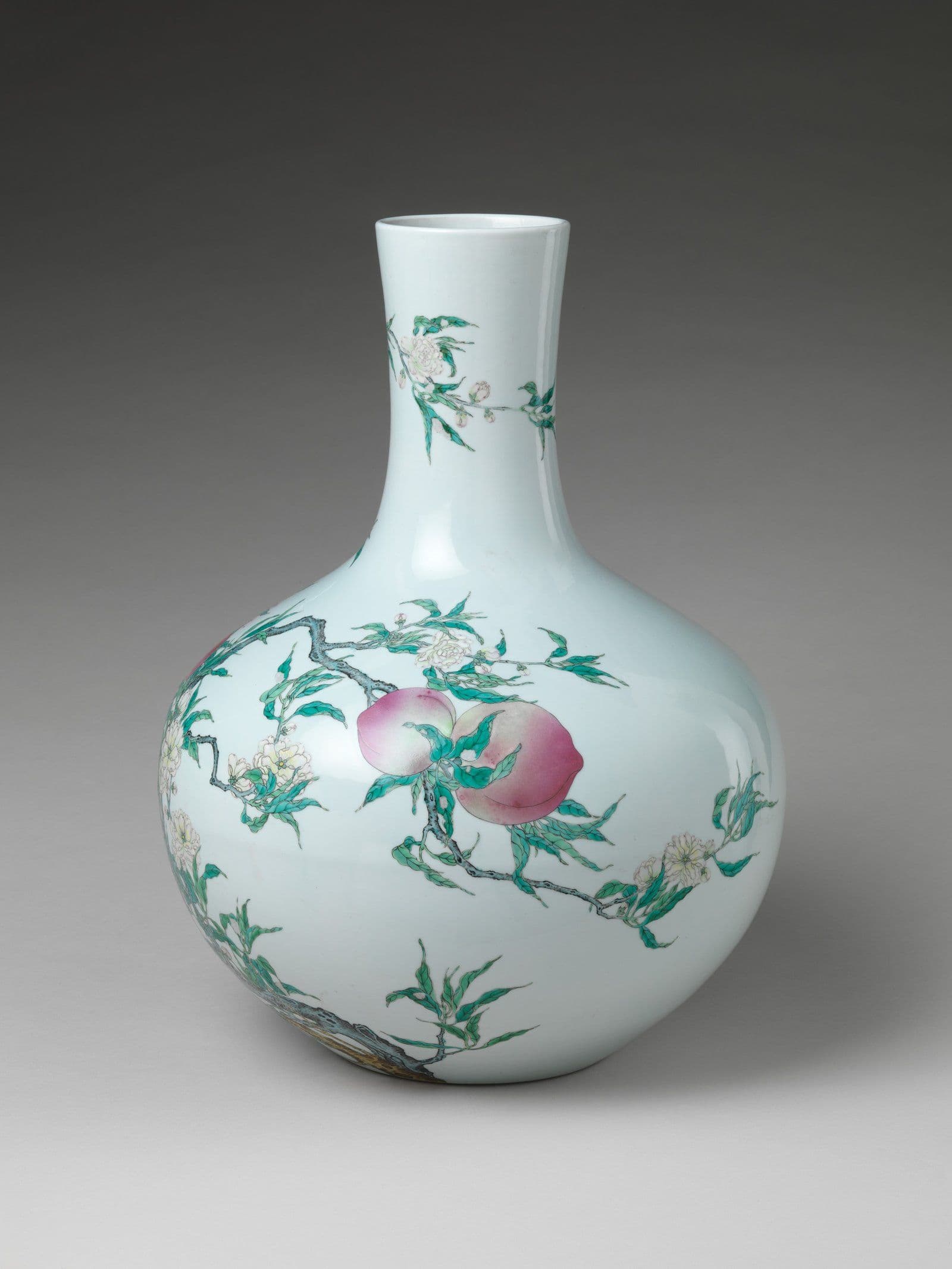
Daoguang signature on rebirth pieces: The "famille rose with peach decoration" pattern was extensively reproduced in the late 19th century — almost all Daoguang-marked famille rose pieces showing peaches are 1880s-1920s copies.
7. Xianfeng 咸丰 (1851-1861)
Mark: 大清咸丰年製 (6-char, rare)
Notes: Xianfeng's reign was disrupted by the Taiping Rebellion (1850-64), which destroyed the Jingdezhen kilns in 1853. Imperial porcelain output essentially halted. Authentic Xianfeng marks are extraordinarily rare — virtually all market pieces with this mark are later forgeries.
If you encounter a Xianfeng mark on what looks like a normal-quality vase, you're almost certainly looking at a Tongzhi or Guangxu piece dressed up.
8. Tongzhi 同治 (1862-1874)
Mark: 大清同治年製 (6-char) · 同治年製 (4-char) · 体和殿製 (Cixi's Tihe Hall mark, very desirable)
Notes: The Jingdezhen kilns were rebuilt in 1864 under Empress Dowager Cixi's patronage. Quality is uneven but distinctive — bright famille rose enamels, often with peach + bat (寿桃寿带) auspicious motifs. Marks are rendered confidently in iron red.
The 体和殿 (Ti He Dian) hall mark from Cixi's pavilion in the Forbidden City is a high-end collector's prize today, often outpricing equivalent reign-marked pieces.
9. Guangxu 光绪 (1875-1908)
Mark: 大清光绪年製 (6-char) · 光绪年製 (4-char)
Notes: Long reign with substantial output. Quality varies enormously: imperial pieces can rival Qianlong work, while bulk export pieces are mediocre. The vast majority of "Kangxi mark" reproductions on the antique market today are actually Guangxu-period homages — they were made openly as copies, not deceptions.
Guangxu's own mark is reasonably honest in pricing because it carries no false-attribution premium. Excellent value for new collectors.
10. Xuantong 宣统 (1909-1911)
Mark: 大清宣统年製 (6-char, rare)
Notes: Two-year reign before the Qing collapse. Imperial commissions were limited and short. Authentic Xuantong-marked imperial pieces are scarce and have collector value as the final dynastic period. The script is a continuation of late Guangxu style.
11. (Honorable mention) Hongwu 洪武 reverse marks
Some Qing-period pieces bear marks of earlier dynasties — 大明宣德年製 (Xuande), 大明成化年製 (Chenghua), 大明嘉靖年製 (Jiajing) — as apocryphal homage marks. These are NOT forgeries, they're tribute pieces. See: Apocryphal Marks.
Quick reference table
| # | Reign | Years | Common form | Quality | Notes ||---|---|---|---|---|---|| 1 | Shunzhi 顺治 | 1644-61 | 6-char rare | — | Mostly museum pieces; market = fakes || 2 | Kangxi 康熙 | 1662-1722 | 6-char in double circle | Top tier | Often signed Chenghua (apocryphal) || 3 | Yongzheng 雍正 | 1723-35 | 6-char or 4-char | Apex | Thinnest body, finest glaze || 4 | Qianlong 乾隆 | 1736-95 | 6-char + seal script | Top tier | Most copied of any reign || 5 | Jiaqing 嘉庆 | 1796-1820 | 6-char or seal | Decline begins | Hall marks appear || 6 | Daoguang 道光 | 1821-50 | 6-char + 慎德堂 hall | Variable | Famille rose peaches widely copied || 7 | Xianfeng 咸丰 | 1851-61 | rare | Disrupted | Kilns destroyed in Taiping || 8 | Tongzhi 同治 | 1862-74 | 6-char + 体和殿 hall | Recovery | Cixi rebuilds kilns || 9 | Guangxu 光绪 | 1875-1908 | 6-char common | Variable | Many "Kangxi" reproductions || 10 | Xuantong 宣统 | 1909-11 | rare | Collectible | Last Qing reign |
Apocryphal & hall marks you'll also see
In addition to the 11 reign marks above, Qing-period imperial and high-end commercial pieces frequently carry:
Apocryphal Ming marks — Xuande, Chenghua, Jiajing, Wanli — see our apocryphal marks article
Hall marks (堂名款) — 慎德堂 (Daoguang), 体和殿 (Tongzhi/Cixi), 大雅斋 (Cixi), 退思堂, 古月轩
Studio commissions — for prominent collectors and ministers
Auspicious phrases — 福 (fortune), 寿 (longevity), 永和 (eternal harmony) — common but not indicative of imperial origin
A "double circle without character" — just blank concentric rings — is also a known imperial Yongzheng-Qianlong convention indicating "withhold judgment, mark not assigned" status.
Common questions
Why are some Qing emperors more copied than others?
Three factors: prestige (Yongzheng + Qianlong = peaks), output volume (longer reigns = more genuine pieces to imitate), and aesthetic recognizability. Qianlong's seal-script square mark is the most copied because it's visually iconic and the period associates with imperial luxury.
How can I tell apocryphal from forgery?
Apocryphal = period potter knowingly using earlier reign mark as homage; openly disclosed and respected. Forgery = later piece pretending to be the reign claimed in the mark. The distinction is usually in the body/glaze: if the body matches the apocryphal-claim period (e.g., a Chenghua-marked piece with Kangxi body), it's apocryphal. If the body matches the forger's period, it's deception.
What's the easiest reign to authenticate?
Tongzhi and Guangxu — the marks are reasonably consistent, the bodies are recognizably 19th-century, and they don't carry the price premium that motivates aggressive forgery. Good entry-level reigns for new collectors.
What's the hardest?
Qianlong — both because of the volume of forgeries and because of the variety of legitimate styles (regular script + seal script + falangcai cartouches). Always get expert provenance documentation for any piece marketed as imperial Qianlong.
Are reign marks ever painted UPSIDE DOWN?
Yes, occasionally — and it's actually a sign of quickly-painted commercial output, not necessarily forgery. Imperial pieces have correctly oriented marks; provincial/export pieces sometimes show inversions or mirror-imaging because the painter copied without understanding the script. Period authentic but lower grade.
Further reading
Chinese Porcelain Marks: A 2026 Identification Guide — comprehensive overview
Reading Chinese Porcelain Marks: Step-by-Step Tutorial — how to read the script
Ming Dynasty Reign Marks Guide — the predecessors
Republic Period Porcelain Marks — what came after
Browse our Qing-style pieces
Chinese porcelain collection → — including Kangxi, Yongzheng, and Qianlong-style hand-painted reproductions, faithfully marked.
Explore Further