Published July 19, 2026
Langyao oxblood, peachbloom, flambé — the copper-red glaze family explained: how the color works, why it is so hard, and how collectors date and judge it.
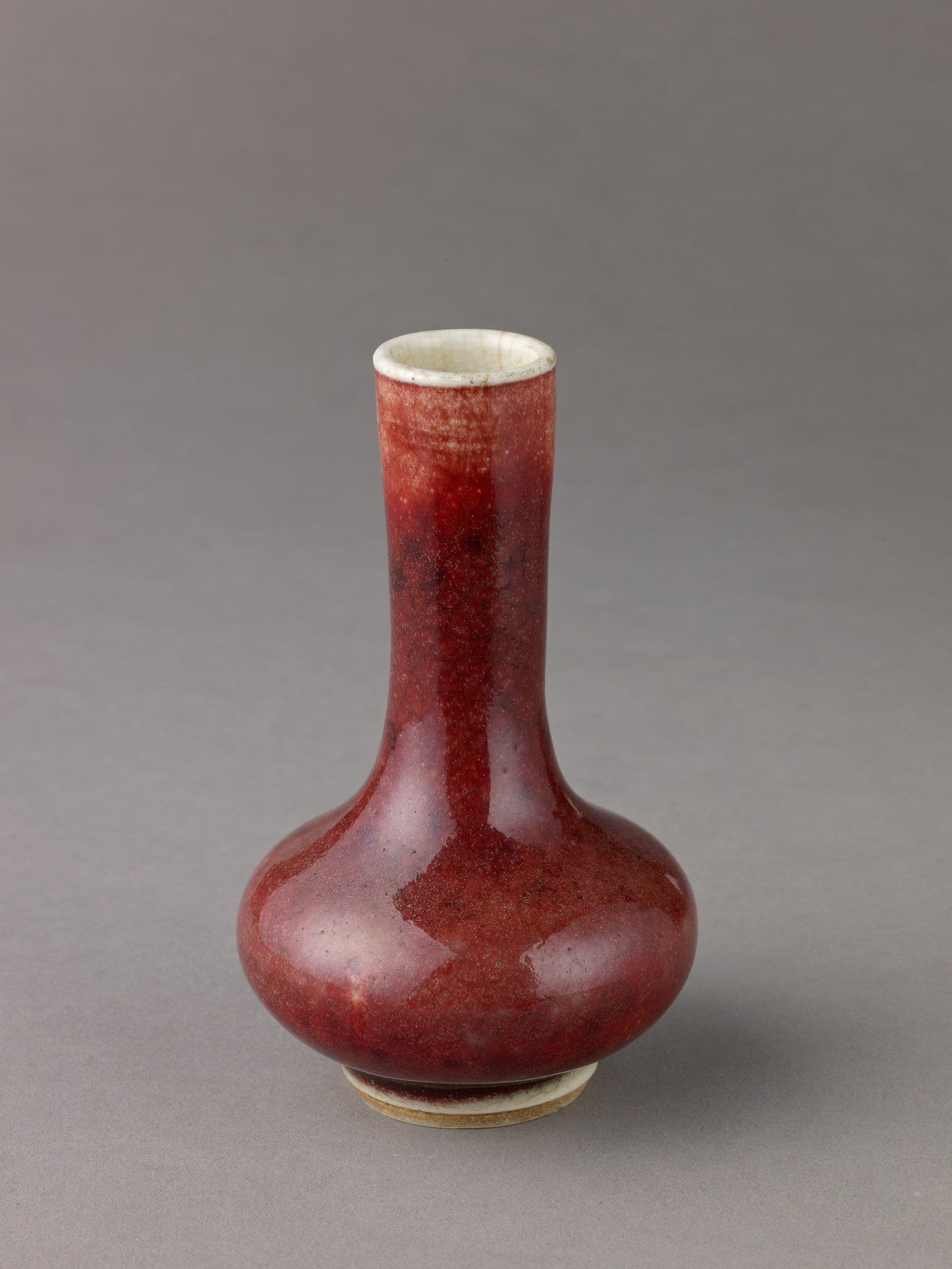
Set two red-glazed vessels side by side: one a deep, glassy oxblood vase the color of garnet, the other a small writing-table jar in soft pink dappled with green. They look like different traditions. They are the same colorant — copper — fired in the same city, and the distance between them is the story of the most temperamental glaze chemistry Jingdezhen ever mastered.
This guide explains why copper red is so difficult, walks through the family a collector actually meets — Ming sacrificial red, Kangxi langyao (sang-de-boeuf), peachbloom, underglaze red, and flambé — and lays out the practical checks that help you place and judge a red-glazed piece.
Why copper red is the hardest color
Most porcelain colorants are forgiving. Cobalt fires blue under almost any competent regime; iron gives its yellows and celadon greens across a wide window. Copper is the diva. To produce red, copper must be held in a reduced state — starved of oxygen — through a precise arc of the firing, at high temperature, in exactly the right concentration. Let oxygen back in at the wrong moment and the red burns away to gray, liver, or a ghostly celadon-green; fire slightly too hot and the color volatilizes entirely, leaving near-white.
The consequence was ruinous wastage. Even at the height of production, kilns discarded the majority of copper-red attempts, which is why genuine period pieces carry the prices they do, and why the color kept disappearing from the repertoire: when the accumulated kiln knowledge lapsed, nobody could simply look up the recipe. Within the broader family of Chinese monochrome glazes, copper red is the one where technique itself is the connoisseurship story.
The Ming benchmark: sacrificial red
Copper red matured early. Yuan and early Ming Jingdezhen produced underglaze copper-red painting alongside blue-and-white, and by the early fifteenth century the Xuande kilns had achieved the monochrome that later ages treated as the summit: the so-called sacrificial red, a saturated, slightly soft crimson developed for court and ritual use. In the Ming ritual color scheme, altar vessels were color-matched to their altars — red serving the Altar of the Sun as yellow served the Altar of Earth and blue the Altar of Heaven — so the glaze carried institutional weight from the beginning.
Then it vanished. By the middle of the Ming dynasty the technique was effectively lost, and the court fell back on low-fired iron-red substitutes for its ritual reds. For roughly a century and a half, nobody in China could reliably make a high-fired copper-red monochrome. That gap is worth remembering at market: a "Ming" copper-red monochrome claiming a mid- or late-Ming date is contradicting the production history.
Langyao: the Kangxi revival that Europe named
The revival came in the Kangxi period, and tradition ties it to Lang Tingji, the official who supervised the Jingdezhen kilns in the early eighteenth century — hence langyao, "Lang's kiln ware." Whatever the exact division of credit, the kilns under his era recovered and surpassed the lost art, producing the deep, glassy, faintly crackled red that French collectors later christened sang-de-boeuf and English ones oxblood.
A classic langyao vase has a recognizable anatomy. The color deepens as it descends — thin and pale at the lip, where the glaze runs off in firing to leave the famous "white lip," then gathering to a rich crushed-strawberry or oxblood depth over the body. The surface is glassy, with a fine crackle you often feel before you see. And at the base the glaze stops in a remarkably neat line just above the foot — the control celebrated in the old trade saying that langyao red never runs over the foot. Bases are typically finished in a crackled apple-green or buff wash, and — a point that surprises newcomers — genuine Kangxi langyao wares are normally unmarked. A six-character Kangxi mark on an oxblood vase is a reason for more suspicion, not less; the mark conventions of the period are covered in our Kangxi reign marks guide.
Peachbloom: the scholar's red
Peachbloom — jiangdouhong, "cowpea red" — is the same copper chemistry pulled in the opposite direction: not depth and drama but softness and intimacy. The glaze fires to a muted rose-pink, mottled with moss-green flecks and clouds where the copper re-oxidized in the kiln. What langyao would count as a flaw, peachbloom makes the point: the prized examples are the ones where the green sits in the pink like lichen on a peach.
Just as distinctive is what the glaze was allowed to cover. Peachbloom appears almost exclusively on a small, canonical group of Kangxi-period vessels for the scholar's desk — the celebrated set of eight small shapes that includes the beehive-form water pot, the radish and willow-leaf vases, the chrysanthemum vase, seal-paste boxes, and small washers. No massive vases, no dishes for the table: it was a connoisseur's glaze from birth, made for objects that live within arm's reach. Unlike langyao, genuine peachbloom pieces normally do carry the six-character Kangxi mark in underglaze blue.
Because the group is so codified and so valuable, it has been copied continuously — later Qing, Republic, and modern — usually betrayed by shape proportions, by a pink that is too even, or by green flecking that looks sprayed rather than grown.
Flambé and the wider copper family
The eighteenth century domesticated the diva. Yongzheng and Qianlong kilns, in their systematic recovery of classic glazes, learned to produce copper-red effects on demand — including the deliberately streaked and clouded transmutation glazes known as flambé (yaobian), in which copper reds and blues run in veined cascades in conscious homage to Song-dynasty Jun ware. What had been a kiln accident became a controllable style, and flambé wares continued through the nineteenth century in quantity.
Alongside the monochromes, underglaze copper-red painting returned as well, often paired with underglaze blue. And the reds of later reigns each have their own cast — generally more even, more opaque, and less alive than the Kangxi benchmark, which is precisely how specialists begin separating them.
Reading a copper-red piece in the hand
Start with tone and life. A Kangxi langyao red has depth and variation — the color seems suspended in the glass, changing with the light and darkening down the body. Later and modern reds tend toward flat, even opacity. Pale lip, gathering depth, crackle you can feel: all consistent with the classic profile.
Then the foot, which does the most work in this category. Check where and how the glaze stops: the neat controlled line above the foot on langyao, against clumsy grinding where an overrun glaze had to be wheeled off — common on later copies. Look at the base wash and its crackle, and read the foot rim itself; the profile and finish carry period information of their own, as covered in our guide to dating porcelain from the foot rim.
Finally the mark logic — which here is mostly the logic of absence. Unmarked langyao is normal; a marked one needs explaining. Marked peachbloom is normal; an unmarked one needs explaining. And any reign mark should be tested on its own merits against the standard references, starting from our master guide to Chinese porcelain marks, because copper red's prestige has attracted apocryphal marks for three centuries.
Common questions
What is the difference between oxblood and sang-de-boeuf?
None — they are the English and French names for the same Kangxi-type langyao glaze, coined by nineteenth-century Western collectors. Chinese sources say langyao or langyao hong. All three terms describe the deep, glassy, crackled copper red with the pale lip and the controlled foot line.
Why are peachbloom pieces all so small?
The glaze was reserved for a codified set of scholar's-desk objects — water pots, small vases, seal boxes, washers — made for the Kangxi court and its literati taste. The effect itself also favors small surfaces: the pink-and-green mottling reads as subtlety at hand scale and as blotchiness on a large vase. Big "peachbloom" vessels are essentially always later pastiches.
Is underglaze red the same as a copper-red glaze?
Same colorant, different application. Underglaze red is copper painted in designs on the body and covered with clear glaze, parallel to blue-and-white; a copper-red glaze colors the entire covering glaze itself. Both share the firing risks — early underglaze red frequently fired gray or silvery where reduction faltered, which is itself a period characteristic collectors learn to read.
How can I tell a modern langyao copy?
Modern Jingdezhen reproduces every glaze in this family, often competently. The tells are usually cumulative rather than single: a red that is even and opaque rather than deep and variable, crackle that is absent or theatrically strong, a glaze line at the foot that was ground rather than controlled, an unworn base wash, and a piece that is suspiciously perfect overall. Weight and potting matter too. When several signals disagree with the claimed age, believe the signals.
Further reading
- Imperial Yellow: The Most Regulated Color in Chinese Porcelain — the other color the court controlled, with its own rank system.
- Longquan Celadon: A Collector's Guide to the Green Glaze That Conquered the World — iron chemistry's masterpiece, and copper red's calm opposite.
- Ge Ware and Crackle Glazes: Reading the Cracks in Chinese Ceramics — how to judge crackle when the crackle is the point.
- Dehua Blanc de Chine: A Collector's Guide to Chinese White Porcelain — the white end of the monochrome spectrum.
Browse the collection
We do not sell ceramics. The Kiln & Ink collection is limited-edition archival giclée reproductions of Qi Baishi, Xu Beihong, Wu Guanzhong, Zhang Daqian and their contemporaries — hand-numbered, printed on rice paper, and supplied with a Certificate of Authenticity.
Explore Further