Published August 7, 2026
Gongshi are Chinese scholar's rocks: what they are, Lingbi against Taihu stone, the four criteria collectors judge by, and how to spot a worked stone.
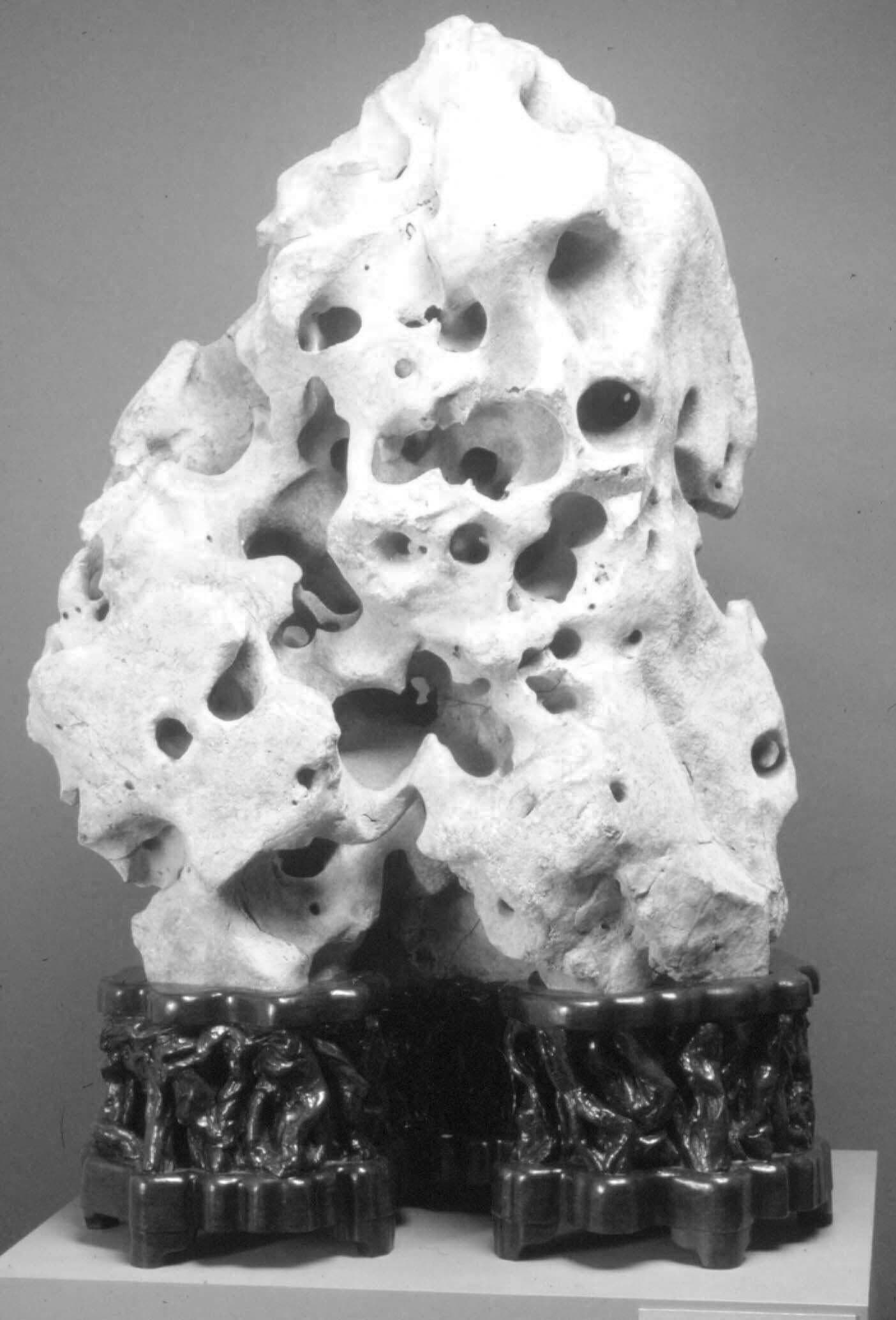
The object is a piece of limestone about the height of a wine bottle, dark grey, deeply eroded, standing upright in a fitted wooden base. Nobody carved it into that shape. Somebody found it, judged it, cut the bottom flat so it would stand, had a stand made to hold it at exactly that angle, and put it on a desk — and for the next several hundred years other people agreed that this was worth doing.
Scholar's rocks, gongshi in Chinese, are among the least explained objects in the Chinese decorative arts and among the easiest to misjudge in the market. This guide covers what they are, the classic stone types, the criteria by which they were traditionally judged, what the stand contributes, and how to sort an old stone from a recent one.
What a scholar's rock is for
The Chinese scholar's studio was a curated environment. Alongside the brush, ink, paper and inkstone — the four treasures of the study — a desk might hold a brush rest, a water dropper, a censer, and a stone. The stone was not ornament in the Western sense. It was a landscape in miniature, a mountain range small enough to sit at eye level, and looking at it was understood as a form of mental travel available without leaving the room.
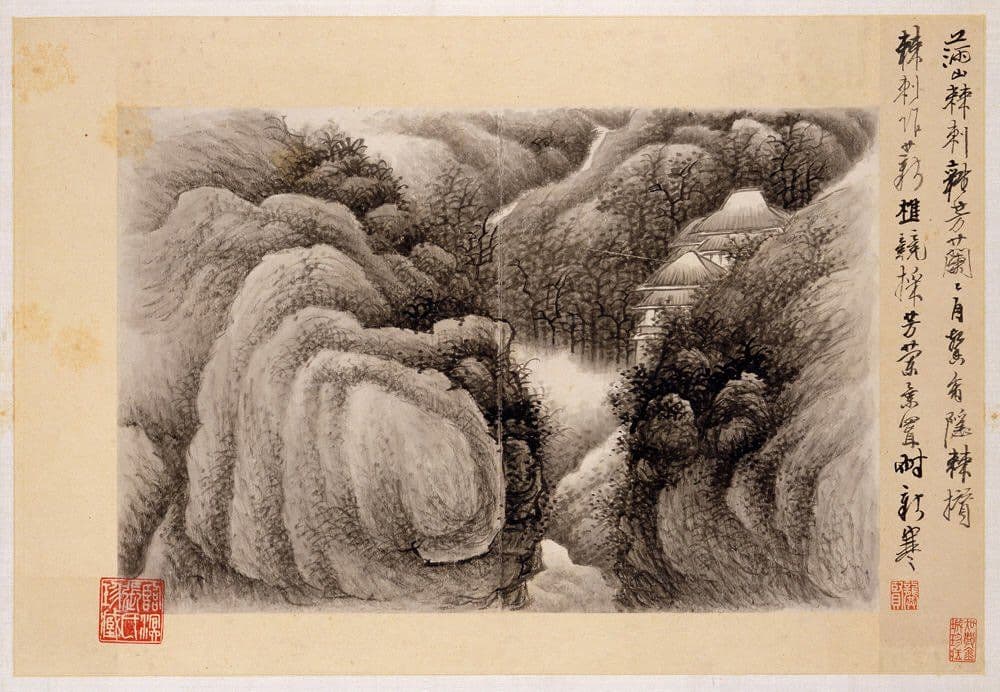
That idea connects directly to painting. The same literati who kept rocks painted them, and the strange perforated forms in Chinese landscape painting are not stylisation so much as observation of objects like these. Our comparison of literati and court painting explains the milieu; the rocks are that milieu made physical.
There is a well-known story about the Song dynasty painter and calligrapher Mi Fu (1051–1107), who is said to have dressed formally to greet a particularly fine rock and addressed it as his elder brother. Whether or not it happened, the anecdote survived because it captured something real about how these objects were treated.
The four classic stone types
Chinese connoisseurship recognises a small group of named stones, defined by where they come from and how they behave.
| Stone | Source | Character ||---|---|---|| Lingbi | Anhui province | Dark grey to black limestone, hard, often with a resonant ring when struck || Taihu | Lake Tai, Jiangsu | Pale water-eroded limestone, riddled with holes and channels; also the great garden rock || Ying | Yingde, Guangdong | Dark, sharply ridged and craggy, often tall and narrow || Kun | Kunshan, Jiangsu | White, crystalline, intricate and brittle, quite unlike the others |
Lingbi and Taihu are the two you are most likely to be offered. Taihu stones were dredged from the lake, where circulating water and sediment hollowed them over long periods, and their perforations are the reason the type became the standard rock of the Suzhou garden. Lingbi stones are denser and quieter in colour, and their acoustic quality was prized — struck stone was historically used for chimes.
Beyond these four there are many regional stones, including patterned "picture" stones cut and polished to reveal landscape-like markings in the section. Those are a distinct taste and a distinct market, and they should not be conflated with the upright eroded stone that gongshi normally refers to.
How a stone is judged
The classic criteria are traditionally traced to Mi Fu and reduce to four words.
- Shou — thinness. The stone should be slender rather than blocky, with a sense of upward reach. Bulk is not a virtue.
- Zhou — wrinkling. The surface should be furrowed and folded, with texture that repays close looking, rather than smooth.
- Lou — channels. Passages should run through the interior, so that the stone is not solid but riddled.
- Tou — openness. Holes should pass right through, letting light and air move across the form. A stone you can see through is doing something a solid one cannot.
To these, connoisseurs added considerations that are harder to reduce to single words: whether the stone reads convincingly as a mountain from more than one side, whether it has a clear front, whether its proportions hold at the scale it is displayed, and whether its colour and surface look weathered rather than worked.
None of this is a checklist to be scored. The four terms are a vocabulary for describing what your eye is already doing, which is deciding whether an inert lump of rock has presence.
The stand is part of the object
Almost every serious stone sits in a carved hardwood base cut to fit its irregular underside. The stand does three things: it holds the stone at the angle its finder judged best, it hides the sawn base, and it declares that this is an object of contemplation rather than a rock.
For a collector, the stand is also evidence. Signs worth reading:
- Fit. An old stand made for its stone will meet the rock's contours closely, with no gaps stuffed with filler and no visible modern adhesive. A stone sitting loosely in a base that nearly fits has probably been married to it recently.
- Wood and wear. Old hardwood stands show consistent patina, shrinkage cracks, and wear on the feet. A crisp new stand under a supposedly old stone is not damning on its own — stands do get replaced — but it removes a piece of supporting evidence.
- Design. The best stands are restrained: low, with feet and a shaped apron that echo the rock without competing. Overelaborate carving usually indicates a later commercial stand.
The relationship between stone and stand is the closest thing scholar's rocks have to a mount, and it deserves the same scrutiny a collector of works on paper gives to a scroll mounting.
Old stone or new? What to look at
Scholar's rocks are unusually difficult to date, because the object itself is geological and the human contribution is mostly selection. There is no reign mark, no signature, and no material analysis that will tell you when a stone was picked up. What you can assess is whether it was worked, and how it has been treated.
Look for tool marks. Run a light raking across the surface. Genuine erosion produces soft, irregular, directionally coherent texture. Chiselling, grinding and drilling produce marks that repeat, that follow a hand rather than water, and that often cluster where a hole was "improved". Drilled perforations are typically rounder in section and more uniform in diameter than natural channels.
Check for acid. Artificially eroded stones — limestone attacked with acid to fake weathering — tend to have an even, slightly frosted, uniformly pitted surface with none of the variation in hardness that natural weathering exposes.
Check the base cut. The underside is normally sawn flat. A modern diamond saw leaves a very different surface from an older cut, and the base is the one place where nobody bothers to disguise anything.
Check for joins and fills. Broken projections are often reattached. Look at transitions in colour and texture, especially at narrow points, and look for a sudden change in surface character.
Be sceptical of stated age. Sellers will describe stones as Ming or Qing with a confidence the evidence rarely supports. Honest cataloguing tends to describe the stone type, the stand, and any documented collection history, and to leave the geology alone. Where there is a collection history, treat it the way you would any other provenance documentation: as evidence to be weighed, not a certificate.
None of this makes a recent stone a bad object. A well-chosen contemporary Lingbi in a good stand is an honest thing to own, and it costs what an honest thing should cost. The problem is only ever the gap between what is claimed and what is there — the same principle we apply to jade carving, another category where age claims routinely outrun the evidence.
Living with one
A stone needs a plinth, a shelf, or a table where it can be seen from more than one side and lit from an angle. Flat frontal light kills it; raking light from one side is what makes the furrowing read. Give it space — a rock crowded by other objects becomes an object rather than a landscape.
Handle it by the mass, not by projections, which snap. Dust it dry with a soft brush; do not oil or wax it, and do not wash it, since water can carry dirt into channels where it will stay. Keep it out of freeze-thaw conditions if the stone is porous.
Displayed properly, a scholar's rock does something few other objects manage: it changes with the hour, because the shadows inside it move. That is most of the reason people have kept them on desks for a thousand years.
The taste is not confined to stones. The same appreciation for irregular natural form runs through the flower-and-rock paintings of Wu Changshuo, where a rugged rock frequently anchors the composition and the flowers grow out of it — his flower studies show how directly the studio object fed the brush.
Common questions
Are scholar's rocks carved at all?
Traditionally, the ideal is that they are not — the point is that nature produced the form and a connoisseur recognised it. In practice, minor adjustment has a long history: the base is always cut, and a projecting element that spoils the silhouette may be trimmed. What the market penalises is substantial reshaping, particularly drilled or ground holes made to satisfy the criteria of perforation and openness.
How can I tell Lingbi from Taihu?
Colour and weight are the fastest cues. Lingbi is dark grey to near-black, dense, and often rings when struck with a knuckle. Taihu is paler, greyish-white to buff, more visibly honeycombed with through-holes, and generally lighter for its size. Ying stone is dark like Lingbi but craggier and more angular, with sharp ridges rather than rounded folds.
Do scholar's rocks have to be small?
No. The same aesthetic operates at two scales: desk-sized stones for the studio, and very large garden rocks set upright in courtyards, which is what most Taihu stone was used for. Chinese gardens treated the large rock as sculpture, and the desk stone as its portable equivalent. Collectors in the West almost always encounter the desk scale.
Is there a reliable way to date one?
Not from the stone itself. Dating rests on the stand, on any inscription or collection marks associated with it, and on documented ownership history. Where a seller offers a firm dynasty attribution with none of those supports, treat the date as an opinion rather than a fact and price accordingly.
Further reading
- Chinese Rubbings and Stone Inscriptions — another scholarly art built on stone.
- Collecting Chinese Carved Lacquer — a neighbouring category where age claims outrun the evidence.
- Shiwan Pottery of Guangdong — figures made for the same scholar's-desk instinct.
- How to Collect Chinese Art — the general framework, if you are starting out.
Browse the collection
Stones are a subject we write about rather than one we stock. What Kiln & Ink sells is limited-edition archival giclée reproductions of the twentieth-century Chinese ink masters — fifteen artists, printed on rice (xuan) paper or museum-grade cotton rag, hand-numbered, and issued with a Certificate of Authenticity.
Explore Further