Published August 4, 2026
Chinese jade carving explained: nephrite against jadeite, why jade is abraded rather than cut, the motifs to know, and the treatments that set price.
Pick up a good piece of Chinese jade and the first surprise is the weight. It sits heavier in the hand than glass or marble of the same size, and it warms slowly rather than instantly. That density is not decoration — it is the physical property that made the material worth the enormous labour of working it, for roughly five thousand years, with abrasive sand rather than a blade.
This guide covers the two very different stones both sold as "jade", how carving was actually done, the forms and motifs you will meet in the market, the treatments that determine value today, and how to look after a piece once it is yours.
Nephrite and jadeite are not the same stone
Almost every problem in jade collecting starts here.
Nephrite is the historic Chinese jade. It is a fibrous, interlocking silicate — the tremolite-actinolite series — and that interlocking structure makes it extraordinarily tough, meaning resistant to breaking rather than resistant to scratching. It runs about 6 to 6.5 on the Mohs hardness scale with a specific gravity in the region of 2.9 to 3.0. Colours range from near-white through celadon and spinach green to dark, almost black tones, with browns and russets where the outer skin has weathered. The most prized historic material is the white nephrite from the Khotan (Hetian) region of Xinjiang, and the finest grade of that white is described as mutton-fat jade for its slightly oily surface quality.
Jadeite — feicui in Chinese — is a different mineral entirely, sourced principally from Myanmar. It is slightly harder, roughly 6.5 to 7, and noticeably denser, with a specific gravity around 3.3. It takes a brighter, more glassy polish and occurs in the vivid emerald greens, lavenders and near-transparent whites that dominate the modern jewellery market. It arrived in China in commercial quantity comparatively late — the Qing dynasty, with strong imperial taste for it developing in the eighteenth century.
So a Neolithic ritual disc and a twentieth-century bangle can both be called jade and share almost nothing. When a listing simply says "jade", the first question is which mineral, and the second is who determined that.
How jade is actually worked
Jade is not carved in the way wood or even marble is carved. Steel will not cut it. The material is shaped by abrasion: a rotating tool — historically a treadle-driven disc or a bow-driven drill — carries an abrasive slurry against the stone, and the abrasive does the cutting. Quartz sand, crushed garnet and corundum were used historically; modern workshops use diamond and silicon carbide.
The consequences are visible on the object, and they are useful to you.
- Time. A significant Qing carving represented months or years of work. That is why jade was an imperial and scholarly material rather than a common one.
- Tool marks. Under magnification, old work often shows the slightly irregular, wandering grooves left by hand-fed abrasion. Modern high-speed rotary work tends to leave more uniform, cleanly parallel marks and sharper internal angles.
- Design logic. Skilled carvers worked with the boulder — using a russet skin as a bat's wing or a fish's back, a paler zone as a cloud. This is called skin-colour carving, and clever use of the natural colouring is one of the clearest markers of quality.
The same "work with the material" instinct runs through the Chinese decorative arts generally — it is the same thinking you see in Chinese carved lacquer, where the depth of the cut is dictated by how many layers were built up first.
Forms and motifs you will meet
Jade has carried meaning as well as value, and the shapes are conventional rather than arbitrary.
- Bi discs and cong tubes — flat perforated discs and squared tubes with a circular bore, made in quantity in the Neolithic Liangzhu culture and revived repeatedly in later periods as archaistic forms.
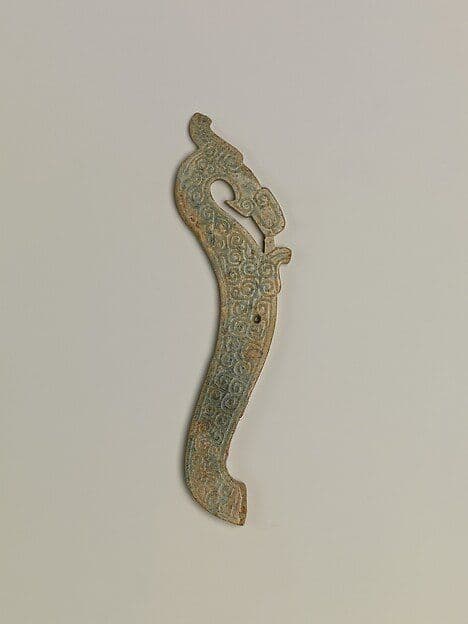
- Pendants and plaques worn at the belt, often carved with dragons, phoenixes or interlaced scrollwork.
- Brush washers, brush rests, table screens and scholars' objects — the desk material of the literate class, alongside the ink, stone, paper and brush covered in our guide to the four treasures of the scholar's studio.
- Snuff bottles, an enormous and well-documented Qing category in their own right; many of the finest are jade, and the collecting conventions are set out in our snuff bottle collector's guide.
- Vessels and archaistic bronzes translated into stone — Qianlong-era workshops in particular produced jade versions of ancient bronze shapes.
- Bangles and cabochons, the modern jadeite jewellery market, valued mainly on colour, translucency and texture rather than carving.
Motifs are usually auspicious and often punning: bats for happiness, gourds for fertility and lineage, lingzhi fungus and peaches for longevity, carp for abundance, and mythical composites such as the pixiu. Reading them is a large part of dating and understanding a piece.
Treatments, and why they decide the price
This is the single most commercially important thing to understand about jadeite in particular. The trade uses a lettered shorthand:
- A jade — natural. Cut and polished only, with no chemical bleaching, impregnation or dyeing. Wax on the surface is generally accepted.
- B jade — bleached with acid to remove brown iron staining, then impregnated with polymer resin to restore integrity. It looks better and is structurally compromised; the resin can yellow and degrade.
- C jade — dyed to add or intensify colour.
- B+C — both.
The visual difference can be very hard to see. The reliable answer is a report from an independent gemmological laboratory, which can detect polymer and dye through spectroscopy. For anything at a serious price, the cost of that report is trivial against the risk.
Two further categories are worth knowing. Serpentine, quartzite and glass are all sold as jade substitutes, sometimes innocently under regional trade names. And archaistic jade — new carvings made deliberately in ancient styles — has been produced continuously for centuries; a Qing carving of a Han-style dragon is a legitimate object with its own value, and only becomes a problem when it is sold as Han.
Buying, and what documentation should look like
Apply the same evidence standard you would to a painting. A named source, a dated invoice, prior ownership, and where relevant a laboratory report. Attribution to a dynasty on a label, with nothing behind it, is an opinion offered by someone with an interest in the outcome.
Auction remains the most transparent route for anything significant, because condition reports and estimates are published and results are recorded — the mechanics are covered in how to buy Chinese art at auction. Be sceptical of any account of an object's history that cannot be checked, and be especially sceptical when a very early date is combined with a very low price.
Living with jade
Jade is tough but not indestructible, and treated material is fragile.
- Keep pieces away from harder stones in storage; a diamond or corundum-set ring will scratch jade. Line boxes with soft cloth.
- Avoid sudden temperature change. Rapid heating or cooling stresses stone that may already have internal fractures.
- Do not use ultrasonic or steam cleaners, particularly on anything that may be impregnated or has been repaired. Warm water, a soft brush and a mild soap is sufficient.
- Avoid household chemicals, perfume and prolonged strong sunlight on dyed material, which can fade.
- If a piece has an old silk cord or fitted stand, keep them. Fittings are part of the object's history and are frequently discarded.
Common questions
How can I tell nephrite from jadeite without a laboratory?
Imperfectly, but there are indicators. Jadeite generally feels denser for its size, takes a brighter glassy polish, and under magnification often shows a slightly granular, sugary structure. Nephrite has a softer, waxier lustre and a fibrous, felted texture. Colour is not a reliable guide — both occur in green and white. If the value of the decision is significant, test it properly rather than relying on feel.
Does a scratch test tell me anything useful?
Not enough to justify the damage. A steel blade will not scratch either jade, which distinguishes true jade from softer substitutes such as serpentine — but it does not separate nephrite from jadeite, and it can mark the polish. Non-destructive testing exists and is inexpensive.
Is antique jade a better investment than modern carving?
They are different propositions. Antique jade is valued on age, rarity, quality of working and provenance, and it carries authentication risk. Fine modern carving in top-grade natural material is valued mainly on the stone itself and on the carver's skill, with far less attribution risk. Neither is a reliable investment; buy the object you want to keep.
Why do prices for apparently similar green bangles vary so widely?
Because the variables are invisible to an untrained eye: whether the material is natural or impregnated, the evenness and saturation of colour, translucency, texture fineness, and the absence of fractures. Two bangles that photograph identically can differ by orders of magnitude on those points. This is the category where a laboratory report matters most.
Further reading
- Chinese Snuff Bottles: A Collector's Guide — the best-documented small-scale jade category.
- Chinese Carved Lacquer: A Collecting Guide — another material where labour and layering set the value.
- The Four Treasures of the Scholar's Studio — the desk context many jade objects belong to.
- How to Buy Chinese Art at Auction — condition reports, estimates and what the paperwork should say.
Browse our collection
Kiln & Ink deals in works on paper rather than worked stone, but the same standards of documentation and condition apply throughout. Browse the full collection of modern Chinese master prints.
Explore Further