Published October 5, 2026
Yaozhou celadon is carved olive-green stoneware: how knife and glaze make the design, how to judge a bowl from cuts and foot, and how to spot copies.
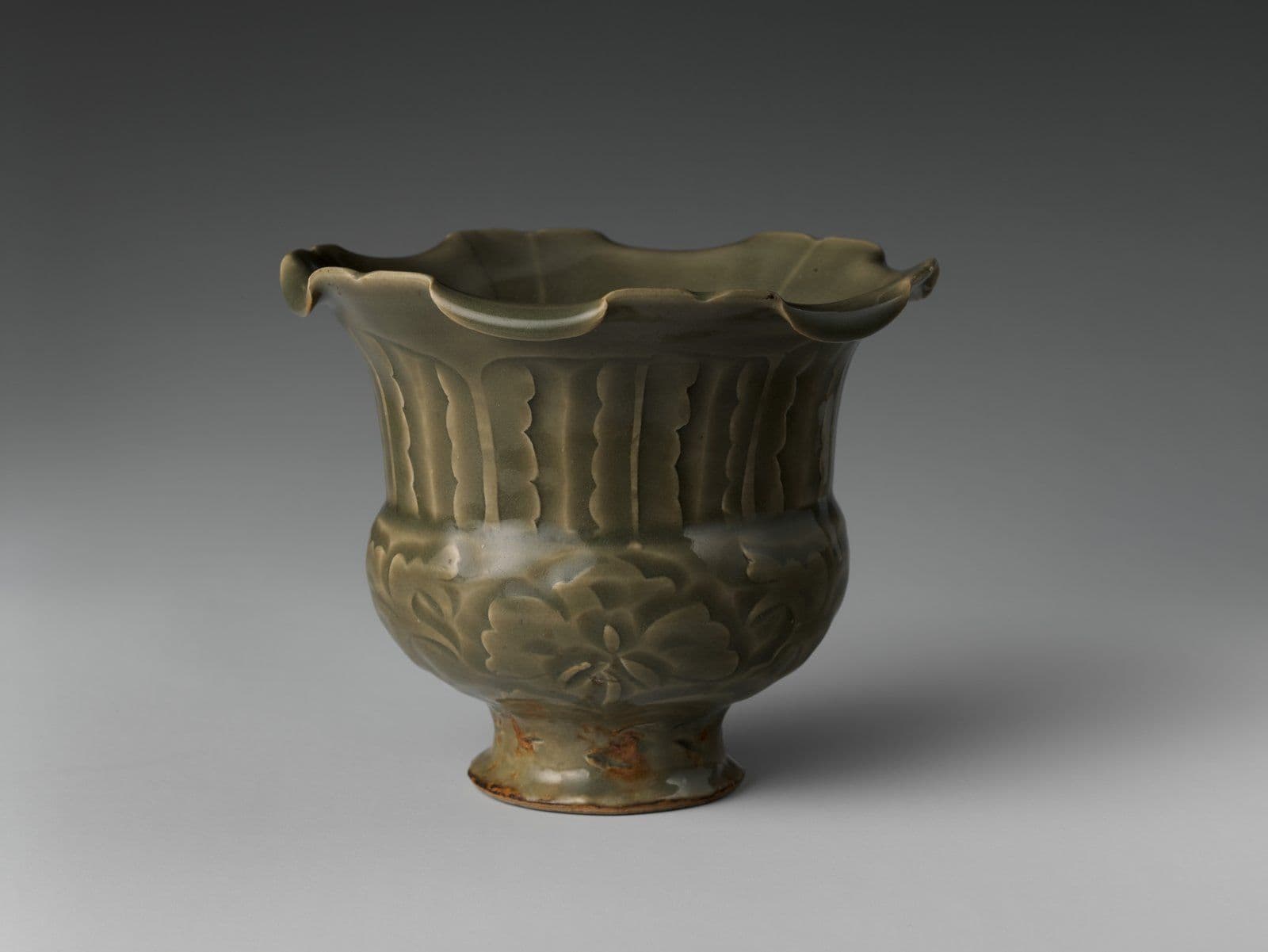
Set a Yaozhou bowl on a table and walk a step to the side. The carved peony on the interior wall stops being a pattern and becomes a landscape: the knife travelled through the wet clay in one continuous gesture, the glaze gathered darker in the cut, and the flower now reads as relief rather than drawing. That is the whole experience of Yaozhou celadon in one move. The ware is not admired for a painting applied on top of a surface; it is admired for a surface carved into clay and then flooded with a green glaze that knows how to pool.
This guide walks you through what Yaozhou ware is and where it was made; how the carving, combing and glazing actually work; how the olive-green glaze behaves and why it looks the way it does; how to judge a piece from the foot ring and the cut lines rather than from the overall impression; how to separate it from related northern greenwares and from later revivals; and what to check before you buy.
What Yaozhou ware is
Yaozhou celadon is the olive-green carved stoneware produced at the kilns around Huangbao, near Tongchuan in northern Shaanxi. It is a northern greenware, not a southern one: the clay body is greyish, the glaze is a warm olive rather than the cool blue-green of later southern celadons, and the decoration is cut into the clay body itself. Production reached its height in the Northern Song, when the kilns were supplying both everyday tables and a wider trade.
The standard pieces are the ones you meet first: bowls, dishes, plates, ewers, pillows, small vases and covered boxes. They are not precious court objects in the way a single-imperial-commission piece might be; they are well-made wares from a serious production centre, and their quality is consistent in a way that rewards close looking. That is what makes them a good field for a collector who wants to learn how to judge greenware from physical evidence rather than from labels.
How the carving actually works
Yaozhou decoration is cut into leather-hard clay before glazing. The carver's knife — not a brush — is the primary tool. The quality of a piece is decided here, before any glaze has been applied.
- One-stroke fluidity. Good peony and lotus carving looks as if the knife moved once per petal or leaf. The lines taper naturally as the blade lifts. Stiff, repeated, overworked lines with retraced edges are a weaker hand, or a mould-made piece pretending to be carved.
- Combing (huaji, "comb scratching"). Fine parallel lines are dragged through wet clay to suggest grasses, feathering, water and hair. On good pieces the combed lines are parallel without being mechanical, and they change spacing where the form turns.
- Depth against the glaze. The cut must be deep enough for the glaze to pool in it and darken the design, but not so deep that the wall is weakened. Look at a bowl in transmitted light: the carved area should show a consistent thickness of wall.
- Design layout. Northern Song Yaozhou pieces are usually designed for the interior of a bowl or dish: a central medallion and a band of carving around the wall. The design is meant to be read from above, over a meal or a tea.
The olive-green glaze
The glaze is what gives Yaozhou its identity. It is an iron-bearing glaze fired in a reducing or partially reducing atmosphere, and it comes out warm olive-green to yellow-green rather than blue-green. In the cut lines the glaze thickens and darkens; on the raised ridges it thins and goes browner where the body shows through. That contrast is the design.
- Pooling is the picture. On a good piece the carved peony or fish is legible only because the glaze is darker in the cuts. If the carving looks flat and the glaze is an even colour across the design, the glaze has been applied too thickly or the cut is too shallow.
- Colour range. Genuine period pieces span olive, yellow-green and a slightly brownish-green. A pure bright green, or a cold blue-green, is not the usual Yaozhou answer.
- Surface quality. The glaze is glossy but not glassy-slick, with a soft sheen that responds to raking light. Very high gloss, or a dry matte surface, is either a different ware or a modern surface treatment.
- Bubbles and wear. Under magnification the glaze shows a population of small bubbles and a pattern of fine wear consistent with use. The pattern should look grown rather than applied.
Three moves in its history
Yaozhou greenware has a long pre-history in northern China, but the carved olive-green ware that collectors mean is a Northern Song achievement. The kilns were large, organised and commercially minded, and their wares travelled. In the twelfth century, political disruption and the shift of kiln activity south changed the picture. Jin dynasty Yaozhou continues the types but the carving often loosens, the glaze shifts, and the production becomes more routine. Later revivals and modern copies take the motifs without always taking the cut.
What that means practically is that dating is done from the combination of cut, glaze and foot rather than from the subject matter alone. A peony scroll is not a date. The way the knife turned through the leaf, and the way the glaze sat in the cut, are.
Judging a piece from the foot and the cut
Turn the bowl over before you fall in love with the flower.
- Foot ring and firing traces. Yaozhou pieces typically have an unglazed foot ring, with the body showing a warm orange-brown to grey tone where it was exposed to the kiln atmosphere. The ring should look cut, not moulded smooth; the junction of glaze and foot should be a clean stop, not a drip of green running over the edge.
- Wall thickness and weight. Northern Song Yaozhou is carefully potted: light enough to handle, thick enough to survive the carving. A heavy, clumsy foot with a thick wall often means a later piece or a different kiln.
- Carving confidence at the rim. Weak pieces fall apart at the edges: the carving becomes hesitant where the wall curves up, and the rim decoration is a filler band. Good pieces stay confident from centre to rim.
- Interior vs exterior. Much of the design lives on the interior of bowls and dishes. If the exterior is plain and the interior is richly carved, that is normal. If both sides are busy with no clear focus, the piece may be a composite of styles.
Related wares and how they differ
Northern greenware sits inside a larger family, and the differences are material rather than stylistic. Yue-type greenwares from Zhejiang are earlier and greyer-green, with less reliance on deep carving and more on incised or applied decoration. Longquan celadon, especially the Southern Song product, is a cool blue-green with a thicker glaze and a different potting tradition. The broader family of Chinese monochrome glazes is the frame to keep in mind here. Modern replicas of Yaozhou often get the motifs right and the glaze wrong: either too even, too blue, or too thickly applied so the design flattens out.
If you are building a small greenware group, keeping one good Yaozhou bowl beside one good southern celadon is the fastest way to teach your eye the glaze difference. The subject matter overlaps constantly; the colour temperature and the behaviour of the glaze in the cuts do not.
What to check before buying
- Carving first, then glaze. Judge the cut under good light before you judge the colour. A mediocre glaze over a superb cut is a more interesting object than a beautiful glaze over a shallow pattern.
- Glaze pooling in the cuts. The design should darken where the knife went deeper. Uniform colour across the carving is a warning.
- Foot and body colour. The unglazed foot should show a plausible stoneware body with firing traces. A perfectly clean or vividly painted foot is a modern answer.
- Condition and repair. Chips at the rim and foot, hairlines and old fills are common on used wares; the foot rim dating tests and a careful look at glaze bubbles and wear will carry most of the work. A professional restoration can be acceptable; an undocumented one is not. Raking light and magnification at the rim will show fill lines and colour retouching.
- Too-good motifs. The most commonly copied Yaozhou designs are the peony scroll, the fish among waves and the children among foliage. Popularity is not evidence of age. Judge the knife work.
Common questions
What is Yaozhou celadon made of?
It is a carved stoneware with an iron-bearing green glaze, made from a greyish northern clay body and fired at high temperature. The decoration is cut into the leather-hard clay before glazing, and the glaze pools in the cuts to make the design visible. The colour is warm olive-green rather than the cool blue-green of later southern celadons.
How can I tell Yaozhou from Longquan celadon?
Glaze colour and decoration method are the fastest tests. Yaozhou is olive-green with design cut or combed into the clay body under a relatively thin glaze. Longquan, especially the Southern Song product, is a cooler blue-green with a thicker glaze and a different potting feel. Side by side, the difference is obvious; in isolation, look at whether the decoration is carved into clay or formed in the glaze itself.
Why does the design look darker than the background?
The glaze is thicker in the carved lines than on the raised surfaces. More glaze means more colour, so the cuts go darker and the ridges go browner or lighter. That pooling is not an accident or a stain; it is the mechanism that makes the carving legible. If the design is not darker than the field, the cut is too shallow or the glaze is too even.
Are Jin dynasty Yaozhou pieces worth collecting?
They are collectable and often more affordable than Northern Song work, but the carving frequently loosens and the glaze shifts. Judge each piece on its own knife work and foot rather than on the dynasty label. A fine Jin piece is a better buy than a weak Northern Song attribution.
What should I look at first when judging a piece?
The carving, then the glaze in the cuts, then the foot ring. Subject matter, size and overall prettiness come later. Yaozhou is a knife-and-glaze ware; if those two do not convince you, nothing else about the piece will hold up.
Further reading
- Chinese Monochrome Glazes Collector Guide — how green glazes fit into the wider monochrome tradition.
- Chinese Porcelain Foot Rim Dating — why the foot is the first place to look.
- Chinese Porcelain Glaze Bubbles Wear Dating — reading age in the glaze surface.
- Chinese Porcelain Authentication Checklist — a broader list of physical tests.
Browse the collection
Kiln & Ink sells limited-edition archival giclée reproductions of twentieth-century Chinese ink masters, hand-numbered and supplied with a Certificate of Authenticity. Yaozhou celadon is a subject we write about rather than one we stock; if you want painting on your walls rather than carved clay on your shelves, the collections page is where to start.
Explore Further