Published January 25, 2026
Zhang Daqian could forge any master — and did. His fakes hang in major museums to this day. But the story of how he transcended that reputation to become arguably the most versatile Chinese painter of the twentieth century is far more interesting.
In 1956, Pablo Picasso received a visitor in his studio at Cannes. Zhang Daqian — Chinese painter, bon vivant, owner of multiple residences on four continents, and the most technically accomplished forger of classical Chinese painting the world has ever known — sat down with the greatest Western artist of the century for an afternoon of mutual inspection. They could not speak a common language. They communicated through drawings made back and forth across a table.
Picasso, whose Cubist deconstructions had shocked Europe for four decades, reportedly told Zhang: “I do not dare go to China. There are so many good painters there.” He was thinking, it seems, of Zhang himself.
The Forger Who Fooled the World
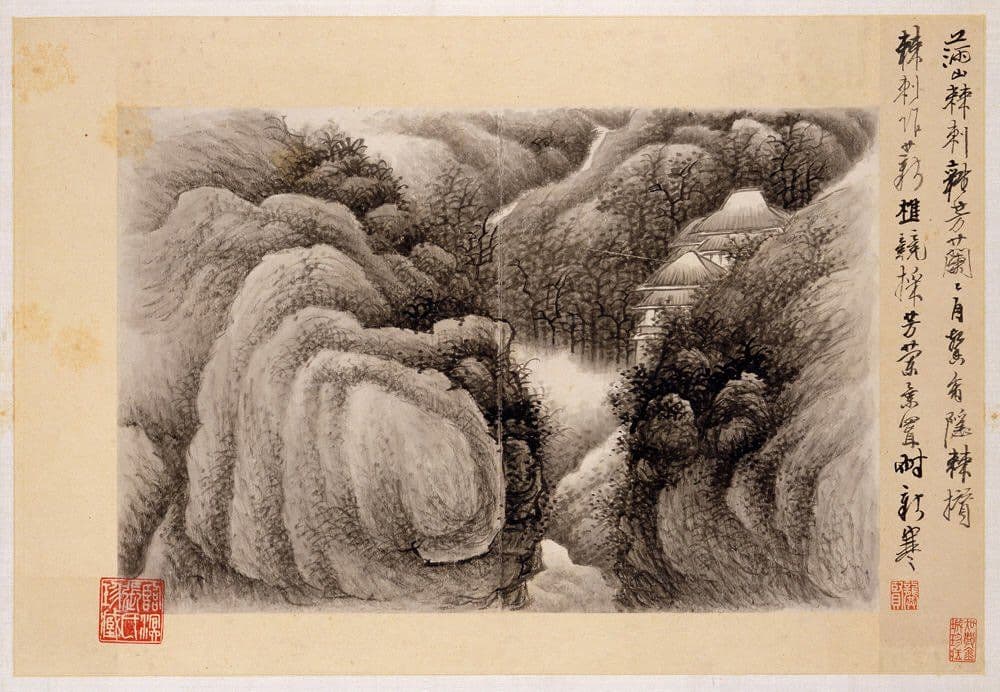
Zhang Daqian was born in Sichuan in 1899, the tenth of twelve children. He showed prodigious artistic talent from childhood and, by his twenties, had begun to study the great masters of Chinese painting by the most direct method available: copying them obsessively, and then — here the story becomes complicated — selling those copies as originals.
The scale of his forgery operation is almost incomprehensible. Zhang produced fakes of Shitao, Bada Shanren, and other seventeenth-century masters so convincing that they fooled the leading Chinese art scholars of the day. Several of his forgeries remain in major museum collections — the Palace Museum in Beijing, the Shanghai Museum — where their authenticity continues to be debated. The scholar C.C. Wang, who knew Zhang personally, once estimated that half of all Shitao works in the world were painted by Zhang Daqian.
Zhang himself was unapologetic. To copy the masters so convincingly, he argued, required understanding them more deeply than any critic or historian. The forgeries were, in their way, an act of homage — and an education that no academy could provide.
The Invention of a Style
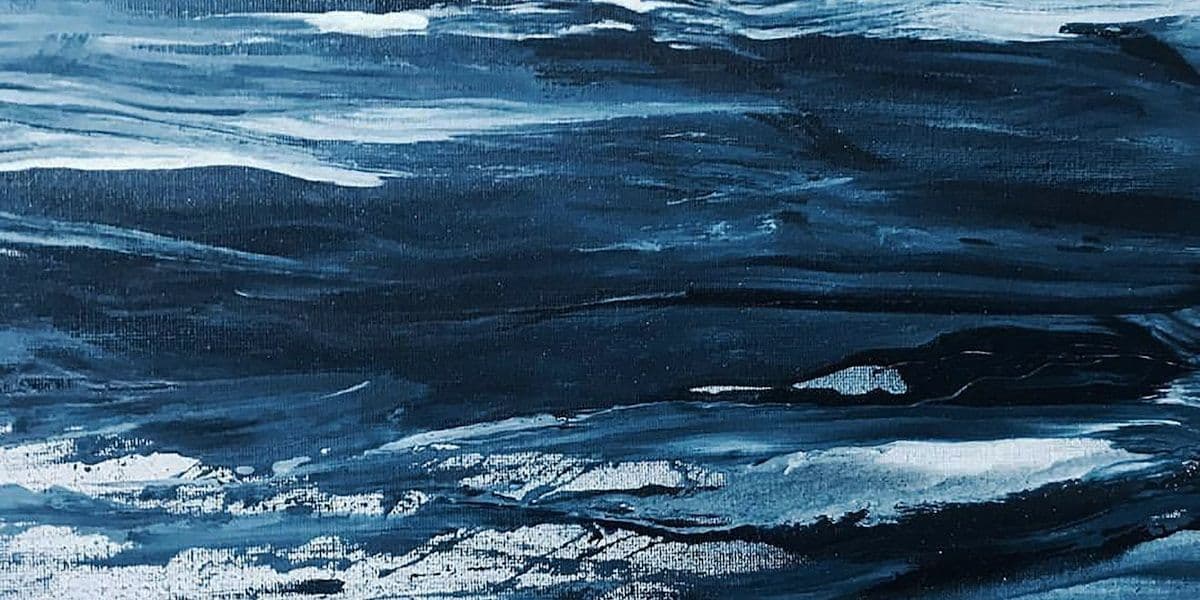
What makes Zhang Daqian's story genuinely remarkable is not the forgeries but what came after them. In the 1960s, suffering from deteriorating eyesight that made fine-detail brushwork impossible, Zhang invented an entirely new technique: pomo, or “splashed ink.” He would pour diluted ink and mineral pigments directly onto paper or silk, tilt and rotate the surface to create flowing, unpredictable forms, and then — with remarkable economy — add a few precise brushstrokes to suggest mountains, waterfalls, and mist.
The results were extraordinary: works that looked superficially like Western Abstract Expressionism but were rooted in a completely different logic — the logic of classical Chinese landscape painting, where empty space is not absence but presence, and the mark that suggests a mountain range is more powerful than one that describes it.
The Market and the Legacy
Zhang Daqian died in Taiwan in 1983, having spent his final decades in a garden studio outside Taipei that he designed himself, complete with a waterfall and a viewing pavilion. He had been, for most of his adult life, simultaneously celebrated and suspected — a man whose genius was undeniable but whose relationship to authenticity was permanently complicated.
Today, Zhang Daqian consistently appears among the top-selling artists at major auction houses worldwide. His late pomo landscapes have sold for tens of millions of dollars. The forgeries, paradoxically, have added rather than diminished his reputation — demonstrating a range and depth of technical knowledge that no other twentieth-century Chinese painter can match.
The lesson his career offers collectors is a useful one: in Chinese painting, the ability to inhabit the tradition fully — to understand it from the inside — is itself a form of mastery. Zhang Daqian learned this by deception, and then transcended that beginning to create something wholly original.
From the Kiln & Ink collection: Blue and Green Landscape, an archival giclée edition after Zhang Daqian, hand-numbered on xuan paper with a certificate of authenticity.
Explore Further