Published August 12, 2026
Chinese ancestor portraits explained: why they are unsigned, how to read rank badges and court dress, and what condition problems to expect.
The first thing most people notice about a Chinese ancestor portrait is that the sitter is looking straight at them. Not three-quarters, not downward, not off to one side in the manner of a European state portrait — dead centre, symmetrical, both ears showing, hands resting on the knees. The second thing they notice is that nobody signed it. Those two facts are related, and understanding why is the beginning of understanding what these scrolls actually are.
This guide covers what ancestor portraits were made for, why they are almost always anonymous, how to read the rank badge and court dress that identify the sitter, how the workshop system produced them, and the condition and authenticity problems that come with a category of painting designed to hang above burning incense.
They were ritual equipment, not decoration
An ancestor portrait was not made to be admired on a wall. It was made to be used.
In the household practice these scrolls belong to, the portrait was brought out at prescribed times — most importantly around the New Year, and on the death anniversaries of the person depicted — hung above or behind the family altar, and placed at the focus of offerings, incense and prostration. The rest of the year it was rolled up and stored. The painting was, functionally, the ancestor's seat at the family occasion.
This purpose explains the entire visual system. The frontal pose is not stiffness; it is availability — the sitter faces the descendants who face the sitter. The symmetry is not naivety; it is decorum. The absence of narrative background is not laziness; it is focus. Nothing in the picture is permitted to compete with the person in the chair.
It also explains the scale. Surviving examples are frequently large, sometimes considerably taller than a person, because they had to hold the attention of a room full of kneeling relatives. Multi-figure versions exist too — group compositions with rows of ancestors ranked by generation, essentially a painted family tree, which could grow as the family did.
Almost all material reaching collectors is Qing, with Ming examples correspondingly rare and generally institutional.
Why they are unsigned, and why that is not a defect
Ancestor portraits were painted by professional artisans, usually anonymous, often working to commission after the subject had died. They were not painted by the scholar-artists whose names organise most of the Chinese painting market. The commissioning family wanted an accurate, dignified, correctly dressed ancestor; they did not want, and would not have valued, a painter's personal expression imposed on a grandfather.
So the painter did not sign. Signing would have been a category error — like a stonemason signing a gravestone across the deceased's name.
This is worth dwelling on, because it is the single biggest reason the category was undervalued for so long in a market organised around attribution. Western and Chinese collecting alike prized the literati tradition, where the artist's identity, seals and inscription are the point. Ancestor portraits belong to the opposite pole of Chinese picture-making — the professional, functional, court-adjacent tradition described in our comparison of literati painting and court painting. Their anonymity is a feature of the genre, not evidence of a problem with the individual scroll.
Practically: if a dealer offers you a signed ancestor portrait attributed to a named master, that is a reason for more scepticism, not less.
Reading the sitter
Because the painter tells you nothing, the clothing has to. Ancestor portraits are unusually rewarding to read closely, since the sitter's formal dress encodes their position with some precision.
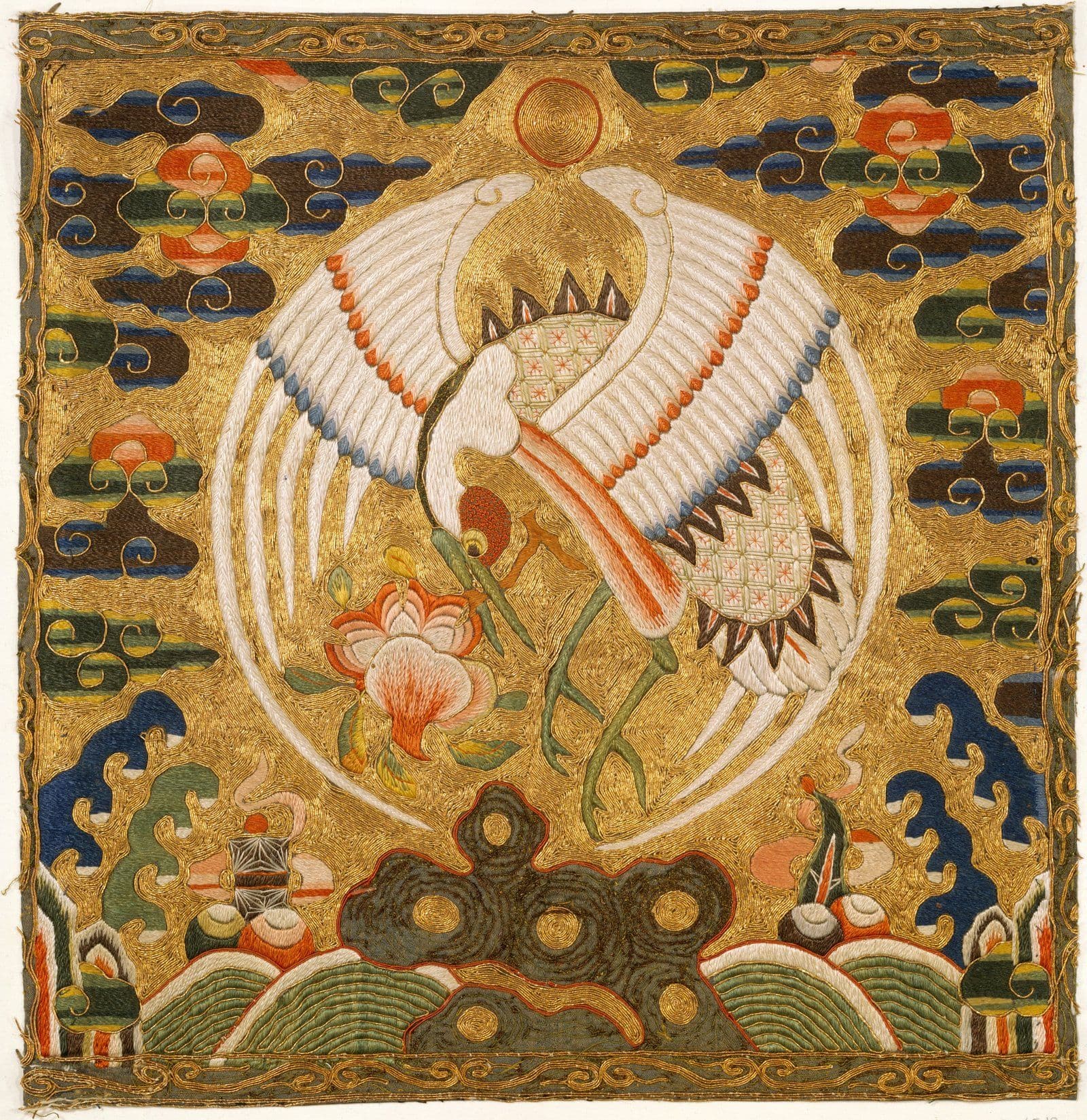
- The rank badge. The embroidered square worn on the chest — and matched on the back — is the primary indicator. Under the Qing system, civil officials were designated by birds and military officials by animals, across nine graded ranks. The crane belongs to the topmost civil rank. Beyond that, the specific creature-to-grade assignments are worth checking against a specialist reference rather than trusted to memory, since they were revised over time and are easy to misremember.
- The hat and its finial. Formal headwear carries a mounted finial whose material and colour also signalled rank. It is a useful cross-check: the hat and the badge should agree. When they do not, you are looking either at an error, a later repainting, or an invention.
- The court necklace. A long strand of beads worn over the robe, associated with formal court dress at certain ranks. Its presence tells you the portrait is depicting official standing rather than ordinary gentry status.
- The chair, the textile and the floor covering. The sitter is typically seated in a substantial hardwood-style chair draped with a patterned textile or an animal skin, feet on a footstool, a carpet beneath. These props are conventional, but their elaboration tracks with the family's claim to status.
- The woman's portrait. Wives were portrayed to the same conventions, in formal dress with its own headdress and insignia, and were frequently painted as pendants to a husband's scroll. Pairs that have stayed together are worth more than the sum of two singles, and are increasingly uncommon.
One caution: dress can flatter. A family commissioning a memorial portrait had reasons to depict an ancestor at their highest attained rank, or occasionally at a rank they had purchased rather than earned. Read the costume as the family's statement about the ancestor rather than as an official record.
Faces, templates and the workshop system
Here is the working reality behind these paintings, and it explains most of what puzzles collectors.
The face was the portrait. The body, very often, was the pattern.
Professional portrait workshops maintained standardised compositions — the chair, the robe, the carpet, the pose — into which an individualised head could be placed. The likeness was taken from sketches made during life, from a drawing made at the deathbed, or in the least satisfactory cases from the recollection of relatives. Manuals and model books circulated among these workshops.
You can often see the join. Look for a face rendered with genuine observation — asymmetry, sagging, a specific nose, real modelling around the eyes — sitting above a robe rendered with pattern-book regularity. That contrast is not a fault to be held against the picture. It is the genre working exactly as designed, and it is also a reasonable authenticity signal, because it is a subtlety that later decorative copies frequently fail to reproduce.
Materials follow the same logic of durability and display. Most are ink and colour on silk, mounted as hanging scrolls; the pigments are the traditional mineral and vegetable colours described in our guide to mineral pigments in Chinese painting, with the vermilions and blues of the robes carrying much of the visual weight. Silk was the appropriate support for a formal, repeatedly displayed object, and it behaves differently in age from paper — a distinction covered in silk versus paper in Chinese painting.
Condition, copies and what to look at
These objects lived above smoke. Expect that.
Damage that makes sense for the genre. An overall warm-brown darkening from incense and candle soot, usually heavier at the top. Horizontal fold lines at regular intervals from decades of rolling. Splits and losses along those folds. Brittleness and shattering in the silk, especially where pigment is thick — heavy mineral colour is dense and can crack the support beneath it. Wear at the very bottom edge where the scroll was handled.
Damage that should worry you. Faces that are noticeably fresher than the robes below them, which usually means overpaint on the one area a buyer looks at. Rank badges whose colours sit crisply on top of a darkened surface, which can mean a badge has been upgraded to make the ancestor more senior and the scroll more saleable. Uniform, evenly applied "age" tone, which is a finish rather than a history.
Mounting. Most of these scrolls have been remounted, sometimes repeatedly, and remounting is normal conservation rather than a defect; the process is explained in our guide to Chinese painting mounting. What matters is whether it was done competently. A modern remount can be a positive sign of care — or a chance to disguise repairs.
Later production. Decorative ancestor-style portraits were made well into the twentieth century for the export and tourist trades, and continue to be made. They are usually recognisable by a certain sameness: symmetrical to a fault, brightly and evenly coloured, with a generic face and no observed individuality. If nothing about the sitter's face suggests a specific human being, you are probably looking at furniture rather than at an ancestor.
Common questions
Are ancestor portraits considered fine art or folk art?
Both labels get used, and neither fits comfortably. They were produced by professional artisans to a functional brief, which excludes them from the literati canon; but the best are accomplished, closely observed portraits made with expensive materials for serious purposes. Scholarly and curatorial interest has grown considerably as attention has shifted away from a market organised purely around famous names.
Is it disrespectful to hang one in a Western home?
This deserves a straight answer rather than a reassuring one. These images were made as ritual objects representing specific deceased individuals, and some collectors — and some people of Chinese descent — feel their removal from that context is troubling. Others regard preserving and studying them as the more respectful outcome, given that the alternative was often destruction. The considered position is to buy knowingly, display with dignity rather than as exotic decoration, and keep whatever documentation exists about who the sitter was.
How can I tell a Qing portrait from a twentieth-century copy?
Work from the face outward, then check materials. A period portrait usually shows individualised observation in the head and pattern-book regularity in the body; a copy is generic throughout. Then look at the silk for genuine age behaviour — brittleness, fold damage, uneven soot — rather than an applied overall tone. Where the value is significant, pay for a specialist examination rather than relying on your own reading of a photograph.
Do the sitters' identities survive?
Occasionally. Some scrolls carry a written cartouche or an attached label naming the ancestor, and some arrived in Western collections with family documentation. Most did not, and the names are lost. A securely identified sitter adds real interest and is worth paying for — but be aware that identification supplied by a seller without documentary support is a claim rather than a fact.
Further reading
- How Experts Authenticate Chinese Paintings — the general method applied to an unsigned genre.
- How to Display a Chinese Scroll Painting — light, humidity and rotation for silk hanging scrolls.
- The Chinese Handscroll: A Viewing Guide — the other great scroll format and how its use differs.
- Collector Seals on Chinese Painting — the ownership marks that sometimes accumulate on these scrolls later.
Browse the collection
Antique ancestor portraits are a subject we write about rather than one we stock. What Kiln & Ink sells is paper: limited-edition archival giclée reproductions of the twentieth-century Chinese ink masters, printed on xuan paper or museum-grade cotton rag, hand-numbered, and issued with a Certificate of Authenticity.
Explore Further