Published September 18, 2026
How to read Chinese porcelain symbols: the rebus behind bats, peaches, lotus, fish and dragons, what each wish means, and how motifs date a piece.
Hold a Qianlong bowl up to the window and turn it slowly. A bat hangs upside down above a spray of peach. Four more circle the exterior. A ribbon knot trails from a stone chime, and a single character in seal script sits inside the foot. None of this is filler. Each element is a word, and the arrangement is a sentence — a wish spoken in pictures to a recipient whose name nobody wrote down.
This guide walks you through the grammar of that sentence: how the rebus works, the motif families you will meet most often on blue-and-white and enamelled wares, how to count bats and peaches before you interpret them, how the drawing of a motif helps date a piece, and which symbols the market actually pays for.
A picture is a pronunciation
Most Chinese decorative symbolism runs on homophones — xieyin (諧音), "harmonising sounds". A bat is fu; a blessing is also fu. A deer is lu; an official's salary is also lu. A fish is yu; surplus is also yu. The painter is not drawing a bat because bats are handsome. He is writing the word "blessing" in a form that survives the kiln.
Two other mechanisms sit alongside the pun. The first is literary allusion: peaches summon the orchard of Xiwangmu, the Queen Mother of the West; chrysanthemums summon Tao Yuanming, the poet who resigned his post and went home to grow them. The second is emblem sets — fixed groups of Buddhist and Daoist attributes that work as vocabulary lists rather than puns.
The practical consequence is that motifs are read in combination, never singly. A lotus on its own is a lotus. A lotus with an egret standing in it is a wish for examination success. Painting obeys the same grammar, which is why a porcelain motif chart and the bird-and-flower symbolism decoder overlap so heavily.
Bats, and how to count them
Count before you interpret. The number carries as much meaning as the creature.
- Five bats. The wufu, or Five Blessings, listed in the Hongfan chapter of the Book of Documents: long life, wealth, health and composure, love of virtue, and a natural end. Five bats around a shou character is the standard birthday formula.
- A bat descending from clouds. Dao means both "to arrive" and "inverted", so a bat shown upside down reads as blessings arriving. This is why bats on porcelain so often hang head-down.
- Red bats. Hong fu, "red blessing", puns on hong meaning vast. Red bats on a famille rose ground are an intensifier, not a species.
- A bat with a stone chime and paired fish. Qing, ji and yu together read as a wish for good fortune and surplus year after year.
A single bat with no supporting cast is a polite generic wish. Five with a peach is a specific one, and usually means the piece was made for a sixtieth or seventieth birthday.
Peaches, cranes and the longevity family
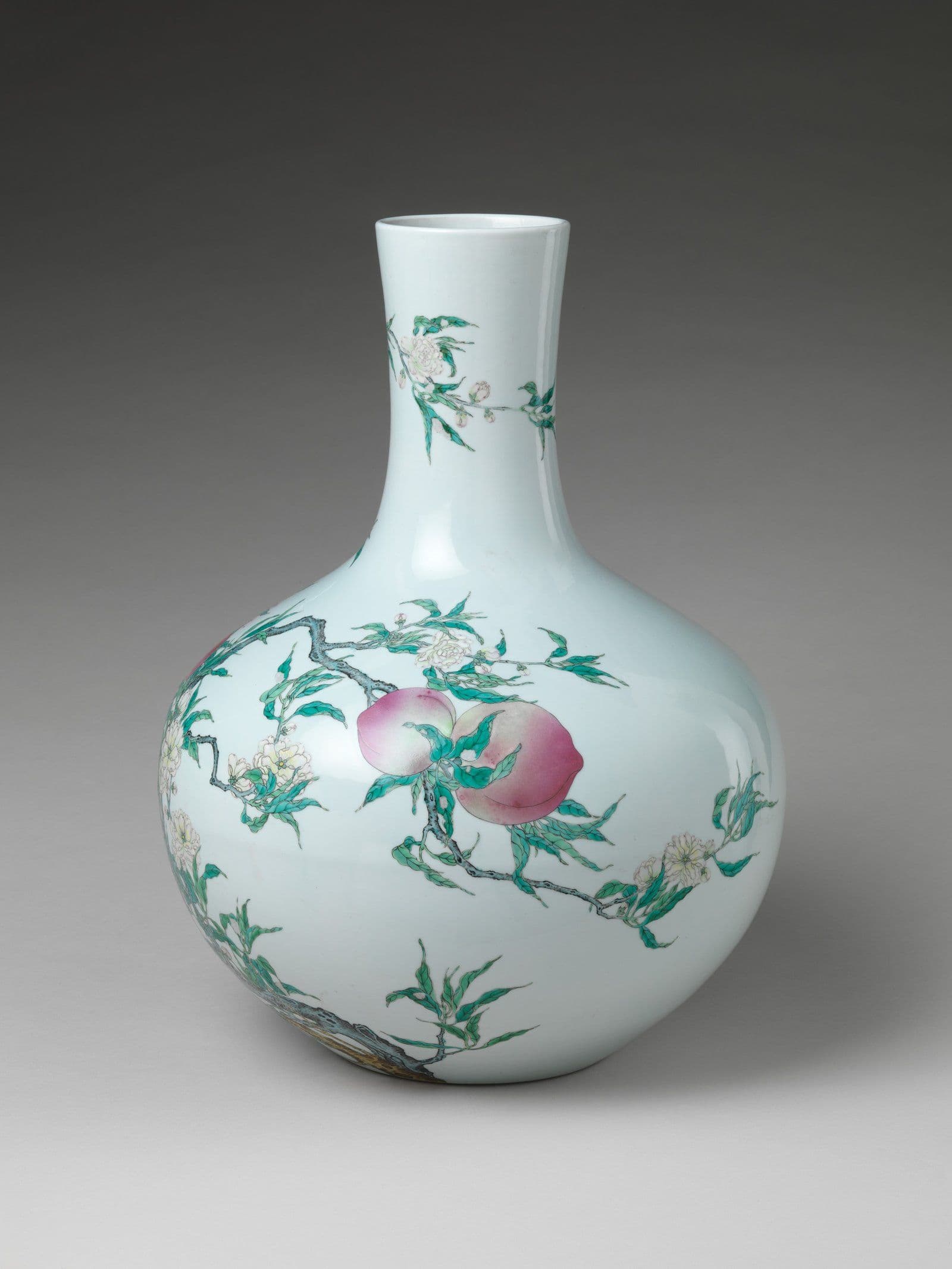
The peach is the densest longevity symbol in the repertoire. In the Xiwangmu legend the fruit ripens once in three thousand years, and the eater does not die. On Qing imperial porcelain the peaches are counted too: nine on a vase is the classic Yongzheng and Qianlong arrangement, painted in famille rose with the branch wrapping from the body over the shoulder.
Around the peach sits a whole family that means the same thing by different routes. Pine and cypress endure the winter. The crane carries immortals. The lingzhi fungus, drawn as a cluster of ruyi-shaped caps, was believed to extend life, which is also why the ruyi head itself became a longevity border. Deer and crane together give liuhe tongchun, spring throughout the universe, on the strength of a pun on liu.
Two combinations catch collectors out. A cat with a butterfly is maodie, a pun on the words for a seventy- and an eighty-year-old — it wishes the recipient into deep old age and has nothing to do with pets. And a hundred shou characters, each written differently, is a vase decoration in its own right rather than a mark. The same auspicious grammar carried straight into twentieth-century ink painting, as the longevity peaches of Qi Baishi show.
The lotus and the scrolling vine
The lotus is the one motif that works on three levels at once. It is Buddhist, as the seat of the Buddha and the flower that rises unstained from mud — the image Zhou Dunyi fixed in his Northern Song essay on the love of the lotus. It is a pun, since lian also means continuous and he also means harmony. And it is the single most common border on blue-and-white, as the chanzhi lian or scrolling lotus vine.
That vine is a dating instrument. On Yuan blue-and-white the lotus scroll is fleshy and crowded, with heavy outlines and little empty ground. On Yongle and Xuande wares it opens out and breathes. By the Qianlong period it has hardened into a stiff, mechanically symmetrical scroll, often with enamel added over the blue. Reading the vine is one of the quickest orientations available, and it pairs well with the broader blue-and-white porcelain guide.
Watch for the lotus carrying something. A lotus supporting an emblem belongs to the Eight Buddhist Emblems. A lotus beside a box, he, reads as harmony. A lotus with an egret is the examination wish, yilu lianke, one road of successive passes.
Sons, examinations and salaries
A large share of Chinese decoration is about careers and descendants, because a large share of the objects were gifts at weddings, promotions and examinations.
- Pomegranate and melon vine. A split pomegranate showing its seeds wishes for many sons. A melon vine trailing with butterflies is guadie mianmian, generations of descendants without a break.
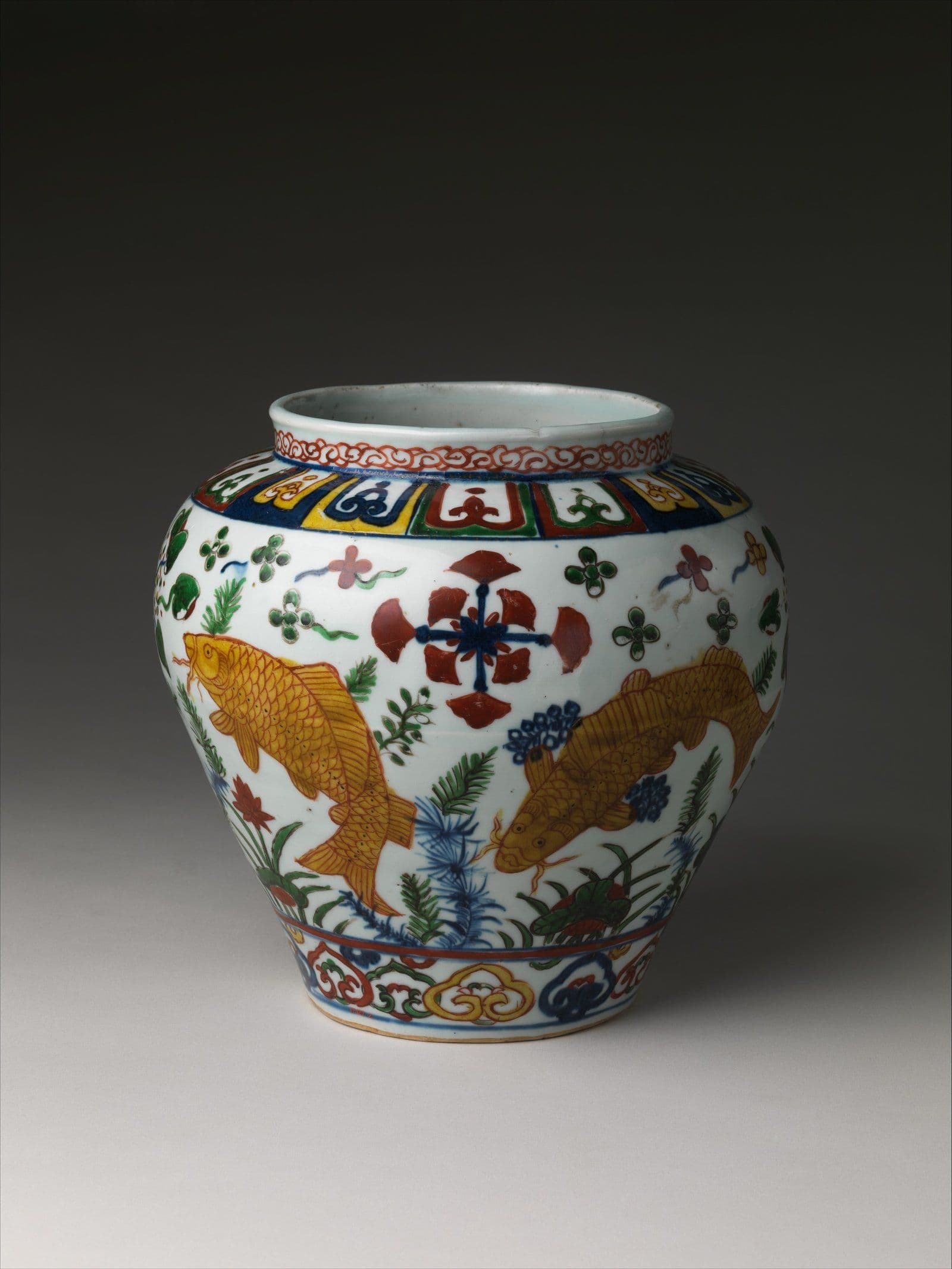
- Carp at the Dragon Gate. The carp that leaps the gate on the Yellow River becomes a dragon. On a scholar's brush pot or a dish given at examination time it means one thing only: pass, and rise.
- A hundred boys. The baizitu, boys at play with drums, lanterns and a mock procession, appears on Ming and Qing jars and on wedding wares.
- Qilin bearing a child. Qilin songzi, the mythical beast delivering a son, is a marriage gift image and appears on Kangxi and later export wares.
- Deer, and the three stars. Deer for salary, bat for blessing, peach for longevity — fu, lu, shou, the three most reliable Chinese wishes, sometimes shown as three old men rather than three animals.
Marriage, friendship and the polite wish
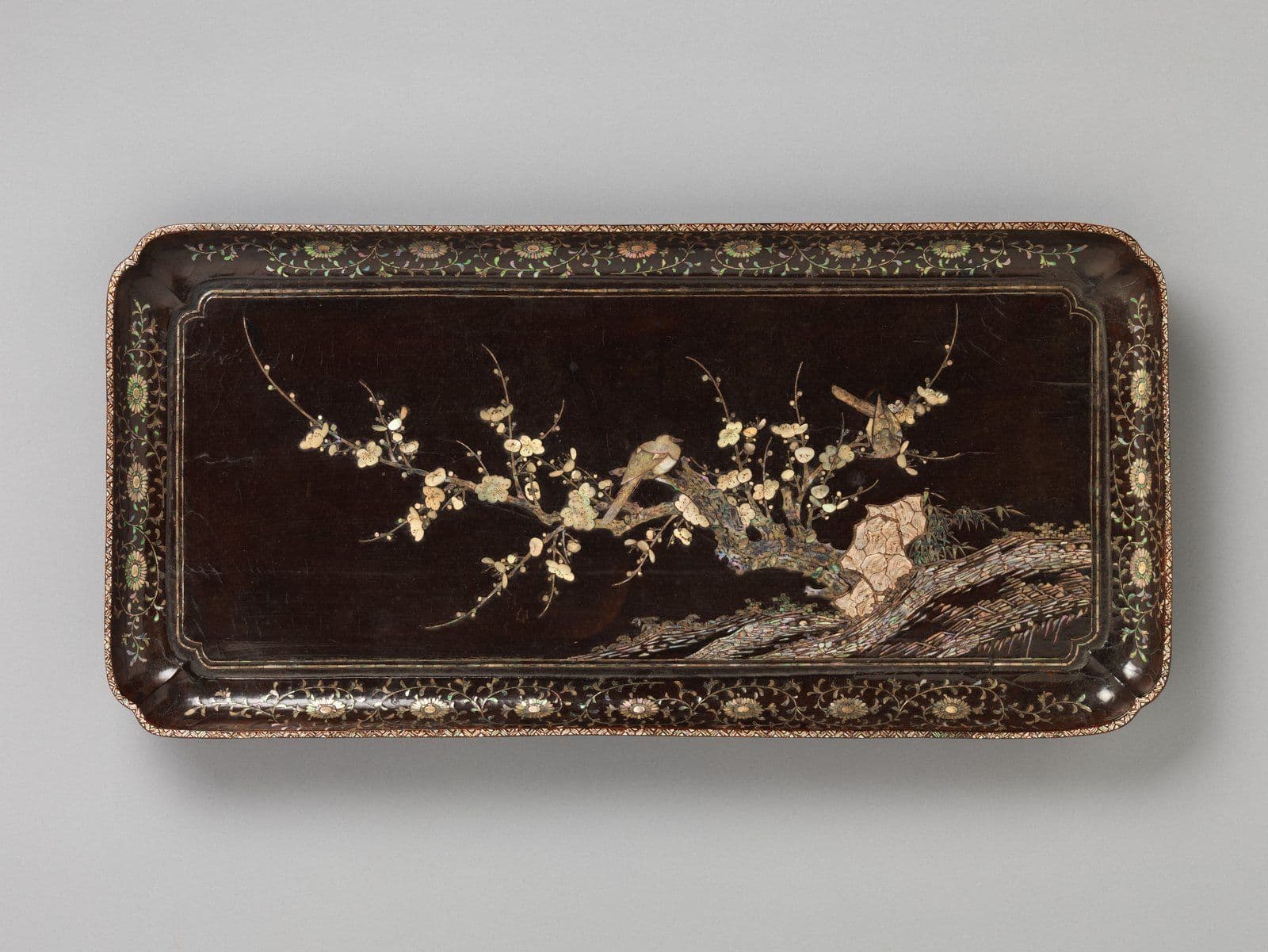
Mandarin ducks swim in pairs and were believed to mate for life, so a pair on a dish is a wedding wish. A magpie perched at the tip of a plum branch is xi shang meishao, joy up to the brow, which works because the word for branch tip puns on eyebrow. The doubled xi character, two joy characters side by side, is unambiguous: it is wedding porcelain, and it appears in quantity on the famille rose services made for the Tongzhi emperor's marriage and on the commercial wares that copied them for decades afterwards.
Friendship and integrity have their own set. The Three Friends of Winter — pine, bamboo and prunus, suihan sanyou — endure cold together and stand for constancy. The Four Gentlemen, plum, orchid, bamboo and chrysanthemum, map the seasons onto four virtues and move freely between porcelain and paper; the four gentlemen in Chinese painting carry exactly the same load on a hanging scroll.
Dragons, emblems and what they do not prove
The dragon is the most misread motif on the market. Claw count mattered under sumptuary rules: the five-clawed long belonged to the emperor, four claws to ranked nobility, and the distinction was enforced on court goods. The phoenix pairs with the dragon as the empress, and a dragon-and-phoenix pair is an imperial marriage image.
What the claws do not do is authenticate. Late Qing, Republic-period and modern decorative wares use five-clawed dragons without restraint, and a great many were never near a court. Read the claws as part of the evidence, alongside body, glaze, mark and foot — the five-clawed dragon on porcelain is a claim about intended status, not a certificate.
The emblem sets are more stable. The Eight Buddhist Emblems, bajixiang, are the wheel, conch, parasol, canopy, lotus, vase, paired fish and endless knot, usually shown on lotus pads and usually in a fixed order. The Eight Daoist Emblems are the attributes of the Eight Immortals — fan, sword, gourd, castanets, flower basket, bamboo tube, flute and lotus — and when they appear without their owners they are called the hidden Eight Immortals. The bogu or hundred antiques pattern scatters bronzes, scrolls and vessels across a surface to signal scholarly taste.
Using motifs to date and to doubt
Motif style moves with cobalt, brush and workshop habit. Yuan painting is outlined and washed heavily. Xuande blue carries iron-oxide spots that sit in the glaze, the so-called heaping and piling. Chenghua outlines finely and fills with a pale, even wash. Kangxi painters graded a single cobalt into several distinct tones. Qianlong crowds the surface and makes it symmetrical. Late Qing blue is thin and flat, and by the Republic period transfer-printed outlines appear, with a mechanical evenness no brush produces.
Two checks are worth building into a routine. First, ask whether the message is coherent: an imperial yellow ground carrying a wedding double-happiness is a combination no court workshop would have produced, and a mismatch of that kind is worth more than a hundred stylistic impressions. Second, test the motif against the physical evidence rather than the other way round, starting with the foot rim, where grinding, glaze line and wear are much harder to fake than a painted bat.
Common questions
What does a bat mean on Chinese porcelain?
A bat means blessing, because the word for bat and the word for blessing are both pronounced fu. Count them before reading further: five bats are the Five Blessings of the Book of Documents, and a bat hanging upside down adds a second pun, since the word for inverted also means to arrive. Red bats intensify the wish. A bat combined with a peach moves the meaning towards long life, and a bat with a stone chime and fish towards prosperity.
What do nine peaches on a Chinese vase mean?
Nine peaches is a wish for long life, drawn from the orchard of the Queen Mother of the West, whose fruit was said to ripen once in three thousand years. The arrangement with a branch wrapping from the body over the shoulder is a Yongzheng and Qianlong famille rose formula, and it was repeated continuously afterwards, including on twentieth-century and modern copies. The number nine is itself auspicious as the highest single digit and an imperial number.
Is a five-clawed dragon proof that a piece is imperial?
No. Under the sumptuary rules the five-clawed dragon was reserved for the emperor, but enforcement ended with the dynasty, and five-clawed dragons appear freely on late Qing, Republic and modern decorative porcelain. Treat the claws as a claim about intended status. The body, the glaze, the potting, the reign mark and the foot rim decide whether the claim is credible.
Which symbols add value to a piece?
Symbolism rarely moves a price on its own; quality of painting, period and condition do. Where it matters is in coherence and rarity of combination. A complete, correctly ordered set of the Eight Buddhist Emblems, a well-painted nine-peach vase, or a dragon-and-phoenix pair in imperial taste will be sought after, while a generic scattering of auspicious motifs on an indifferent body adds nothing.
Further reading
- Blue-and-white porcelain and the history of cobalt — how the pigment behaved in each period, which is what makes motif style datable.
- Chinese porcelain vase shapes — motif and form were chosen together, and the shape narrows the date before the decoration does.
- Chinese porcelain marks — the second half of the evidence when a decorative scheme looks right.
Browse the collection
Kiln & Ink does not deal in porcelain, but the symbolic vocabulary on a Qianlong bowl is the same one the twentieth-century ink masters inherited and reworked. Qi Baishi painted peaches and shrimp for the same audience that once commissioned birthday vases. Our limited-edition archival giclée reproductions of those masters are hand-numbered and issued with a Certificate of Authenticity; you can see the artists we publish across the collection.
Explore Further