Published August 8, 2026
Chinese vase shapes explained: meiping, yuhuchunping, tianqiuping, gu, zun, rouleau and moonflask, and how shape works as a dating clue.
Dealers describe Chinese vases by silhouette before they describe them by anything else. A catalogue entry opens with meiping, yuhuchunping, or rouleau, and everything that follows — the period, the glaze, the price — is arranged behind that word. If the shape vocabulary is unfamiliar, half of every description is doing nothing for you.
This guide gives you the forms that recur, what each one was originally for, and how shape functions as a dating tool — including the important limits on how far you can push it.
Why shape comes first
Potters did not invent silhouettes freely. A vase form is the product of a function, a technical constraint, and a fashion, and all three leave traces.
Function sets the proportions. A vessel made to hold and pour wine has a mouth sized for a stopper and a body sized for a hand. Technique sets the limits: a very long thin neck has to be thrown or moulded separately and joined, and the join is visible to anyone who looks for it. Fashion sets the rest, and fashion is datable.
The result is that shape and reign mark are the two pivots of dating, and they check each other. A mark says what a piece claims to be; a shape says what period the potter was actually working in, or at least which period they were imitating. When the two disagree, you have learned something. The master guide to Chinese porcelain marks covers the first pivot; this is the second.
The classic forms
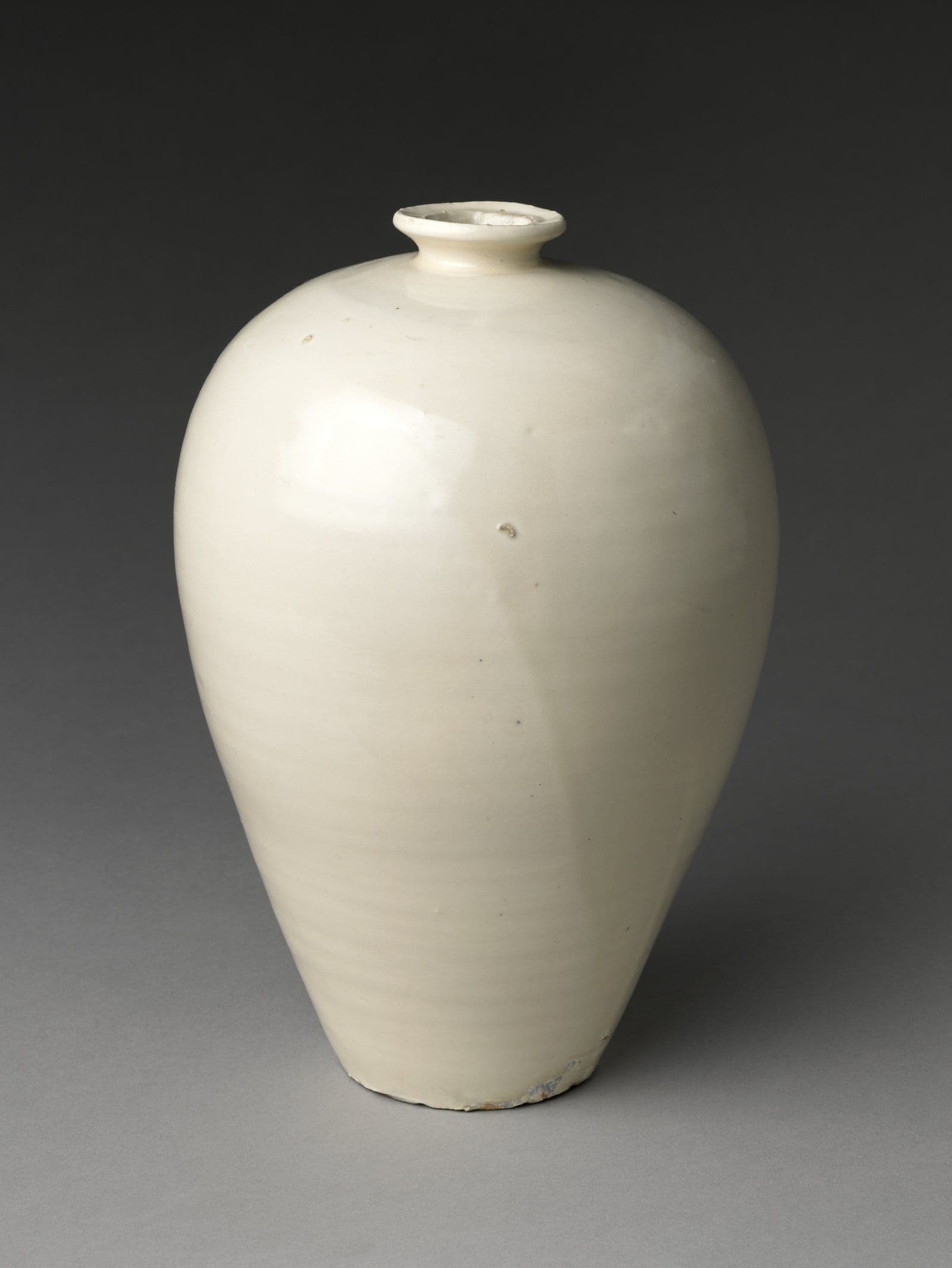
Meiping
A tall vessel with a small mouth, a very short neck, a wide high shoulder, and a body that tapers to a narrow foot. The name translates as "prize plum vase" and refers to a later use — displaying a single branch of blossom — rather than the original one, which was storing and serving wine. The small mouth is the giveaway: it was sized for a stopper.
The meiping is one of the longest-lived Chinese vase forms and has been made continuously in many periods and glazes, which means the silhouette alone will not date a piece. Proportion will help. Earlier meiping tend to read as more sharply shouldered and more strongly tapered; later ones are often heavier and less abrupt.
Yuhuchunping
The pear-shaped bottle: a slender neck flaring into a trumpet mouth, a body that swells low and sits on a small foot. Where the meiping is top-heavy, the yuhuchunping is bottom-heavy, and the two are often shown together for exactly that contrast.
It is also one of the great decorating surfaces in Chinese porcelain — the continuous curve gives a painter an uninterrupted field, and the form recurs constantly in blue and white.
Tianqiuping
The "celestial globe" vase: a nearly spherical body with a long, straight, cylindrical neck. The form is imposing, technically demanding, and strongly associated with imperial production. On a large tianqiuping, look at the base — the weight of a globular body means the foot and the thickness of the wall have to be handled precisely, and that is where quality separates.
Gu
A beaker with a flaring trumpet mouth, a narrower waisted middle, and a spreading foot — an archaic bronze ritual wine vessel translated into porcelain. The gu is the clearest example of a whole category: forms that exist because the Chinese ceramic tradition repeatedly went back to ancient bronzes and jades for its shapes. Understanding that habit stops you reading "archaic form" as "archaic date".
Zun
Zun is less a single shape than a family, also descended from bronze prototypes, generally broad-shouldered and often on the larger side. Several named small variants belong to it and are worth recognising as a group rather than memorised individually: apple-form, willow-leaf, and phoenix-tail among them. When a catalogue says zun, expect a form with an archaic ancestor.
Hu
Another family term with a bronze ancestry, covering jar-and-bottle forms that are broadly ovoid with a constricted neck. As with zun, the word tells you the lineage rather than the exact silhouette.
Rouleau
A cylindrical body with sharply angled shoulders and a short straight neck — a form that reads almost architecturally, and one strongly associated with the Kangxi period. Rouleau vases were made in quantity for both the domestic and export markets, and the angular shoulder gives painters a natural register break for decorative schemes.
Moonflask
A flattened circular body — think of a disc set on a small foot — with a short neck and, usually, a pair of handles linking neck to shoulder. The form descends from Near Eastern metal prototypes and entered Chinese porcelain in the early Ming, then came back into favour in later imperial production. The flattened body has a structural consequence worth knowing: the two faces are prone to warping and to firing cracks, and later repairs cluster there.
Garlic-head and cong-form
Two more forms that announce their ancestry. The garlic-head vase has a bulbous, lobed swelling at the top of the neck, copied from bronze. The cong-form vase is square in section with rounded shoulders and a round mouth, copied from the neolithic jade cong, and appears most often under monochrome glazes where the shape carries the whole effect. If you are drawn to that quiet register, monochrome glazes is the natural next subject.
Double gourd
Two swelling bodies, the lower larger than the upper, joined at a waist — the shape of a bottle gourd, and a form with strong auspicious associations. It appears across a wide range of periods and glazes.
Reading shape as a dating clue — and where it fails
Here is the honest version. Shape narrows the field. It does not close it.
Chinese potters revived earlier forms deliberately and continuously. The imperial kilns treated archaism as a virtue, and later commercial production copied whatever sold. So a form first popular in one period will be found in later ones, made both as an homage and as an outright imitation. Shape is therefore a terminus post quem at best: it can tell you a piece is not earlier than the form, and it rarely tells you it is not later.
What raises confidence is agreement across several independent features:
| Feature | What to check ||---|---|| Silhouette | Does the proportion match the form's period, or only the general outline? || Foot and base | Glaze on the footrim, the cut of the rim, the finish of the base || Body and weight | Does it feel right in the hand for the size and the claimed period? || Mark | Present, absent, or apocryphal — and consistent with the shape? || Decoration | Palette and drawing convention consistent with the form's period? || Condition | Damage patterns consistent with age and with the form's weak points |
The foot is where the most reliable evidence usually is, because it is the part potters finished by habit rather than by design — foot rim dating goes through what the underside actually shows. And on marks, the single most common misreading in the field is treating a reign mark as a date rather than as a claim; apocryphal marks are normal, not exceptional.
One more practical point. Shape drives display as much as dating. Vases were often made and sold in sets, and a form that looks unbalanced alone was designed to sit in a rhythm of five or seven — which is the whole logic of garniture sets.
Common questions
If two vases have the same shape, are they from the same period?
No. Chinese potters revived earlier forms constantly, both as respectful homage and as commercial imitation, so a shared silhouette establishes a relationship of influence rather than a shared date. Use shape to narrow the possibilities, then let the foot, the body, the glaze, the decoration, and the mark decide between them. A conclusion that rests on shape alone is a guess wearing a technical vocabulary.
Which shapes are hardest to make?
Anything with a long thin neck on a heavy body, and anything flattened. Long necks are prone to slumping and often need separate throwing and joining; flattened bodies like the moonflask warp and crack in the kiln because the two faces dry and shrink unevenly. Those difficulties are why examples in good condition in those forms are less common, and why restoration clusters at exactly those weak points.
Does a chip or a crack destroy the value?
It reduces it, sometimes sharply, but the effect depends on rarity and on where the damage sits. A hairline in the foot of a common later form is very different from a rim chip on a rare early one. What matters most in practice is disclosure: undeclared restoration discovered after purchase is a much bigger problem than declared damage priced in. The condition and damage guide sets out the standard vocabulary.
Why do so many forms come from bronzes?
Because bronze ritual vessels carried the prestige of antiquity, and reproducing their shapes in porcelain transferred some of that prestige. The habit runs deep and recurs in almost every period, which is why gu, zun, hu, and cong forms turn up in ceramics made two thousand years after their metal ancestors.
Further reading
- Chinese Porcelain Condition and Damage — the vocabulary dealers use, and what each term costs.
- Blue and White Porcelain: A Guide — the decoration tradition these forms most often carry.
- Kangxi-Era Porcelain Collecting — the period that produced several of the shapes above at their sharpest.
- Chinese Vase Stamps: A Reference Guide — the other half of the dating pair, on the base.
Browse the collection
Porcelain is a subject we write about rather than one we stock. What Kiln & Ink sells is paper — limited-edition archival giclée reproductions of the twentieth-century Chinese ink masters, printed on xuan paper or museum-grade cotton rag, hand-numbered, and issued with a Certificate of Authenticity, at roughly $300–$1,200.
Explore Further