Published September 23, 2026
Qing dragon robes decoded: the lishui hem, nine dragons and claw counts, kesi against embroidery, how to date one, and the alterations that cut value.
Lay the robe face down on a clean sheet before you look at the front. The reverse is where a dragon robe tells the truth: the tails of hand-worked stitches, the couching threads that hold the gilt down, the seams where narrow loom widths were joined, the linings that have been replaced and the ones that have not. A robe that reads convincingly from the front can be a twentieth-century opera costume from the back.
This guide walks you through the Qing court robe as a collector meets it: what the different robes are called and how they were ranked, how to read the design from the hem upwards, what the claws and the colour actually signify, how the robe was made, how to date one within a few decades, and the alterations and condition problems that decide most of the price.
Dragon robe, longpao, mangpao: getting the names right
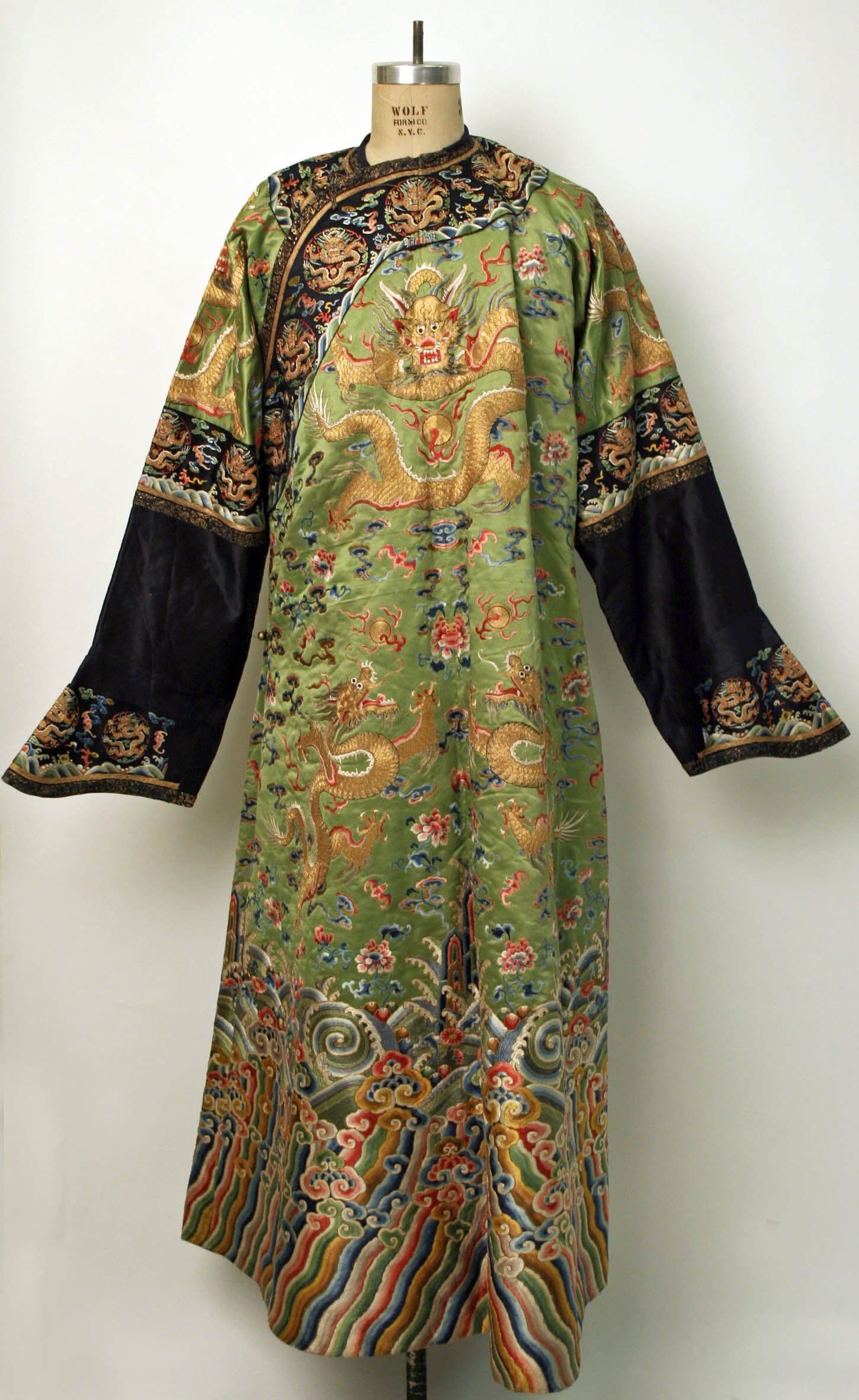
Qing court dress ran in tiers. The chaofu was full formal court dress, worn for state ritual, with a pleated or panelled skirt joined to a fitted upper body. The jifu was the semi-formal festive robe, cut straight and full length, and it is this garment that the English-speaking trade calls a dragon robe. The changfu was plainer everyday dress without dragons at all.
Within the jifu, longpao names the robe bearing the five-clawed long dragon and mangpao the robe bearing the four-clawed mang. That distinction is a regulation rather than a reliable description. From the eighteenth century onwards the rules were widely stretched, and by the late Qing five-clawed dragons appear on robes worn far below the ranks entitled to them.
Court dress was codified in the Huangchao liqi tushi, the Illustrated Precedents for the Ritual Paraphernalia of the Imperial Court, promulgated under the Qianlong emperor in 1759. It is the document every later description of Qing dress rests on, and the point at which colour, motif and rank were fixed on paper.
Reading the robe from the hem upwards
The design is a diagram of the universe, and it reads from the bottom.
- Lishui, the standing water. The band of diagonal stripes at the hem, rising in coloured rays. Its height is the single most useful dating cue on the garment.
- Pingshui, the still water. Above the stripes, the curling wave crests worked in rolling bands.
- The mountains. Rocky peaks rising from the waves at the front, back and sides, marking the world axis.
- The dragons. Nine on a complete jifu: four at chest, back and shoulders, four more around the skirt, and a ninth on the inner flap, hidden when the robe is closed. Counting eight and finding the ninth under the overlap is a good habit.
- The sky. Ruyi-headed clouds, bats for good fortune, shou roundels for longevity, and the Eight Buddhist or Eight Daoist emblems scattered between the dragons.
The twelve symbols of imperial authority, the shi'er zhang, including the sun, the moon, the constellation, the axe and the fu emblem, were reserved for the emperor. A robe carrying all twelve is an imperial garment and needs to be treated as an extraordinary claim, supported by provenance rather than by the presence of the symbols themselves.
Claws and colour
Bright yellow, minghuang, belonged to the emperor, the empress and the empress dowager. Other shades of yellow were allotted down the imperial line, and blue, brown and black grounds served the wider court and officialdom. Because yellow silk fades and browns shift with age, judge the ground colour inside a seam or under the collar where light has not reached.
The same imperial logic governs claw count across every medium, and the five-clawed dragon on porcelain follows exactly the rules it follows on silk, as set out in our guide to the five-clawed dragon as an imperial symbol. The yellow ground has its own strict history on ceramics too, traced in Qing imperial yellow porcelain.
Rank on a Qing official was carried by the badge, not by the dragon robe, and the square insignia sewn to the plain surcoat worn over the robe is the piece that names a man's grade. The system is set out in rank badges and buzi.
How the robe was made
Three techniques dominate, and they are worth a lot of price difference.
- Embroidery on satin. The commonest construction. Satin stitch, long-and-short stitch and Peking knot in floss silk, with the dragons outlined or entirely worked in gold.
- Kesi, cut silk tapestry. Woven to the design bobbin by bobbin, so the image exists in the structure of the cloth rather than on its surface. The slit boundaries between colour areas are diagnostic and are explained in the kesi tapestry guide.
- Brocade and figured silk. Woven grounds with supplementary wefts, often combined with embroidered detail.
Gold on a period robe is not thread but a narrow strip of gilded paper wound around a silk core, then couched to the surface with fine silk stitches. Under magnification the paper edge shows, and where the gilding has rubbed the paper beneath reads warm and matt. Modern metallic strip is a coated synthetic filament: springy, uniformly bright, and it does not fray into a ribbon.
Dating a robe
- The hem. Early Qing lishui is a low band. It grows steadily through the eighteenth century and by the late nineteenth century can occupy a quarter of the garment's height. Proportion first, everything else second.
- The dragons. Eighteenth-century dragons are drawn with articulated limbs, an alert head and a sense of movement. Later dragons flatten, the faces round out, and the bodies become more decorative than muscular.
- The colour range. Synthetic dyes reach Chinese workshops in the later nineteenth century and bring magenta, harsh purple and acid green into the palette. A vivid mauve on a robe otherwise presented as mid-Qing is a problem.
- The cut. Horseshoe cuffs, matixiu, and the side slits are standard, but the length of the body, the width of the sleeve band and the depth of the collar band all shift, and a robe altered for Western wear loses these proportions entirely.
Portraits are a useful control. Ancestor portraits show robes as they were worn, correctly assembled with hat, collar and surcoat, and comparing a garment against painted evidence of its supposed period catches a good deal, as ancestor portraits show.
Alterations: the most common problem in the market
Most dragon robes that reached the West were not kept as they left China. Sleeves were shortened, side slits stitched closed, collars removed, bodies cut down for shorter wearers, and whole panels taken out to make cushions, table covers, screens and ecclesiastical vestments. A robe advertised as complete is worth checking seam by seam.
- Look for the ninth dragon. Its absence usually means the front flap was cut away.
- Check the sleeve joins. Extensions in slightly different silk, or a sleeve band that does not meet its neighbour, indicate reworking.
- Feel the hem. A turned-up hem that shortens the lishui band is a common alteration and it destroys the dating evidence.
- Read the lining. Replaced linings are normal and not fatal, but a lining in machine-woven cloth stitched by machine tells you when the last intervention happened.
An unaltered robe with its original lining, collar and cuffs commands a substantial premium over a cut-down one of the same date and quality. Say plainly what has been done to a piece when you sell it, because the next specialist will find it.
Condition, storage and display
Silk fails in predictable ways. Weighted dark dyes, particularly browns and blacks, embrittle and shatter into fine splits. Light fades the ground and the flat colours, while the golds tarnish. Underarms, shoulders and the hem take the wear.
Store a robe flat if you have the depth, or rolled on a padded tube, never on a hanger where its own weight pulls the shoulders apart. Interleave with acid-free tissue, keep it dark, and accept that any display is a slow expenditure of the object. Rotate anything you hang, and mount it on a padded board with full support rather than suspending it from the shoulders. The wider practicalities of keeping textiles and works on paper safe are covered in shipping, insurance and storage.
Common questions
How can I tell a real Qing dragon robe from a reproduction?
Turn it inside out. Hand embroidery shows individual stitch tails and couching threads on the reverse, while machine work shows a continuous locked bobbin line. Period gold is gilded paper wound on a silk core and frays into a ribbon; modern metallic is a plastic-coated strip. Qing silk was woven narrow, so a period robe is pieced from loom widths and the seams are visible. Finally, check the dyes for the harsh magentas and greens that only arrive late in the nineteenth century.
Does the number of claws tell me who wore the robe?
Only loosely. The regulations reserved the five-clawed long for the emperor and the senior imperial line, with the four-clawed mang for lower ranks, but enforcement weakened through the Qing and by the nineteenth century five claws are found on robes far down the social scale. Treat claw count as one piece of evidence among the ground colour, the quality of the work and the provenance, never as proof on its own.
What is a dragon robe worth?
Price follows condition and completeness before date. An unaltered eighteenth-century kesi robe with its original collar and cuffs sits at the top of the market; a cut-down late-Qing embroidered robe with a replaced lining sits far below it, even though both are genuine period garments. Shattered silk in the dark areas, heavy fading and missing gold each take a substantial bite. Get a textile specialist to look before you commit to a figure.
Can dragon robes be exported and sold internationally?
Antique textiles are subject to the cultural property rules of the country they are in and the import rules of the destination, and the restrictions on Chinese antiquities are tighter than most private owners expect. Check both ends before you consign a robe abroad, and keep whatever import and purchase paperwork came with the piece, since for textiles that paper is frequently the only provenance that exists.
Is it safe to wear or hang an antique robe?
Wearing one is not safe. The silk has lost much of its tensile strength, and the shoulders and underarms are already the weakest points. Hanging from the shoulders concentrates the whole weight on those same seams. Support the garment across its full width on a padded board or store it flat, and treat any display period as a deliberate, time-limited cost to the object.
Further reading
- Chinese art export rules — what may cross a border, and what paperwork has to travel with it.
- Provenance documents — building a history for an object that arrived without one.
- The bird and flower symbolism decoder — the bats, cranes and peaches that fill the sky around the dragons.
Browse the collection
Court textiles are a subject we write about rather than one we stock. Kiln and Ink publishes limited-edition archival giclee reproductions of the twentieth-century Chinese ink masters, hand-numbered and issued with a Certificate of Authenticity, and several of those painters drew directly on the same repertoire of dragons, clouds and auspicious emblems that covers a Qing court robe. Browse the collection to see the artists currently in print.
Explore Further