Published May 6, 2026
Every fine-art print should be hand-numbered. Most aren't, and the difference matters. This is what an edition number actually tells a buyer, why the size of the edition is the single most important detail after the artist's name, and the four certificate red flags that mean a work is not what it claims to be.
Every fine-art print should be hand-numbered. Most aren't, and the difference matters. This is what an edition number actually tells a buyer, why the size of the edition is the single most important detail after the artist's name, and the four certificate red flags that mean a work is not what it claims to be.
What "47/200" means
On a fine-art limited-edition print you will usually see two numbers, separated by a slash, in pencil at the bottom of the work — typically below the image and above the publisher's chop or the artist's signature. Conventionally: 47/200. The first number is the print's position in the run; the second is the total size of the edition.
This means there are two hundred prints in this edition, and you are looking at the forty-seventh one made. Both numbers are written by hand, in pencil, after the print is pulled. Pencil is used because it cannot be confused with a printed mark, and because if there is ever a question of authenticity the original pencil mark can be examined under magnification.
Why edition size is the most important number on the certificate
Edition size determines almost everything about a print's collectible value, second only to the artist. The general rule: the smaller the edition, the more closely the print's behaviour resembles an original.
Editions of 1 to 25 are exceedingly rare in the modern Chinese-master print market and trade as near-original objects. Editions of 50 to 100 are the scale most associated with serious collector editions, because scarcity is the one variable a publisher cannot walk back later. Editions of 100 to 250 are the most common scale for major modern Chinese masters and are the entry point for collecting at sub-$5,000 price points. Editions of 500 to 1,000 are decoration-grade — they look the same on the wall, but the larger the edition, the less the number on it means. Anything over 1,500 is effectively a poster, regardless of the marketing language.
The other number that matters
Some prints carry an additional letter-number combination: A/P (artist's proof), H/C (hors commerce, "outside the trade"), or P/P (printer's proof). These are reserves outside the numbered edition — typically 5 to 15% of the edition size — and are kept by the artist's estate, the printer, and the publisher for personal use, exhibition copies, and gifts.
A/P prints are not less valuable than numbered prints — they are usually more valuable, because they are scarcer. A run of 200 with 20 A/Ps means there are 220 prints total, but the 20 A/Ps trade at a 10–30% premium because they are rarer in the market and were typically retained by the people closest to the work.
The four certificate red flags
The Certificate of Authenticity (COA) is the legal document that lets a print exist as a fine-art object rather than a poster. A real COA is specific. A fake COA is generic. Four red flags:
First, missing edition information. The certificate should explicitly state the edition size, the print number, and any A/P designation. "Limited edition" without a number is meaningless.
Second, no source-work specification. The certificate should name the original work being reproduced — the year, the medium, the dimensions of the original. "Print after Qi Baishi" with no further detail is a red flag.
Third, no paper or ink specification. A real fine-art print is identified by its substrate and inks. The certificate should name the paper (Hahnemühle, Canson, archival Xuan, etc.) and confirm the inks are pigment-based and archival. Generic "high-quality archival materials" is marketing language, not specification.
Fourth, no issuing party. The certificate should be signed by — and traceable to — a specific publisher, gallery, or estate. A certificate from "the artist" is impossible for any deceased master; a certificate from an unnamed party is worthless.
How Kiln & Ink handles this
Every Kiln & Ink print is hand-numbered in pencil at the time of pulling. Every print ships with a Certificate of Authenticity that records: the print number, the total edition size, the source work and its original year, the paper specification (archival Xuan from a licensed Jing County mill), the inks (pigment-based, twelve-channel, archival), and the issuing party (Qingxuan International Trading Limited, the Hong Kong corporate entity behind Kiln & Ink).
Editions are kept small — typically 100 to 250 prints, depending on the source work — and are closed permanently when the run completes. The print register is maintained at Kiln & Ink's Hong Kong office and is available for verification on request, by edition number, in perpetuity.
The certificate is part of the work, not a side document. Keep it with the print, in its archival sleeve, for the life of the collection. If you ever wish to resell, insure, donate, or have a print independently appraised, the certificate plus the pencil-numbered edition mark is what makes the print collectible rather than decorative — and that is the only thing that matters.
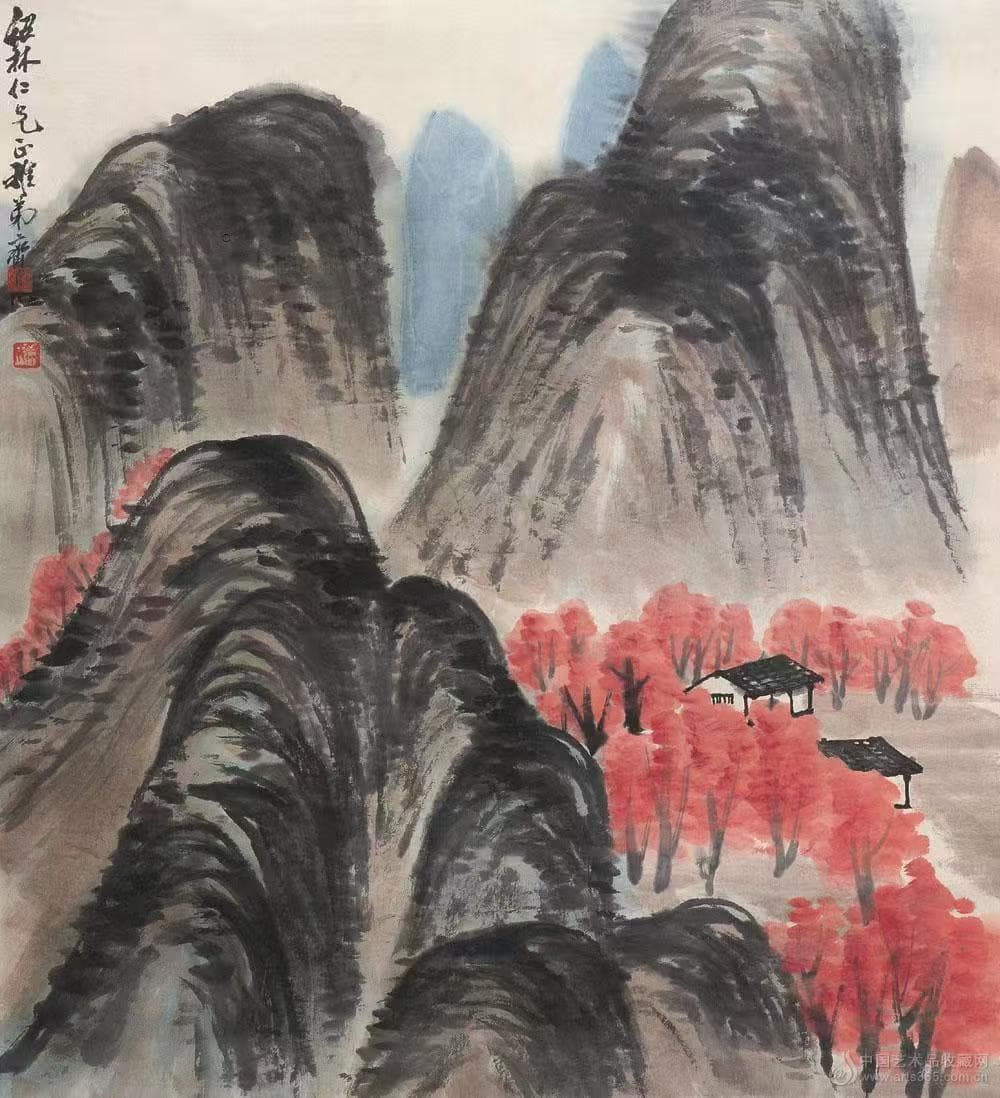
From the Kiln & Ink collection: Fine Autumn Scenery, an archival giclée edition after Qi Baishi, hand-numbered on xuan paper with a certificate of authenticity.
Explore Further