Published July 18, 2026
Chinese snuff bottles pack glass, jade, and inside-painted artistry into a palm-size format. What they are, what drives value, and how to start collecting.
Hold a good Chinese snuff bottle and your thumb finds the answer to a question you didn't know you had: why collectors get obsessed with an object smaller than a chicken's egg. The walls of a hardstone bottle are carved so thin that light passes through them; the stopper lifts to reveal a tiny spoon; the whole thing sits in the palm with the finished density of a much larger sculpture. It is the most concentrated collecting category in Chinese art.
This guide covers where snuff bottles came from, the materials hierarchy that organizes the field, the inside-painted bottles that astonish first-time viewers, and the practical checks — hollowing, wear, stopper, mark — that help you buy your first bottles well.
Why China put snuff in bottles
Tobacco reached China through European maritime trade in the late Ming and early Qing periods, and while smoking was periodically discouraged, powdered snuff found favor at the Qing court — it was taken as a medicine for congestion and headaches as much as a pleasure. Europe carried snuff in boxes; China, in a more humid climate, preferred small stoppered bottles that kept the powder dry, dispensed with a spoon attached to the stopper.
From the Kangxi period onward, the court glassworks and palace workshops produced bottles for imperial use and imperial gift-giving, and the habit spread outward through the official class during the eighteenth and nineteenth centuries. By the late Qing, a gentleman's snuff bottle was jewelry, credential, and conversation piece at once — offered, admired, and compared at every social encounter. That social function explains the field's astonishing variety: a bottle was made to be handled and shown, so every material and technique in the Chinese decorative repertoire was eventually tried at snuff-bottle scale.
The materials hierarchy
Snuff-bottle collecting is organized by material first, then by quality within the material. The broad map:
| Material | What to know ||---|---|| Glass | The core imperial material — plain colored glass, aventurine, and carved overlay (cameo) glass with up to several color layers cut back to a contrasting ground || Porcelain | Jingdezhen production, often enamel-painted; molded forms appear in the nineteenth century || Nephrite and jadeite | Judged like all jade — color, translucency, and the quality of hollowing || Agate and chalcedony | Carvers exploited natural inclusions, turning a stray brown vein into a fisherman or a bird — the best "cameo agates" are keenly contested || Amber, coral, lacquer, mother-of-pearl | Smaller categories, collected for rarity and charm || Inside-painted glass and crystal | A late-Qing specialty painted through the neck — see below |
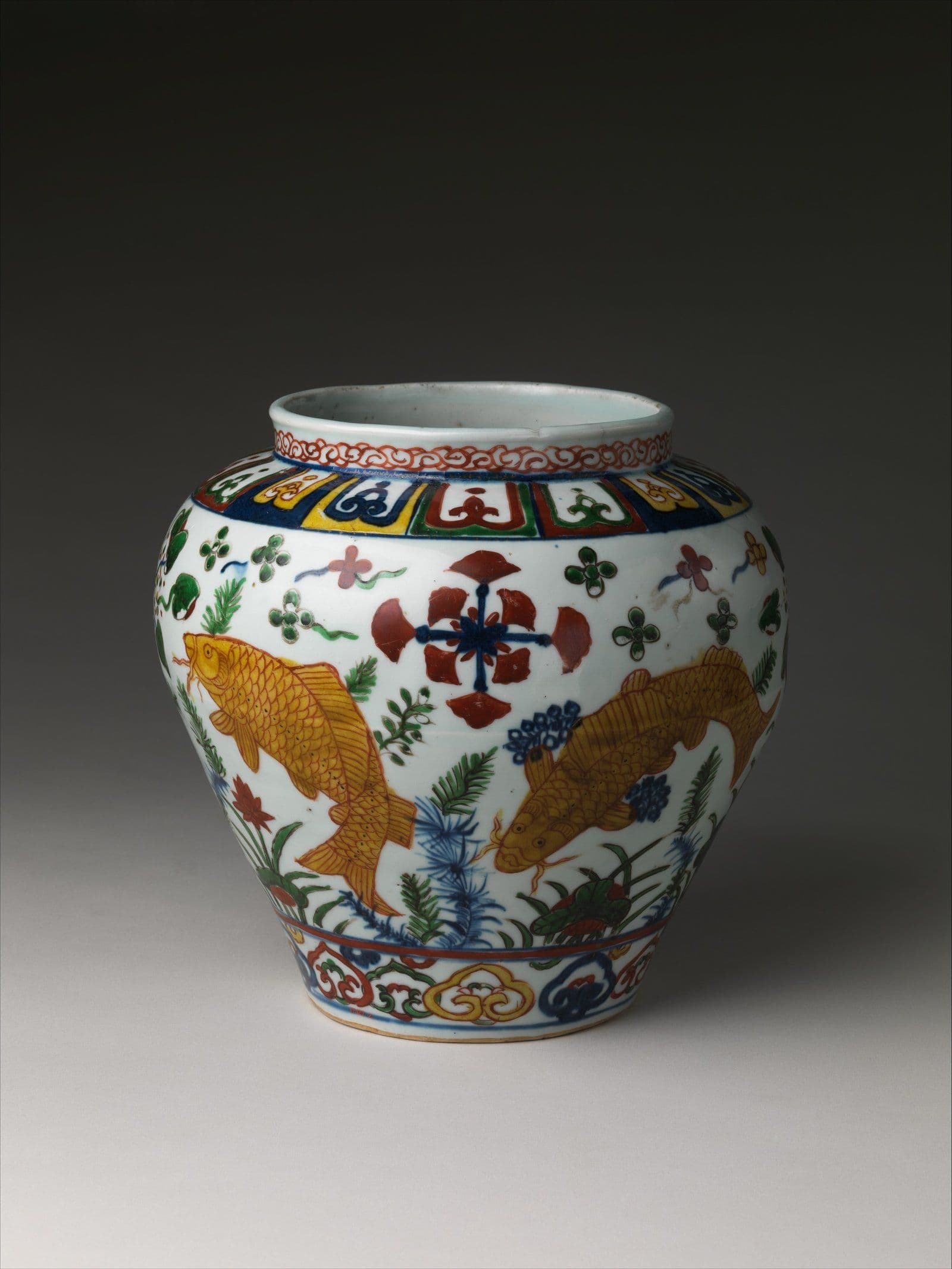
Overlay glass rewards close looking: the crispness of the carving where the colored layer meets the ground is the fastest quality read. On porcelain bottles, the enamel palette itself helps with dating — the same distinctions that separate famille verte from famille rose on full-size wares apply at bottle scale.
On hardstone bottles, the invisible virtue is hollowing. A great agate or jade bottle has been ground out through its narrow neck until the walls are eggshell-thin and the bottle floats in the hand. Thick, heavy, roughly hollowed stone bottles were quicker to make and are worth correspondingly less. Weight is the first test a specialist applies, and you can apply it too.
Inside-painted bottles: the upside-down miniature
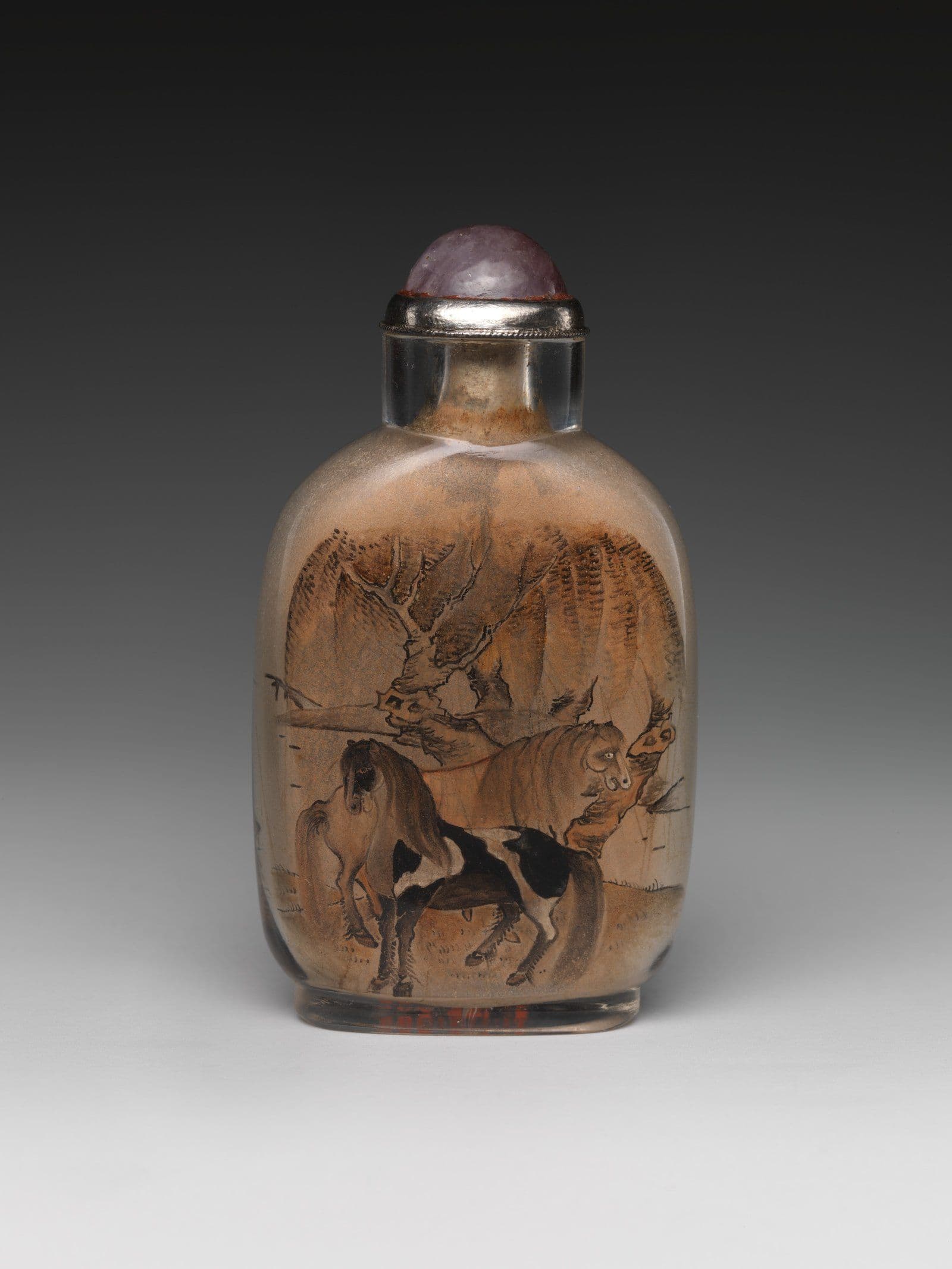
The inside-painted (neihua) bottle is the category that stops people. A painter works through the bottle's neck with a minute bent brush, painting in reverse on the frosted interior wall of a glass or crystal bottle — landscapes, portraits, calligraphy, whole narrative scenes, executed back-to-front in a space the size of a matchbox.
The technique is a nineteenth-century development, and the finest classical work came from masters active in Beijing in the late Qing and early Republic — names such as Ye Zhongsan are cornerstones of the specialty. The tradition never died: inside-painting continues today as a living craft, and modern bottles of real skill are made in workshops in northern China. That continuity is good news for the art but demands category discipline from the buyer — a contemporary inside-painted bottle should be priced as contemporary craft, not as a Qing antique, however accomplished the brushwork.
Condition matters intensely here. The painting is a thin layer on the interior surface; bottles that were actually used for snuff often show scouring from the spoon, and moisture damage can lift or cloud the pigment. Examine inside-painted bottles against strong light, and ask explicitly about interior condition before buying.
How to judge a bottle in the hand
Five checks organize a first assessment.
Hollowing and weight. For stone bottles: thinner and lighter is better, all else equal. For glass and porcelain this check matters less, but crude, heavy potting still signals late or careless work.
Wear. A genuinely old bottle that saw use shows soft, even wear at the high points, around the neck, and on the foot — wear a pocket and a thumb produce over decades. Fresh-cut surfaces with artificially dulled patches are the classic sign of a modern bottle dressed as an old one.
The stopper and spoon. Stoppers are usually replacements at some point in a bottle's life — coral, jadeite, glass — and an ill-fitting or wrong-scale stopper is normal rather than damning. But a well-matched period stopper adds real charm and some value.
The mark. Porcelain and some glass bottles carry reign marks, most often four-character Qianlong or Daoguang marks. As everywhere in Chinese ceramics, the mark is a claim, not a certificate — Qianlong marks in particular were applied reverentially for a century after the reign, a habit our guide to Qianlong six-character seal marks covers in depth. Read the mark as one input alongside material and workmanship.
The story. Snuff bottles are small, portable, and were produced and copied in enormous numbers, so documented history counts. A bottle from a named old collection, or one that appears in an exhibition catalog, carries a premium for good reason — provenance is evidence, and in a field this reproducible it is the strongest evidence there is.
The market: an accessible summit
Snuff bottles are among the most approachable serious categories in Chinese art. The field has an unusually organized collector community — the International Chinese Snuff Bottle Society publishes research and holds conventions — and the major auction houses have run dedicated snuff-bottle sales for decades, many built from named single-owner collections.
The price pyramid is wide at the base. Honest nineteenth-century glass and agate bottles of decent quality remain genuinely affordable at auction — an entry point measured in hundreds rather than many thousands of dollars — while the summit, imperial enameled glass and the finest palace-workshop pieces, competes with major porcelain at the top of the market. In between sits a deep middle field where knowledge pays: the collector who has learned to feel hollowing and read wear can still find quality underpriced, which is precisely the pleasure of the category. Auction basics — condition reports, estimates, premium math — apply at bottle scale exactly as our first-time bidder's playbook describes.
A note on organic materials: some older bottles are ivory or incorporate ivory stoppers and spoons. Trade in ivory is now heavily restricted across most jurisdictions, and buying, selling, or shipping such pieces may be illegal where you live — know your local rules before bidding on organic materials.
Common questions
Were snuff bottles actually used, or just collected?
Used, intensively. Snuff-taking was a daily social habit in Qing China, and most bottles show it — spoon scour inside the neck, wear on the high points, stoppers replaced along the way. Purely ornamental production for the collector market grew in the late Qing and never stopped; by the twentieth century many bottles were made to be admired rather than filled. Signs of honest use are welcome on an old bottle, not defects.
What makes one snuff bottle worth vastly more than another?
Material quality first, then workmanship, then imperial association, then provenance. A palace-workshop enameled glass bottle sits at the top because all four align. Within any material, look for the hard-to-fake virtues: hollowing on stone, carving crispness on overlay glass, painterly quality on inside-painted bottles, and a documented history for anything ambitious.
How can I tell a modern bottle from a Qing one?
Weight and wear do most of the work. Modern stone bottles are usually thicker-walled; modern wear is either absent or artificially uniform. On porcelain, mark style and enamel palette date a bottle the way they date any Jingdezhen ware. And treat suspiciously perfect examples of famous types with extra care — the field's popularity means workshops have copied every celebrated model. When the price is serious, buy through specialists and insist on condition and attribution in writing.
Are inside-painted bottles a good place to start?
They are a wonderful place to look and a demanding place to buy. The visual appeal is immediate, but classical examples by recorded masters carry strong premiums, and the market contains a very large volume of modern work. Starting with honest Qing glass or agate bottles builds the handling instincts — weight, wear, hollowing — that the whole field runs on, and costs less while you learn.
Further reading
- Album Leaves and Fan Paintings: The Affordable Formats of Chinese Painting — the painting world's parallel entry point, for the same reasons.
- How to Care for Chinese Porcelain — handling and display habits that apply directly to porcelain and glass bottles.
- How to Spot Fake Chinese Porcelain Marks — the mark-reading discipline, useful on bottle bases too.
- Chinese Monochrome Glazes: A Collector's Guide — the single-color aesthetic that many glass bottles borrow from porcelain.
Browse the collection
We do not sell ceramics. The Kiln & Ink collection is limited-edition archival giclée reproductions of Qi Baishi, Xu Beihong, Wu Guanzhong, Zhang Daqian and their contemporaries — hand-numbered, printed on rice paper, and supplied with a Certificate of Authenticity.
Explore Further