Published August 17, 2026
Jingtailan is Chinese cloisonné enamel: how the wire and enamel design is built, why Jingtai marks mislead, Ming versus Qing, and what to check.
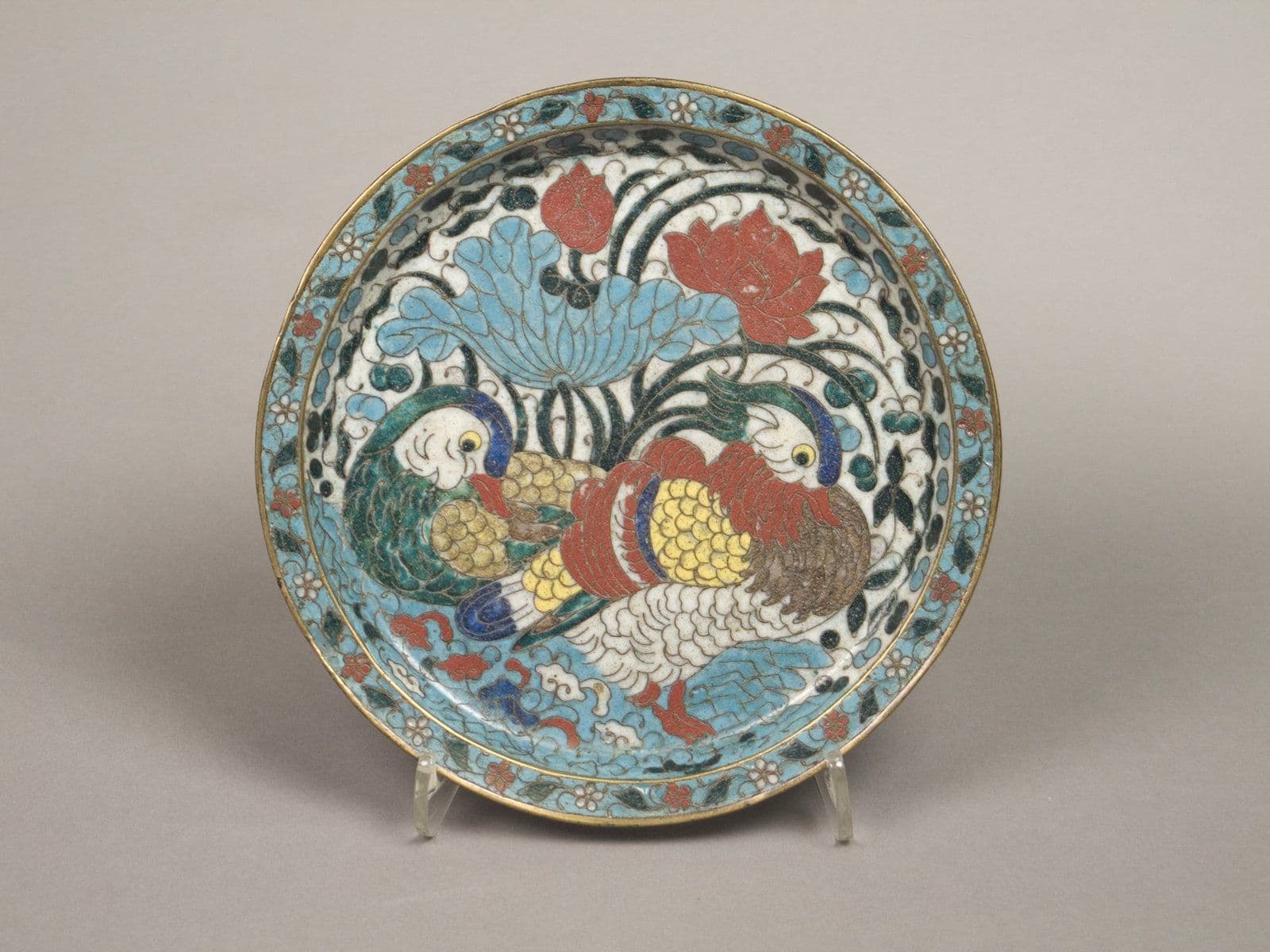
Look closely at the enamel on an early Chinese cloisonné vessel and you will usually find pitting — small craters in the coloured surface, concentrated in the reds and whites. On a twentieth-century export piece the enamel is typically flat and uninterrupted. That difference is not damage. It is a by-product of how the enamel was prepared and fired, and it is one of the first things an experienced eye goes looking for.
This guide explains how a cloisonné vessel is actually built, why the Chinese name for it is misleading, what changes between Ming and Qing work, and what to examine before buying.
How a cloisonné vessel is made
Cloisonné is a metalworking technique before it is a decorative one. The sequence runs roughly like this:
- A body is formed in copper — hammered, or in later work spun or cast — because copper conducts heat evenly and expands at a rate compatible with glass.
- Thin wires, the cloisons that give the technique its French name, are bent to follow the design and fixed to the body, forming hundreds of small cells.
- Each cell is packed with enamel: powdered glass coloured with metal oxides and mixed to a paste.
- The piece is fired. The glass fuses and shrinks below the level of the wires, so the cells are refilled and fired again, several times over.
- The surface is ground flat against stones until wires and enamel sit in one plane, then polished.
- Exposed metal — wire tops, rims, foot, handles — is gilded.
Almost everything a collector judges follows from that sequence. Pitting comes from air trapped in the paste during firing. The crispness of the design depends on the wire work. The evenness of the surface depends on how patiently the grinding was done. And the colour and wear of the gilding tell you about both period and later restoration.
The copper body also connects these objects to a much older Chinese metalworking inheritance. The techniques are unrelated — cloisonné is built up, ritual bronze was cast — but the status of worked metal as a vehicle for imperial display runs continuously between them.
Cloisonné, champlevé and painted enamel
Dealers routinely describe three different enamelling techniques as "cloisonné". They are not the same thing, they were not equally valued, and telling them apart takes about ten seconds once you know what you are looking at.
- Cloisonné (diaosi falang) builds the cell walls from applied wire. Look at a dividing wall end-on where it meets the rim: it should read as a thin, flat ribbon of metal standing on the surface, of consistent thickness along its length.
- Champlevé (zantai falang) carves the cells out of a thicker metal body, so the dividing walls are the body. The walls are noticeably heavier, they vary in thickness where the carving wandered, and the design tends to be bolder and less intricate because a gouge cannot follow a tight curl the way a bent wire can.
- Painted enamel (huafalang) has no cells at all. Enamel is painted directly onto a metal ground and fired, which allows shading and blended tone impossible within wire cells. It developed under the Kangxi emperor with European technical input and is strongly associated with Guangzhou, which is why it is often sold as Canton enamel.
The distinction matters commercially as well as descriptively, because the three were made in different quantities and are valued differently. It also explains a connection collectors often miss: the shading achieved in painted enamel is the same technical advance that produced the famille rose palette on porcelain.
The Jingtai problem
The Chinese name for cloisonné is jingtailan (景泰藍), literally "Jingtai blue", after the Jingtai reign of the Ming dynasty (1450–1457), which became associated with a distinctive turquoise-blue ground.
The name has caused a great deal of trouble, because it encouraged centuries of pieces to be marked "Jingtai" regardless of when they were made.
Two points are worth holding onto:
- The technique did not originate in China. Enamelling on metal has a long history in the Byzantine and Islamic worlds, and it most probably reached China overland by the Yuan dynasty. What China did was absorb it, scale it and refine it.
- The earliest reliably datable Chinese cloisonné carries Xuande reign marks (1426–1435), which is earlier than Jingtai. A great many "Jingtai" marks are later additions, applied out of homage, out of commercial motive, or simply out of convention.
The practical rule: a Jingtai mark is not evidence of a Jingtai date. Marks on cloisonné reward the same scepticism as marks on porcelain, and the same reign-mark literacy applies to both.
Ming and Qing: what actually changes
Rather than trying to date to a single reign, most collectors first place a piece in a broad period. The useful contrasts:
Earlier work, broadly Ming
- Heavier gauge wire, sometimes visibly uneven in width.
- A more restricted palette, with the characteristic turquoise ground doing much of the work.
- More pitting in the enamel, particularly in reds and whites.
- Gilding often worn through to the copper on high points and handling surfaces.
- Vigorous, slightly irregular design — lotus scrolls that breathe rather than repeat mechanically.
High Qing work, especially the Qianlong period (1736–1795)
- Finer and more even wire, allowing much denser and more intricate designs.
- A wider colour range, including pinks and opaque whites that earlier palettes lacked.
- Noticeably less pitting, as enamel preparation improved.
- Elaborate gilt-bronze mounts, and cloisonné combined with other techniques on a single object.
- Larger and more ambitious forms, produced in quantity for the imperial workshops in Beijing.
Late Qing and Republic-period export work
- Very regular, machine-drawn wire.
- Thin, light bodies.
- Bright, even enamel with little pitting.
- Repetitive designs aimed squarely at a foreign market.
None of these lists is a test on its own. A restored Ming piece can carry modern enamel in the losses, and a fine Republic-period piece can be beautifully made. Read the object as a whole rather than hunting for a single decisive feature.
What to examine before you buy
- The wires. Uneven, hand-drawn wire points to earlier manufacture; perfectly uniform wire suggests later work. Check also whether wires are missing where enamel has been lost, which usually indicates repair.
- The pitting pattern. Look for pitting distributed consistently across a colour rather than concentrated in one patch. A locally smooth area within an otherwise pitted colour often marks a restored section.
- The gilding. Original fire-gilding wears where a hand would touch. Uniformly bright gilding on an otherwise worn object generally means it has been regilded.
- The interior and base. These are usually left plainer, and they are a good place to judge the quality of the copper and the honesty of the piece.
- Rims and mounts. Replaced rims are common and not necessarily disqualifying, but they should be reflected in the price.
- Enamel colour against the claimed date. A strong pink on a piece presented as early Ming is a serious question, because that part of the palette arrived late.
Cloisonné belongs with carved lacquer and the enamelled porcelains among the great labour-intensive Chinese decorative arts, and one principle governs all of them: the value sits in the hours, so look carefully at where the hours went. The enamel chemistry here is close kin to that of famille rose on porcelain, while the sheer accumulation of skilled hand-work has more in common with carved lacquer.
Common questions
Why is Chinese cloisonné called jingtailan if it predates the Jingtai reign?
Because the Jingtai reign became associated with a particularly admired turquoise-blue enamel ground, and the name attached itself to the whole technique. Datable Chinese cloisonné exists from earlier in the Ming, carrying Xuande marks. The name describes a reputation rather than an origin, which is precisely why Jingtai marks turn up on pieces from every period that followed.
Is pitting in the enamel a defect?
Not in early work. Pitting is caused by air trapped in the enamel paste during firing, and it is normal on Ming and earlier Qing pieces. Its near-total absence is more informative than its presence: very flat, even enamel across an entire object usually points to later manufacture or to extensive restoration.
How do I tell antique cloisonné from twentieth-century export ware?
Look at the wire first. Export ware uses uniform machine-drawn wire, and tends to have thin, light bodies, flat enamel and designs that repeat exactly. Earlier work shows variation in wire gauge, some pitting, gilding worn in places that make physical sense, and design that varies across the surface.
Does a reign mark help date a piece of cloisonné?
Less than collectors would like. Marks were applied retrospectively and commemoratively for centuries, and Jingtai marks in particular are frequently apocryphal. Treat the mark as one input, weighted well below construction, wire, enamel and gilding.
Further reading
- Famille Rose and Fencai Enamels — the same enamel chemistry applied to porcelain.
- Chinese Carved Lacquer: A Collector's Guide — the other great labour-intensive Chinese decorative art.
- Chinese Bronze Vessels — the metalworking tradition standing behind the copper bodies.
- Ming Dynasty Reign Marks — how to read the marks that cloisonné borrowed, and abused.
Browse the collection
Cloisonné is a subject we write about rather than one we stock. What Kiln & Ink sells is paper: limited-edition archival giclée reproductions of the twentieth-century Chinese ink masters, printed on rice (xuan) paper or museum-grade cotton rag, each one hand-numbered and issued with a Certificate of Authenticity, from about $300 to $1,200.
Explore Further