Published July 24, 2026
Rose medallion is Canton export famille rose porcelain. How to identify it, date it from country-of-origin marks, and gauge what an inherited set is worth.
There is a good chance you have already met rose medallion: a platter on a grandmother's sideboard, a punch bowl brought out at holidays, a pair of vases too pink and too busy to ignore. Panels of tiny court figures alternate with birds and peonies, all crowded onto a rose ground netted with gold, with no bare porcelain anywhere. For a century it was the Chinese export ware Americans lived with, and it is still the most common Chinese porcelain to come down through a family.
This guide explains what rose medallion actually is, how it relates to the wider world of Canton export porcelain, how to place a piece in time from its pattern and its marks, and how to think honestly about what an inherited set is worth. If a rose-ground service has landed in your hands, start here.
What rose medallion is
Rose medallion is Chinese export famille rose porcelain, decorated in Canton — today's Guangzhou. The system that made it was a division of labor across a river. Plain white porcelain was thrown and fired at the great kiln city of Jingdezhen, then shipped downriver to workshops in and around Canton, where enamellers painted it in overglaze famille rose colors and gilded it for the export trade. From Canton's docks it sailed to Europe and, in enormous quantity, to America.
The palette is the key to the whole family. Famille rose — fencai, "soft colors" — is the opaque, shaded enamel palette built around a pink derived from gold, introduced in the early eighteenth century. It is the successor to the older, flatter green-led enamels, a distinction worth having clear and one covered in the guide to famille rose versus famille verte. Rose medallion is that pink-centered palette applied at export scale: peonies, butterflies, and figures massed into panels and grounds until every inch is covered.
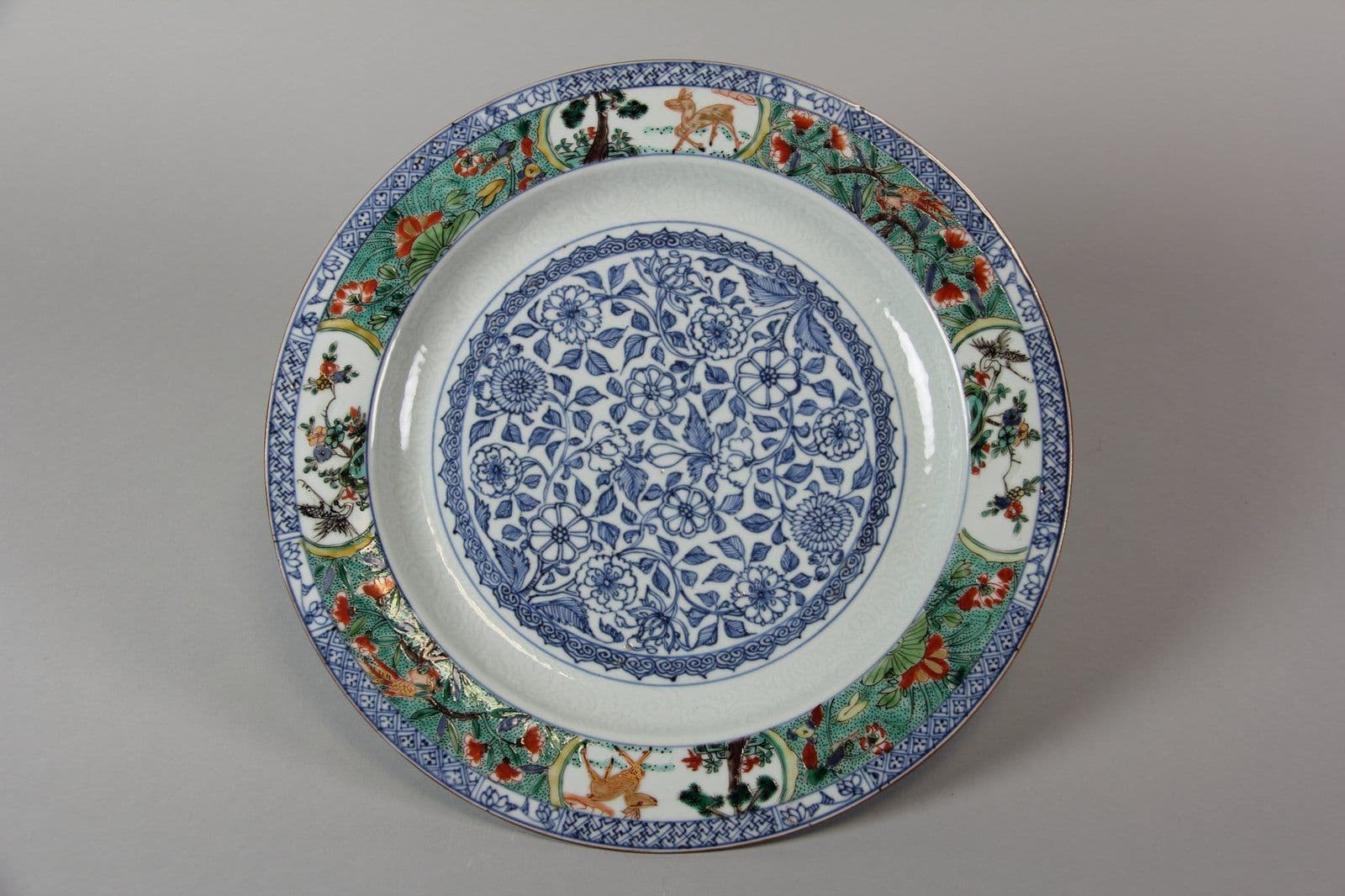
The look is deliberately dense. Reserves — framed panels — sit against a ground packed with rose peony blossoms, green leaves, butterflies, and fruit, laced together with gilt tracery. In the classic rose medallion arrangement, the panels alternate between groups of Chinese figures and passages of birds and flowers, radiating around a central medallion. That alternation of people and flowers is the pattern's signature.
Rose medallion, rose Canton, and Mandarin ware
"Rose medallion" is one term in a small family of American collector labels, and keeping them straight sharpens your eye.
Rose medallion proper alternates figural panels with bird-and-flower panels around a central rose medallion. Both people and nature appear.
Rose Canton uses the same dense rose ground but fills the panels with flowers, birds, and butterflies without human figures. If there are no people, collectors tend to call it rose Canton rather than rose medallion.
Mandarin palette, or "Mandarin ware," leans the other way — heavy on figural court scenes, the "mandarins" of the name, often with a broader range of ground colors and sometimes iron-red and gold borders. It reads as more of a figure-painting tradition than a floral one.
These are trade conventions, not imperial categories — they grew up in the nineteenth-century Western market to sort what was arriving by the crate. Dealers use them loosely, and a single service can drift between labels. What matters is learning to see the two variables underneath: how much of the surface is figures versus flowers, and how the panels are arranged against the ground.
All of this belongs to a long export lineage. A century earlier the export trade ran on blue-and-white, and the transition from those earlier wares to the enameled Canton porcelain is part of the same commercial story told in the account of Chinese export porcelain and kraak marks.
Placing a piece in time
Most rose medallion was made across the nineteenth century and well into the twentieth, so "how old is it" usually means "where in that span." A few reliable signals help.
The country-of-origin mark is the strongest clue. Much rose medallion is entirely unmarked, and an unmarked base is normal, not suspicious. But American import law changed what had to be written on the foot. From 1891, the McKinley Tariff Act required imported goods entering the United States to be marked with their country of origin — so a piece stamped or painted "CHINA" generally dates from 1891 onward, not before. The later wording "MADE IN CHINA" points to the twentieth century, broadly from around the end of the First World War onward. A piece with no country mark at all is more likely to predate 1891, though absence of a mark is only suggestive.
Painting quality drops as volume rises. Earlier nineteenth-century Canton enamelling tends to show finer, more individualized faces, more controlled gilding, and a denser, better-organized ground. As the export machine scaled up late in the century and into the twentieth, faces become more formulaic, gilding thinner and more worn, and the whole surface a touch more mechanical. You are reading effort per piece, and effort per piece fell as demand climbed.
Form and gilding wear round out the picture. Genuine period gilding wears with use — thinning on rims, handles, and high points — in a way that is hard to fake convincingly. Uniformly bright, unworn gold on a supposedly old service is a reason to look harder. When you want to weigh condition properly against age and value, the vocabulary in the guide to reading auction condition reports transfers directly to inherited porcelain.
Rose medallion also sits at the hinge between Qing export ware and the modern era, which is why it connects naturally to collecting twentieth-century Chinese porcelain — many family pieces fall on the twentieth-century side of that line.
What an inherited set is worth
Here is the honest part, because it is the question most people actually have. The great majority of rose medallion that comes down through families is decorative-grade porcelain of the later nineteenth and twentieth centuries, and its market value is modest — pleasant, usable, collectible, but not a windfall. That is not a reason to dismiss it; it is a reason to enjoy it and to judge it clearly.
What lifts a piece above the common run is a combination of age, size, form, and painting. Finely painted early-nineteenth-century pieces, large and unusual forms such as big punch bowls, garniture vases, umbrella stands, and complete matched services in good order all command more than the ubiquitous small plates and teawares. Condition then either protects or erodes that value: chips, cracks, hairlines, and heavy gilt loss pull a piece down, while crisp enamel, intact gold, and no restoration hold it up.
Two cautions. First, twentieth-century and modern reproductions of rose medallion exist in quantity; watch for garish, flat pink, transfer-printed elements masquerading as hand painting, and clumsy, over-bright gilding. Second, resist the urge to "improve" an old set — aggressive cleaning strips gilding, and amateur repair almost always lowers value. If a service has sentimental weight, that is reason enough to keep it; if you are weighing sale, get more than one opinion before acting.
Common questions
Is rose medallion the same as famille rose?
Rose medallion is a type of famille rose — specifically Chinese export porcelain decorated in Canton in the famille rose palette, with the characteristic alternating panels of figures and flowers on a rose ground. Famille rose is the broader palette, used on everything from imperial wares to export services. So all rose medallion is famille rose, but most famille rose is not rose medallion.
How can I tell how old my rose medallion is?
Start with the base. An unmarked piece may well predate 1891; a piece marked "CHINA" generally dates from 1891 onward, and "MADE IN CHINA" points to the twentieth century. Then read the painting: finer, more individual faces and denser, better-controlled gilding suggest earlier work, while formulaic faces and thin, worn gold suggest later mass production. Genuine gilt wears on rims and handles with use. No single sign is decisive, but together they place most pieces within a decade or two.
Why is there no empty space in the design?
The crowded ground is the style, not a flaw. Canton export decoration deliberately filled every surface with peonies, butterflies, birds, and gilt tracery around the figural and floral panels — a dense, maximal aesthetic that suited both the taste of the export market and a workshop system paid to cover porcelain. The busyness is exactly what distinguishes rose medallion from sparer imperial wares.
Is my inherited rose medallion valuable?
Usually it is decorative-grade and modestly valued, especially the common later plates, bowls, and teawares. Value rises with age, size, unusual form, fine painting, complete matched services, and good condition; it falls with chips, cracks, hairlines, gilt loss, and any modern repair. Reproductions are common, so confirm the enamelling is hand-painted rather than transfer-printed. For a piece that might be early or unusual, a second professional opinion is worth seeking before you sell.
Further reading
- How to display a Chinese porcelain collection — making an inherited set look its best.
- How to care for Chinese porcelain — cleaning and handling without stripping gilding.
- The porcelain mark shape decoder — reading the base marks that survive on export wares.
Browse the collection
If the marks and glazes here have you looking at Chinese art more widely, our own catalogue runs to paper rather than clay — archival giclée reproductions of the modern ink masters, hand-numbered on rice paper and supplied with a Certificate of Authenticity.
Explore Further