Published August 17, 2026
A guide to collecting Yixing teapots: zisha clay types, slab construction, the three families of form, reading seals, and how to spot a reproduction.
Pick up a well-used Yixing teapot and look inside the lid. The interior is almost always darker than the outside — decades of tea have soaked into the body, because the body was never glazed and was never meant to be. That absorbency is the whole point of the object, and it is the reason this particular stoneware became the standard vessel for brewing Chinese tea.
This guide covers what zisha clay actually is, why the pots are built rather than thrown, how the main clay types differ, how to read the seals, and what to check before you buy.
What zisha actually is
Zisha (紫砂, "purple sand") is an iron-rich stoneware clay mined in the hills around Yixing, in Jiangsu province. It is fired unglazed at stoneware temperatures, which produces a dense body that remains very slightly porous.
Two consequences follow, and both matter to collectors:
- The body holds heat without being as prone to thermal shock as thin porcelain, which suits the short, repeated infusions of gongfu brewing.
- The body absorbs a small amount of tea oil with every use. Over years this builds an interior patina and, by long tradition, a faint memory of the tea. This is why experienced users keep one pot for one type of tea.
Colour comes from the ore itself and from the firing, not from anything applied to the surface. A Yixing pot wearing a bright applied glaze is a different category of object, and should be priced as one.
The rise of the form is tied to a change in how tea was drunk. As loose-leaf brewing displaced powdered and compressed tea during the Ming, the tall whisking bowls of the earlier tea culture — the Jian ware and tenmoku tradition among them — lost their purpose, and a small steeping vessel became the useful thing to own.
Why the pots are built, not thrown
Most ceramic vessels in the world are thrown on a wheel. Yixing pots, as a rule, are not.
The traditional method beats the clay into flat slabs, then either rolls a slab into a cylinder and paddles it into shape, or assembles the body from cut sections. Spout, handle, foot and lid are made separately and joined. The clay is worked with a set of specialised tools — horn, bamboo, metal — that compress and burnish the surface as the pot takes shape.
This is worth knowing for two reasons.
First, it explains the aesthetic. Slab construction supports crisp geometry — flat planes, sharp angles, precise polygons — that would be awkward to throw. The most admired classical forms are geometric in a way wheel-thrown pottery rarely is.
Second, it gives you something specific to inspect. On a well-made pot the joins are invisible from outside, but the internal finishing is still coherent; the spout is set cleanly through the wall; the lid sits with an even, quiet fit, and when the pot is full and the air hole is covered, the flow stops. Careless interior work on an expensive pot is a warning that should not be argued away.
The main clay types
Sellers use a large and inconsistent vocabulary. A few categories do real work:
- Zini — the classic purple-brown family, the broadest and most common, ranging from chocolate through to a dull plum.
- Zhuni — a fine, iron-rich red clay that shrinks heavily in firing. Because of that shrinkage, zhuni pots tend to be small and often show a faintly wrinkled surface. Genuine older zhuni is scarce and heavily imitated.
- Duanni — a buff, beige or pale yellow clay, frequently with a visibly speckled body.
- Lüni — a pale greenish clay, usually seen as a slip or an accent rather than as a whole pot.
Treat colour claims sceptically. Iron content and firing atmosphere can move a clay a long way, and a great deal of modern production is coloured with additives. The texture of a fracture and the feel of the surface tell you more than the name printed on the box.
The three families of form
Yixing form is traditionally sorted into three families, and the vocabulary is worth learning because sellers use it and because each family fails in a different way.
- Geometric forms (guanghuo) — plain, undecorated bodies built from flat planes and clean curves: cylinders, spheres, squares, truncated cones. With no decoration to hide behind, these are judged purely on proportion, crispness of edge and the quality of the surface. A weak geometric pot has nowhere to hide, which is why the classic shapes remain the hardest test of a maker.
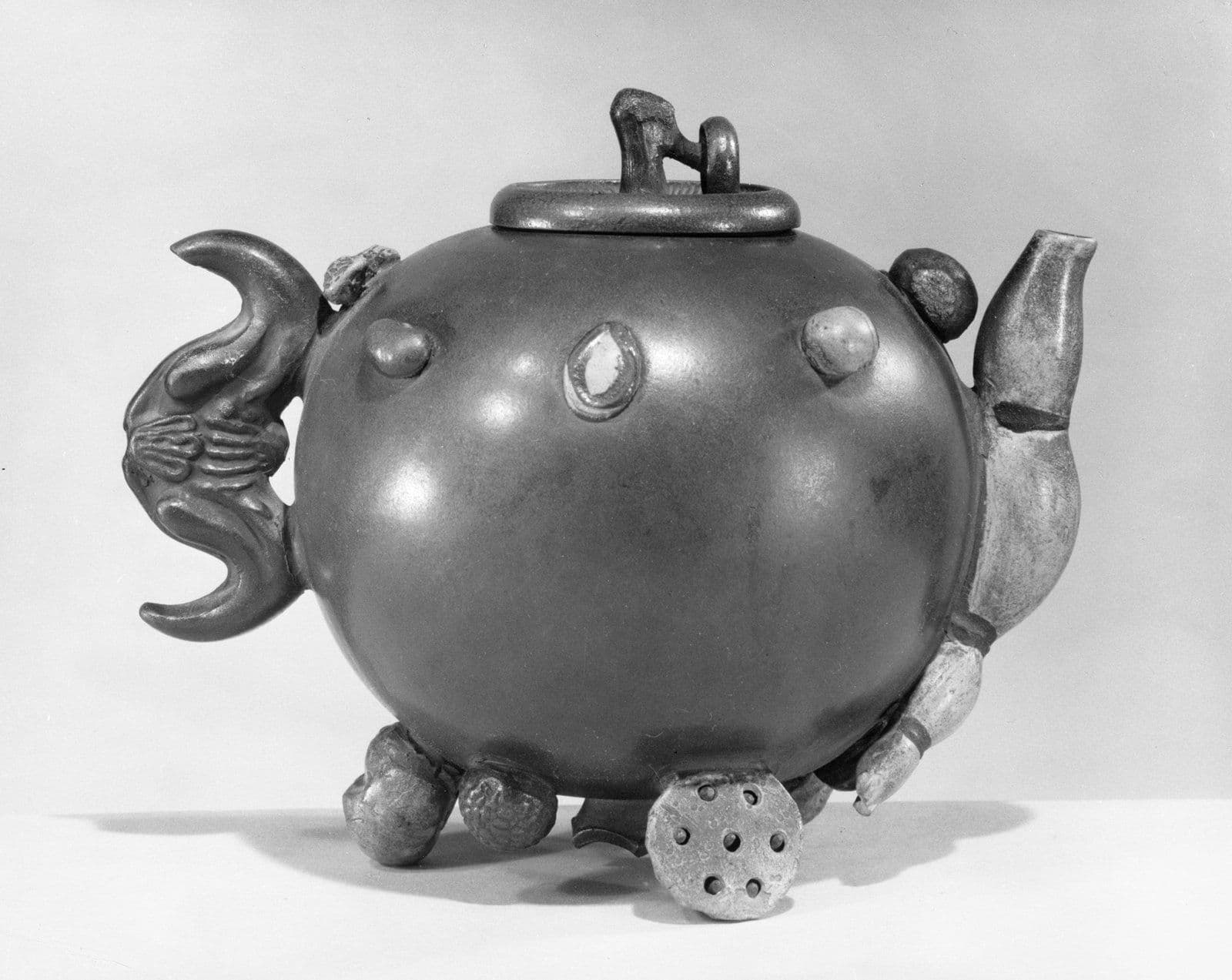
- Naturalistic forms (huahuo) — pots modelled as pine trunks, bamboo stems, lotus pods or gourds, with sculpted spouts and handles. These are judged on whether the observation is convincing and whether the pot still functions as a pot. Over-modelling is the usual failure: a beautiful object that pours badly.
- Ribbed forms (jinwenhuo) — bodies divided into repeating vertical segments, like a melon or a chrysanthemum. The test here is alignment. The ribs on the lid must meet the ribs on the body exactly, and must continue to meet when the lid is rotated. Sloppy segment work is immediately visible and cannot be corrected after firing.
Knowing which family you are looking at tells you what to be strict about.
Makers, seals and lineage
Yixing has a documented tradition of named makers, which is unusual in Chinese ceramics and shapes the market to this day.
The tradition begins in the Ming with the semi-legendary figure of Gongchun, whose story is better attested than his surviving work. Shi Dabin, working in the late Ming, is the first maker whose reputation rests on a solid body of documented pots, and he is credited with establishing the small scale that suits gongfu brewing.
In the Qing the teapot became a literati object. An early-nineteenth-century scholar-official, Chen Mansheng, collaborated with Yixing potters on a series of pots carrying carved inscriptions and seal-style designs — the so-called Mansheng pots. That collaboration fused the teapot to the scholar's desk culture that also produced inkstones, brush pots and seals, and it is why so many pots carry poetry rather than decoration.
In the twentieth century Gu Jingzhou became the most celebrated maker of the modern era, and his name is now attached to a very large number of pots he did not make.
Seals appear on the base, under the lid and beneath the handle, and they follow conventions worth studying alongside the marks on other Chinese stonewares. Read a seal as one piece of evidence among several. It is the easiest thing on a pot to copy — far easier than the construction — so a convincing seal on an unconvincing pot means the pot is wrong, not that the seal is right.
What to check before you buy
- Fit of the lid. Even, quiet, no rocking. Test the flow-stop with a wet finger over the air hole.
- Pour. A good pot pours in a single clean arc and cuts off without dribbling down the spout.
- Interior finishing. Look through the strainer holes into the body. Coherent, deliberate work inside is a strong signal about the maker.
- Surface. An unglazed body should have a soft, slightly granular sheen rather than a hard shine. High gloss often means a coating.
- Smell. Rinse with hot water and smell the interior. A chemical smell after rinsing is a reason to stop.
- Wear that makes sense. Interior staining should be consistent with wear on the lid rim and foot. Staining without corresponding wear is a common shortcut.
- Documentation for attributed pots. Any pot sold on a famous name needs paperwork. Without it, buy the pot for the pot.
Finally, be clear with yourself about what you are buying. A working pot that gets better over a decade of use is a different purchase from an attributed collector's piece, and confusing the two is how people overpay.
Common questions
Why do people say one teapot should be used for only one tea?
Because the unglazed zisha body absorbs a small amount of oil from every infusion, and over years that accumulates in the clay. A pot used for a single type of tea is held to give a more coherent result than one used for many. Whether the effect is large is debated among drinkers; the practice is near-universal among experienced users, and it costs nothing to follow.
Should I season a new Yixing teapot?
Rinsing thoroughly with hot water before first use is sensible and sufficient for most people. The elaborate boiling routines circulated online are traditional rather than necessary, and boiling a pot with tofu or sugar cane is not required to make a good pot work. What genuinely seasons a pot is using it.
How can I tell an older Yixing pot from a modern reproduction?
Rarely from the seal, which is the easiest element to copy. Look instead at construction quality, the coherence of the interior work, the character of the unglazed surface, and wear patterns that make physical sense together. Age claims offered without documentation should be treated as opinion, however confidently they are delivered.
Are Yixing teapots glazed?
Not in the classical tradition. The colour comes from the clay body and the firing, and the porosity that collectors value depends on the pot being unglazed. Glazed wares were certainly made at Yixing, but the pots people mean by "Yixing teapot" are unglazed zisha.
Further reading
- Chinese Pottery Marks: Reading Stoneware, Yixing and Shiwan — how the seals and marks on these bodies actually work.
- Jian Ware and Tenmoku Tea Bowls — the earlier tea vessel tradition that zisha eventually displaced.
- The Four Treasures of the Scholar's Studio — the desk culture that adopted the teapot as one of its own.
- Cizhou Ware: Painted Stoneware — another major Chinese stoneware tradition, handled very differently.
Browse the collection
Yixing stoneware is a subject we write about rather than one we stock. What Kiln & Ink sells is paper: limited-edition archival giclée reproductions of the twentieth-century Chinese ink masters, printed on rice (xuan) paper or museum-grade cotton rag, each one hand-numbered and issued with a Certificate of Authenticity, from about $300 to $1,200.
Explore Further