Published July 17, 2026
Twentieth-century Chinese porcelain is the field's last value corner: dated, signed, and affordable. A collector's map from late Qing to PRC studio wares.
There is a particular pleasure in living with a porcelain plaque painted in 1930s Jingdezhen: the enamels still bright over the white glaze, a poem and a date in the corner, the whole thing hanging at eye level where a print might go — and acquired, quite possibly, for less than the frame on the print. Twentieth-century Chinese porcelain is the rare corner of a famously expensive field where real quality, honest dates, and named painters remain within reach of an ordinary collecting budget.
This guide maps the century for a collector: what was actually made between the late Qing revival and the state factories of the People's Republic, which segments reward attention, how the marks work, and what to check before you buy.
Why the twentieth century is the value century
Chinese porcelain collecting has spent a hundred years focused on the imperial kilns of the Ming and Qing dynasties, and prices there long ago left the ground. The twentieth century sat outside that canon for decades — too recent, too plentiful, too entangled with war and politics — and the market has only partly corrected. The result is a supply-and-attention gap: large quantities of well-made porcelain, much of it dated or datable, trading at prices that would not buy a single respectable Kangxi dish.
Abundance is genuine, but so is quality at the top. The century's best painters worked with a technical inheritance — fine white bodies, refined famille-rose enamels — fully equal to the late imperial workshops, and they signed, dated, and inscribed their work in ways earlier potters rarely did. For a collector who cares about knowing what a thing is, when it was made, and who made it, no other era of Chinese ceramics is this legible.
The lay of the century
Four broad segments cover most of what you will encounter.
| Segment | Roughly | What it looks like | Entry point ||---|---|---|---|| Late Qing revival | 1860s–1911 | Renewed official and commercial production after the mid-century wars; Tongzhi and Guangxu wares in imperial patterns and abundant export lines | Low hundreds to low thousands || Republic period | 1912–1949 | The century's creative peak: painted plaques, scholar-taste vases, the rise of named studio painters; also vast ordinary production | Low hundreds for good ordinary ware; four figures and up for named painters || Early PRC | 1950s–1970s | State-organized factories; export ware, political imagery, and some superb special commissions | Often under a thousand || Studio revival | 1980s on | Reform-era return of individual masters and workshops, feeding today's living tradition | Wide open |
The late Qing revival is the on-ramp. After the destruction of the Taiping war years, Jingdezhen rebuilt, and wares of the Tongzhi and Guangxu reigns carried imperial-pattern porcelain into the new century in quantity. Guangxu blue-and-white and famille rose are plentiful, competent, often genuinely marked — and remain among the cheapest ways to own porcelain made for the Qing court's world.
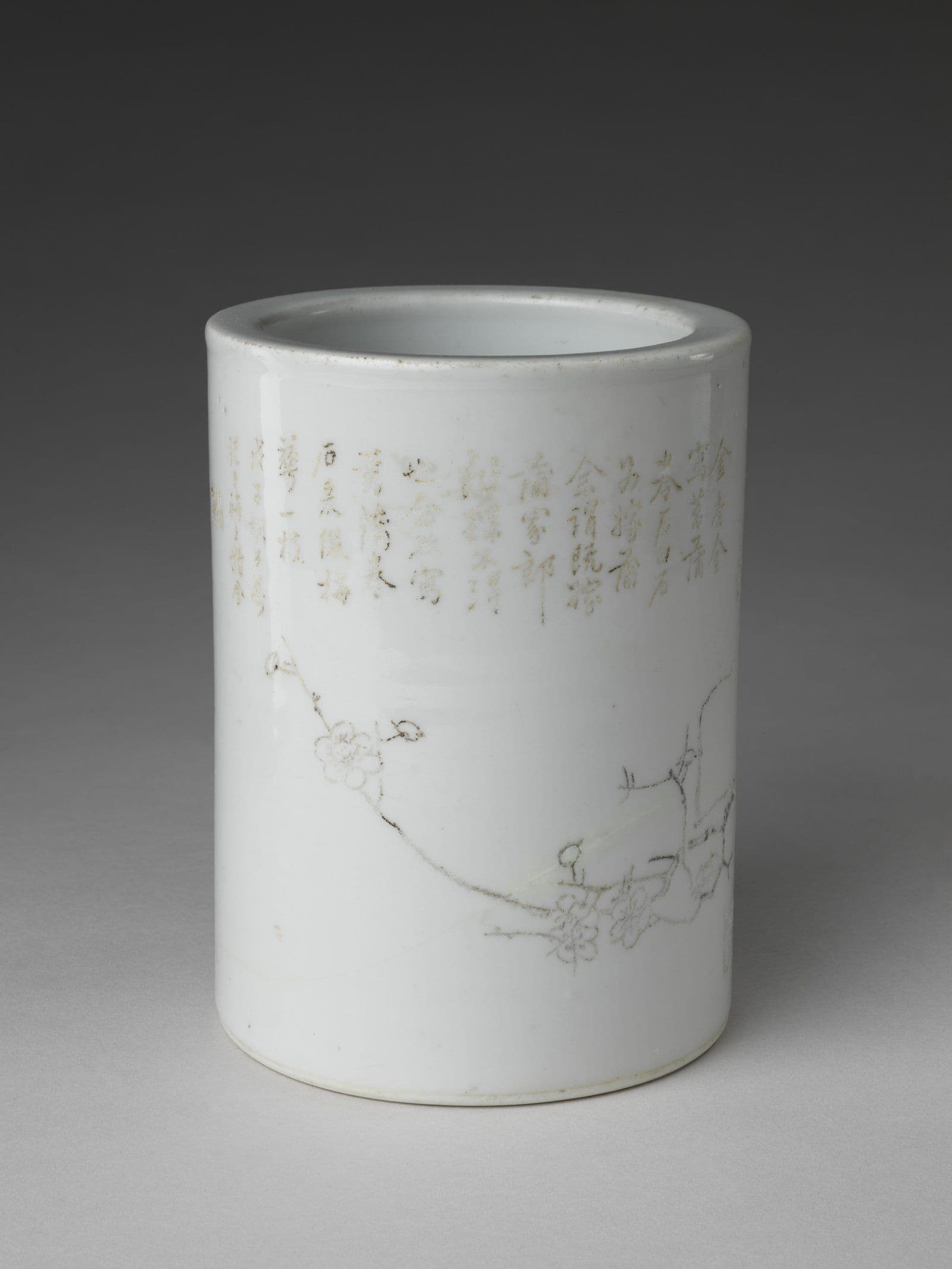
The Republic period is where the century earns its reputation. Alongside enormous ordinary output, Jingdezhen developed something new: porcelain painting as a signed studio art. The loose group remembered as the Eight Friends of Zhushan, and the wider circle around them, painted plaques and vases with the inscriptions, dedications, and dates of literati painting — pictures on porcelain rather than pattern-decorated pots. Fine examples have risen sharply, but the second tier — good unsigned studio work, small plaques, snuff-bottle-scale pieces — still trades modestly.
The early PRC decades produce the century's most distinctive collecting niches: export famille rose continuing Republic patterns, politically themed wares of the 1950s–70s, and occasional state commissions of extraordinary refinement — the famous "7501" porcelain produced for Mao Zedong's household in 1975 being the storied example, with prices to match its legend. Ordinary production from these decades remains inexpensive and is drawing increasing collector interest.
How the marks work — and how they mislead
Twentieth-century marks are a study of their own, and worth having straight before you spend, because the century's habits differ from imperial practice.
First, apocryphal reign marks are everywhere. Republic workshops marked enormous quantities of porcelain with Qianlong, Kangxi, or other earlier reign names — homage and salesmanship, a practice with centuries of precedent. A "Qianlong" mark on a piece with Republic-era enamels and potting is not a forgery scandal; it is simply a Republic piece, and should be priced as one.
Second, the century introduced marks earlier collectors never see: commercial company marks such as those of the Jiangxi Porcelain Company, studio and hall marks of individual painters, and the short-lived marks associated with Yuan Shikai's 1916 imperial episode — Hongxian-era marks that were themselves copied long after. The Republic-period mark repertoire rewards study, because it is where dating information actually lives.
Third, export regulations left useful fingerprints. Wares marked simply CHINA generally date after the 1890s, when American tariff law began requiring the country of origin on imports, and MADE IN CHINA points to roughly the 1920s onward. A two-word stamp will not authenticate anything, but it can stop a "Qianlong" attribution in one glance.
The general discipline is the same one that governs all reign marks: date the object first — enamels, body, foot, subject, calligraphy — and let the mark corroborate rather than testify.
What to look for when buying
Painting quality first. The century's output runs from perfunctory to superb on the same shapes with the same marks, and painting quality is where the segments separate. On famille-rose figure subjects, look at faces and hands; on landscape plaques, look for real compositional intent rather than formula. A well-painted unsigned piece beats a weakly painted signed one.
Dates and inscriptions are the era's gift — use them. Cyclical dates, dedications, and painter inscriptions appear on plaques and better vases throughout the Republic period. Read them, or have them read, before buying; they anchor the object in time and often in place, which is precisely what most antique porcelain cannot offer at this price.
Condition standards should stay strict. Unlike early wares, twentieth-century porcelain is plentiful enough that damage meaningfully hurts value: hairlines, rim frits, and worn enamel all argue for waiting for a better example. The exception is genuinely rare material — top Republic painters, documented special commissions — where the usual auction calculus applies, and where reading the sale catalogue carefully matters as much as it does anywhere else at auction.
Signatures deserve measured skepticism. As Republic studio painters' prices have climbed, their signatures have begun attracting the same forgery attention as famous painters' seals. Buy the painting, not the name — and treat a famous signature on mediocre painting as the warning it is.
Living with the century
One practical advantage of this era deserves its own word: it was made to be lived with, and it still can be. A Republic plaque is, functionally, a framed painting — most come in (or can be returned to) hardwood frames, hang on an ordinary picture hook, and read beautifully at the distance of a hallway or a mantel. Pairs of late Qing vases were made for symmetrical domestic display and still do that work on a sideboard. Because replacement cost is sane, these are pieces you can keep in the open rather than behind glass — with the ordinary cautions about direct sun on enamels and stable shelving.
The century also suits a documentary style of collecting. Since so many pieces carry dates, dedications, and painters' names, a small group can be assembled to tell a coherent story — one painter across a decade, one workshop's range, plaques of a single subject through changing times. That kind of focus costs little extra at these prices, and it is what turns a shelf of objects into a collection: the pieces begin to explain one another.
Common questions
Is 20th-century Chinese porcelain a good investment?
Treat it first as collecting, not investing. That said, the era's trajectory has been upward: Republic studio painting in particular has moved from neglect to serious auction attention within a generation, and well-chosen pieces have appreciated meaningfully. The honest framing: this is one of the few areas of Chinese porcelain where quality is still cheap enough that taste, rather than capital, is the main constraint.
What does a "Qianlong" mark on a Republic-period piece mean?
It means the workshop honored — and borrowed the prestige of — the most famous Qing reign. Apocryphal marks were standard commercial practice, not deception in the modern legal sense. The piece should be identified and valued as Republic-period work; the mark is part of its period character rather than its date.
How can I tell late Qing from Republic porcelain?
Often you cannot draw a hard line, and the trade frequently hedges with "late Qing/Republic." Useful signals: reign marks of Tongzhi or Guangxu argue for the earlier segment; company marks, painter inscriptions with dates, and the fully developed plaque-painting formats argue Republic. Enamel palettes and subjects drifted gradually, so date ranges are honest where single years are not.
Where should a beginner start?
Guangxu-period blue-and-white or famille rose for imperial-pattern porcelain at gentle prices; small Republic plaques or vases with legible dates and decent painting for the studio tradition; or early PRC export ware for sheer affordability. Buy clean examples, favor painting quality over marks, and handle as much material as you can before spending seriously.
Further reading
- Chinese Vase Stamps: The Complete Reference — every stamp family in one place, including the export marks that date this century.
- Chinese Porcelain Studio Marks and Hall Marks — the private and commercial marks that carry the real dating information.
- The Da Ya Zhai Mark: Cixi's Porcelain — the late Qing court commission that bridges into the revival era.
- How to Spot Fake Chinese Porcelain Marks — the checks that apply once 20th-century signatures start commanding real money.
Browse the collection
We do not sell ceramics. The Kiln & Ink collection is limited-edition archival giclée reproductions of Qi Baishi, Xu Beihong, Wu Guanzhong, Zhang Daqian and their contemporaries — hand-numbered, printed on rice paper, and supplied with a Certificate of Authenticity.
Explore Further