Published May 23, 2026
Tongzhi and Guangxu marks are the most common late Qing imperial reign marks. Here is how to read them and what they tell you about period and value.
If you walk through a serious estate sale or a mid-tier auction house and pick up the average Chinese vase, the mark on the base will most often read 大清光緒年製 or 大清同治年製. Late Qing imperial output survives in such quantity, and circulates so widely, that for most Western collectors these are the first old reign marks they hold in their hands.
Knowing what Tongzhi and Guangxu marks actually mean — what the kilns were doing under Cixi, why some pieces are genuinely fine and others are commodity, and how the same mark can sit on objects fifty times apart in value — is the foundation of buying late Qing porcelain without being either overawed or dismissive.
The historical setting: Cixi's century
Tongzhi (1862-1874) and Guangxu (1875-1908) were the two reigns over which Empress Dowager Cixi exercised effective power, first as regent to her young son, then as regent to her nephew. Together their reigns span the last half-century of imperial China.
The crucial fact for porcelain collectors is that the imperial kilns at Jingdezhen had been heavily damaged during the Taiping Rebellion (1850-1864). Rebuilding began under Tongzhi and continued through the Guangxu reign — but with reduced budgets, shifted priorities, and uneven results. Cixi herself was a known patron of porcelain (see Empress Cixi's Da Ya Zhai Mark for her personal studio commissions), and the late Qing kilns produced both genuinely fine pieces for the court and increasingly commercial output to underwrite operations.
This split — between revival quality and commodity quantity — is the single most important thing to understand about Tongzhi and Guangxu wares. The same six-character mark can sit on a wedding service made for the emperor and on a teabowl sold in a treaty-port shop. Your job as a collector is to read what's around the mark.
Reading the Tongzhi mark
The standard Tongzhi reign mark is the six-character formula 大清同治年製 ("Made in the Tongzhi reign of the Great Qing"), arranged in two vertical columns of three characters each, read top-to-bottom, right-to-left.
大清 (right column, top two): "Great Qing"
同治 (right column bottom, left column top): the reign name "Tongzhi"
年製 (left column, bottom two): "year made"
Tongzhi marks are most commonly written in regular script (kaishu) — clean, balanced, slightly squared characters. The strokes are typically more uniform and less calligraphically expressive than the great High Qing marks before them, which reflects a workshop convention rather than the individual brushwork of a master calligrapher.
Marks appear in two media:
Iron-red overglaze: by far the most common, particularly on Tongzhi wedding-service pieces (婚瓷) made for the emperor's 1872 marriage.
Underglaze cobalt blue: less common, used mainly on blue-and-white revival pieces.
Four-character marks (同治年製, omitting 大清) also exist but are rarer; these tend to be on smaller utilitarian pieces.
Reading the Guangxu mark
The Guangxu reign mark — 大清光緒年製 — uses the same six-character format and same column arrangement. The script is again typically regular-style kaishu, broadly similar in feel to the Tongzhi mark but written by different hands across the kiln's thirty-three-year output.
| Mark variant | Frequency within Guangxu | Notes ||---|---|---|| 大清光緒年製 in iron-red | Most common | Across imperial and commercial output || 大清光緒年製 in underglaze blue | Common on revivals | Especially on Kangxi-style blue-and-white || 光緒年製 (four characters) | Less common | Casual or workshop pieces || Hall-mark (堂名款) instead of reign | Substantial portion | See the next section |
A practical observation: Guangxu reign marks vary visibly in calligraphic quality. The imperial kiln continued to produce carefully marked, high-grade pieces — but a great deal of commercial Guangxu-period porcelain bears marks that look hurried, with thicker strokes and less balanced spacing. This variability is itself a dating clue: a perfectly uniform, machine-like Guangxu mark on what otherwise looks like a Republic-period piece is often a 20th-century homage.
Tongzhi wedding porcelain: the high water mark
The Tongzhi reign's most prized imperial output is the wedding service commissioned for the emperor's 1872 marriage. Production began several years earlier, and the kilns turned out large quantities of matched pieces — yellow-ground enameled dishes, bowls and ewers with phoenixes and double-happiness characters (囍), and a recognizable palette of celadon green, pink, and gold.
These wares are well documented in the major palace collections, and authentic examples carry a premium even among Tongzhi-marked pieces. The decoration vocabulary is specific enough that genuine wedding-service pieces are reasonably identifiable — though period homages were made within years of the originals, and 20th-century reproductions are abundant.
If a Tongzhi-marked piece is exuberantly decorated in the wedding palette, well-potted, and has a clean, even iron-red mark, it warrants careful attention. Most pieces wearing the wedding-service vocabulary in the open market today, however, are later.
Guangxu's two faces: revival wares and commodity
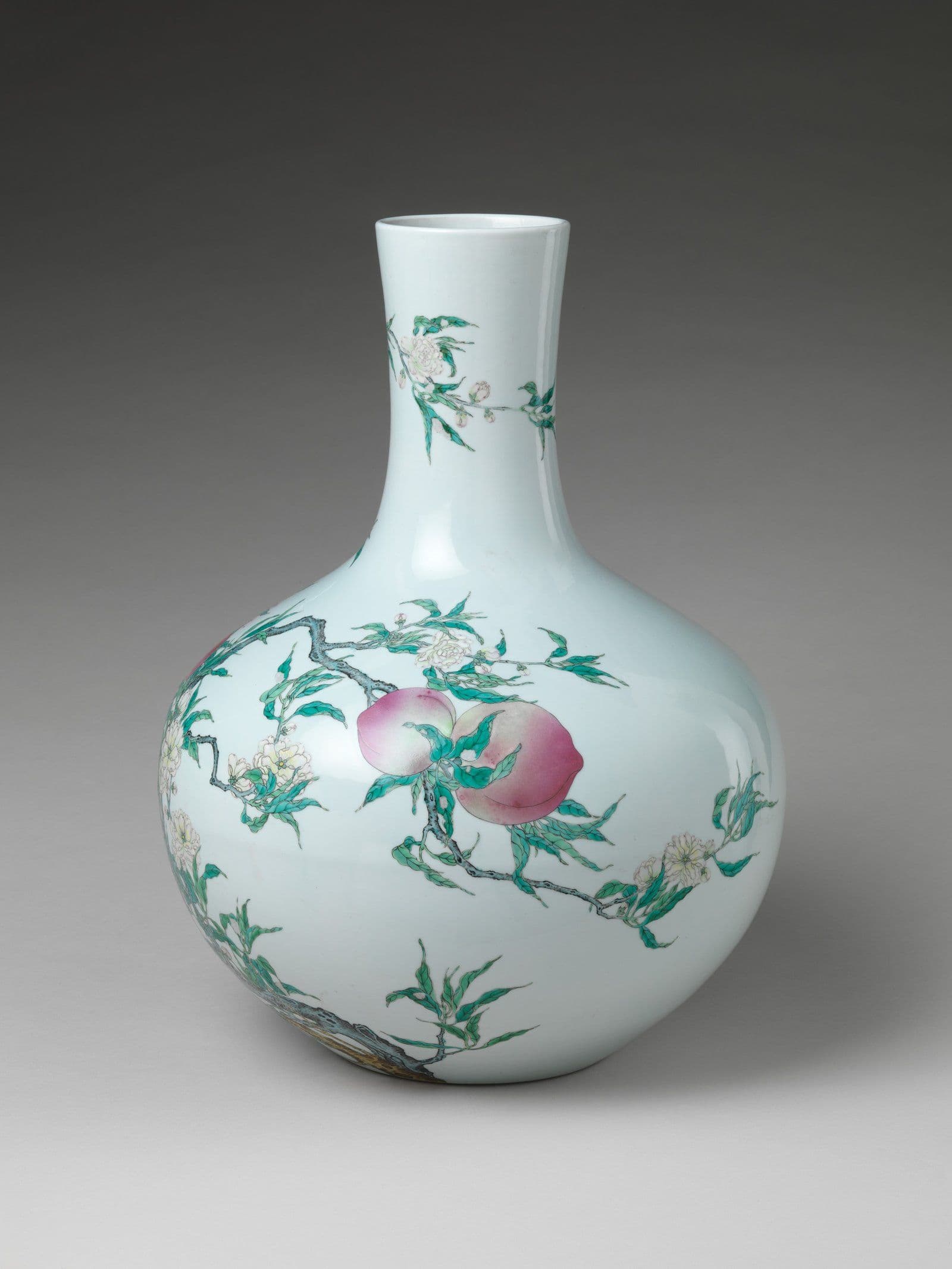
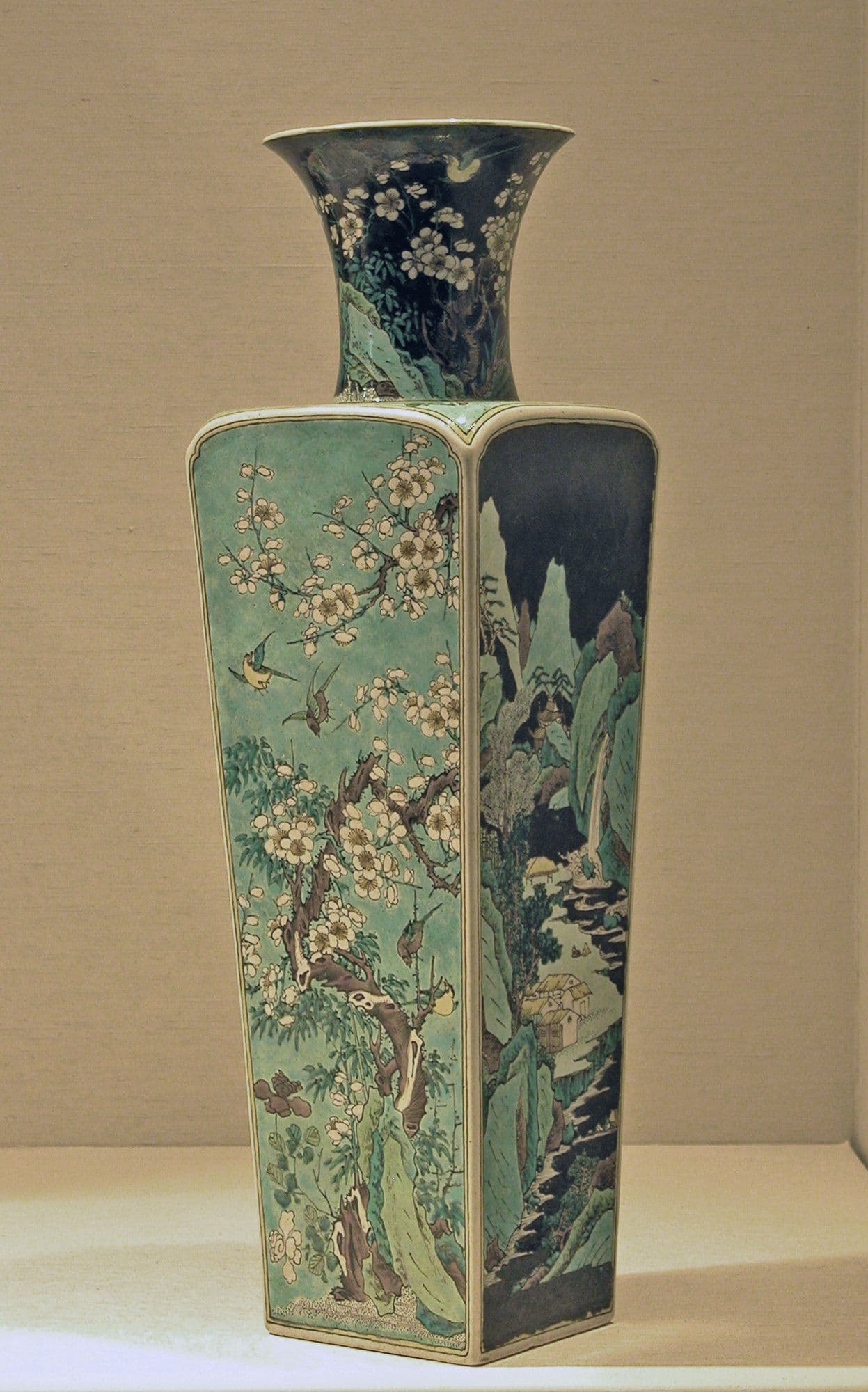
The Guangxu reign saw a deliberate revival of Kangxi and Qianlong styles, often executed at impressively high quality by the rebuilt imperial kiln. A great deal of Guangxu-period porcelain copies earlier reigns directly — Kangxi blue-and-white, Yongzheng famille rose, Qianlong moulded forms — and the better examples are very fine pieces in their own right.
Two things to watch for:
Apocryphal earlier marks. Many Guangxu pieces are signed with a Kangxi six-character mark rather than a Guangxu mark, as a homage to the model they imitate. This is not forgery in the period sense — it is a longstanding Chinese tradition of marking a piece for the master it honors (covered at length in Apocryphal Marks on Chinese Porcelain). A well-potted Kangxi-marked blue-and-white piece that "looks too good to be Kangxi" is very often a Guangxu revival.
Hall marks and studio names. Substantial quantities of late Guangxu wares bear hall marks (堂名款) or studio names instead of the reign mark. These often signal commissions for specific Beijing households or workshops and can be more informative about a piece's purpose than the reign mark itself.
Commodity Guangxu output — the kind that arrived in Europe and North America in large volumes during the late nineteenth century — is the opposite story: hastily potted, sometimes crackled in the glaze, with rapid decoration and a perfunctory reign mark. These pieces have decorative value and modest collector interest but are not investment-grade.
What the late Qing marks together tell you
A useful mental model: Tongzhi and Guangxu marks bracket the porcelain world that gave rise to the Republic-period studio system, where named artist-painters began to sign their work directly (see Republic-Period Porcelain Marks for what comes next). The increasing role of named studios, and the apocryphal-mark tradition itself, both find their late imperial form here.
For broader context on where these reigns sit in the larger Qing arc, the Qing Dynasty Reign Marks Chart shows the full sequence from Shunzhi to Xuantong at a glance.
Common questions
Why are Tongzhi marks more often in iron-red than in underglaze blue?
Iron-red was technically easier and cheaper to apply at the rebuilt post-Taiping kiln. It is an overglaze pigment fired at lower temperatures, which sidesteps the temperature precision needed for stable underglaze cobalt. The Tongzhi wedding-service program also favored iron-red as part of its palette. The result is that iron-red marks dominate Tongzhi imperial output, while underglaze-blue marks (which look more like Kangxi or Yongzheng convention) are reserved for blue-and-white revival pieces.
Is a Guangxu mark on a piece that looks Kangxi a sign of forgery?
Not necessarily — and most often not. The Chinese tradition of marking for the master means a Kangxi-style piece honestly bearing a Guangxu mark is identifying itself as a nineteenth-century revival of a Kangxi prototype. Genuine fraud is the opposite: a Guangxu piece bearing a Kangxi mark designed to deceive a buyer. The decoration, glaze quality, and foot-rim profile usually give the period away faster than the mark does.
Can a Tongzhi or Guangxu piece be more valuable than a Kangxi or Qianlong piece?
Yes, occasionally. A documented imperial wedding-service piece or a fine studio commission from the Cixi era can exceed routine Qianlong commodity wares at auction. But the broad market still values earlier reigns more, all else equal — and "all else" includes condition, decoration, provenance, and historical interest, where Kangxi and Qianlong tend to win.
How do I tell a Guangxu-period piece from a Republic-period copy that's marked Guangxu?
The Republic period made many homages to late Qing imperial styles, sometimes with Guangxu marks intended as honest homage. Tell-tales of Republic work include lighter potting, brighter and more transparent enamels (especially in famille rose), more uniform machine-finished forms, and a foot-rim profile that lacks the slight irregularities of a hand-finished Jingdezhen piece. The mark itself can be near-identical; the body is where the period reveals itself.
What's a reasonable price for a "good" Guangxu-period vase today?
This depends entirely on category — commodity blue-and-white can sell for low hundreds, while a well-documented studio piece or a high-quality famille rose revival can run into five figures. Recent auction catalogs from major Asian art sales are the best public source for current price ranges; the dispersion is wide enough that a single number isn't useful.
Further reading
Studio Marks and Hall Marks on Chinese Porcelain — the 堂名款 tradition that overlaps both reigns.
How to Spot Fake Chinese Porcelain Marks — the practical authentication framework applied to late Qing pieces.
The Complete Reference for Chinese Vase Stamps — a single-page lookup for every mark type and era.
Decoding the Shape and Layout of a Porcelain Mark — read the mark's visual format before the characters.
Browse our Chinese porcelain
Modern hand-painted homages in the late Qing imperial tradition — all faithfully marked and honestly described as the new pieces they are. See the collection.
Explore Further