Published May 16, 2026
The Da Ya Zhai mark identifies Empress Cixi's personal studio — and is one of late Qing porcelain's most imitated. A collector's guide to reading it.
When you turn over a piece of late Qing porcelain — a fish bowl, a jardinière, a pair of vases painted with magpies on flowering branches against a yellow or pink ground — and find a small red rectangle reading 大雅斋 (Da Ya Zhai, "Studio of Great Elegance"), you are reading one of the most personal marks in nineteenth-century imperial porcelain. It does not name a reign. It names a woman.
That woman is Empress Dowager Cixi (1835–1908), the most consequential figure of the final half-century of the Qing. Her personal studio mark sits on a body of court porcelain that collectors have argued about for more than a century — partly because the wares themselves divide opinion, and partly because so many later pieces wear the same red rectangle. This article walks through what the Da Ya Zhai mark is, the porcelain it sits on, the partner phrase that almost always accompanies it, and how connoisseurs separate honest period work from the wide field of later copies.
What "Da Ya Zhai" actually names
The phrase 大雅斋 translates as "Studio of Great Elegance," with 雅 (ya) carrying connotations of cultivated, refined, scholarly taste. In Chinese court tradition, naming a studio (堂號, tanghao) or residence was something a literate aristocrat did to signal aesthetic identity — and Cixi, who presented herself as a calligrapher and painter, chose names that fit that posture.
Da Ya Zhai was originally the name of a hall associated with her residence at the Yuanmingyuan summer palace complex, and was later reused as a hall name inside her later residences after the Yuanmingyuan was destroyed by Anglo-French forces in 1860. The porcelain bearing the mark was commissioned for the empress dowager's personal use across those residences. Because the mark identifies a place and an aesthetic program rather than a reign, it sits within the broader category of studio or hall marks (堂名款) — a tradition you can read more about in our guide to Chinese porcelain studio and hall marks.
This is the first thing to understand: a Da Ya Zhai mark is not a reign mark. It does not say "Made in the reign of so-and-so." Most period Da Ya Zhai pieces were produced during the Tongzhi (1862–1874) and Guangxu (1875–1908) reigns, when Cixi was the de facto power behind the throne, but the mark itself refers to her personally rather than to either nominal emperor.
The phrase that almost always travels with it
If you remember only one thing about Da Ya Zhai porcelain, remember this: the rectangular mark 大雅斋 is almost always accompanied by a longer painted inscription on the body of the piece — typically a phrase 天地一家春 (Tian Di Yi Jia Chun), "Heaven and Earth, One Family of Spring."
The two inscriptions function together:
大雅斋 (Da Ya Zhai): the studio name, usually inside a red rectangle, applied as a small mark
天地一家春 (Tian Di Yi Jia Chun): the longer painted phrase on the side of the vessel, often framed in a circular cartouche or scrolling reserve, and treated as part of the decoration rather than as a base mark
Tian Di Yi Jia Chun was the name of a residential hall inside the old Yuanmingyuan — the same complex destroyed in 1860. Pairing the destroyed-hall name with the new studio name was both a nostalgic gesture and, in the context of a court reasserting itself after defeat, a quietly defiant one.
Practical implication: a piece marked 大雅斋 without any trace of the Tian Di Yi Jia Chun phrase, and without the painted ground and decoration vocabulary discussed below, is a yellow flag. The pairing is consistent enough that its absence on a piece with otherwise unremarkable late-Qing characteristics should make you cautious.
The look of a Da Ya Zhai piece
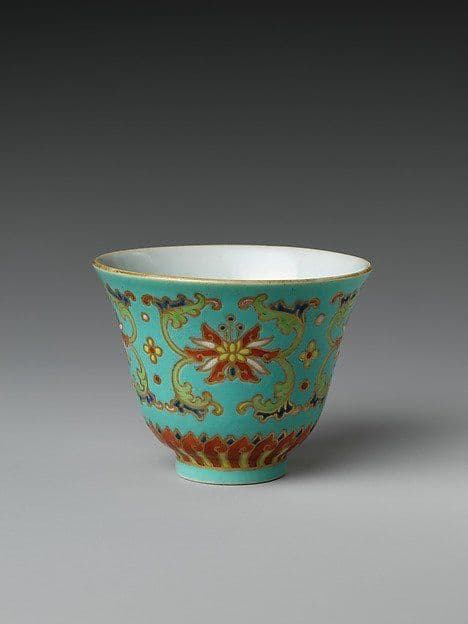
Late nineteenth-century imperial porcelain has a recognisable surface vocabulary, and Da Ya Zhai wares sit squarely inside it. The defining features:
| Feature | What you see ||---|---|| Coloured ground | Yellow, pink (rouge), turquoise, or pale green enamel covering most of the body || Decoration | Polychrome painted flowers (peony, magpie-and-plum, lotus, chrysanthemum), often framed in reserved cartouches || Forms | Mid-sized to large: jardinières, fish bowls, baluster vases, brush pots, dishes || Mark colour | Iron-red, regular script (kaishu), small rectangle || Mark placement | On the base, sometimes on the shoulder; never inside a double circle || Inscription pairing | 天地一家春 painted on the body in a reserve panel |
If those elements are present together, you are looking at the formal vocabulary of Da Ya Zhai. The aesthetic is florid, courtly, and unmistakably late Qing — closer in spirit to the polychrome enamels of the Yongzheng-Qianlong palette than to the spare blue-and-white of the early Ming. For a fuller tour of the Qing dynasty palette this work descends from, see our Qing dynasty reign marks chart, which places the late Qing studio output in the context of the wider dynasty.
Why this mark attracts forgers
Da Ya Zhai is one of the most heavily imitated marks in late Qing collecting. Three reasons account for the volume of copies in the market:
The wares are aesthetically appealing. Colourful grounds and painted flowers translate well to Western interiors and to photography. A pair of yellow-ground jardinières makes an attractive decorator piece, which sustains demand at every price point.
The market spans a wide value range. Genuine period Da Ya Zhai can reach significant prices at major auctions, while later twentieth-century pieces and modern reproductions are sold cheaply at every level — flea markets, online auctions, decorator showrooms. The same mark sits on objects worth a few hundred dollars and on objects worth six figures, which gives forgers cover.
Cixi's reputation generates story-driven buyers. Pieces "from the empress dowager's own studio" carry a built-in romance that helps a seller close.
This dynamic is not unique to Da Ya Zhai. It is the same pattern that produces large numbers of apocryphal Chenghua, Kangxi, and Qianlong marks — a centuries-long tradition of honouring earlier reigns through later marks — but Da Ya Zhai is unusual because the studio name is so specific to one person, in one half-century, in one set of residences.
What separates period from later
When evaluating a possible Da Ya Zhai piece, the questions are not very different from those you would bring to any late Qing imperial-style ware. There is no single decisive tell; you are looking at a stack of indicators.
Body and glaze. Period pieces tend to have a soft, slightly uneven glaze surface — the kind a hand-fired kiln produces. Twentieth-century reproductions often show a glossier, more even surface, sometimes with a slightly plastic feel.
Painting quality. The painted decoration on period Da Ya Zhai is competent court work — confident outlines, conventional but well-organised compositions, careful handling of the coloured ground around the reserves. Decorative-grade copies often show hesitant brushwork, awkward composition, or flat overall colour. Modern fine copies can be excellent, however, so this test alone is not sufficient.
The mark itself. Period iron-red marks have the slight unevenness of hand brushwork — visible character strokes, occasional minute pooling, a depth that you can sense under a loupe. Stencilled or stamped marks are an immediate disqualifier and are common on twentieth-century commercial pieces.
The 天地一家春 inscription. As noted above, the absence of this partner phrase on a Da Ya Zhai-marked piece is a strong negative signal.
Wear and base. Period bases show consistent wear patterns — soft abrasion at points of contact, mineral deposits in low areas, oxidation around foot rims. Artificial aging is often visible as overly uniform discolouration or unconvincing "dirt" trapped where it would not naturally settle.
Provenance documentation. Because the field is so heavily imitated, written provenance — auction records, old collection labels, dated photographs — does a disproportionate amount of work in the Da Ya Zhai market. A piece with documented sale history from a credible mid-twentieth-century source is worth more than an identical-looking piece without records.
Where Da Ya Zhai sits in the late Qing story
Cixi's commissioning of Da Ya Zhai porcelain is part of a broader pattern: a court that had lost its summer palace and much of its political authority, but that still maintained the ceremonial apparatus of an empire — including imperial kilns at Jingdezhen — and used that apparatus to project continuity and personal taste. The wares overlap with the wider output of the Tongzhi and Guangxu kilns. For context on what came right after — the porcelain made in the empire's final shadow and into the early twentieth century — see our survey of Republic-period (Minguo) porcelain marks.
For a Western collector entering Chinese porcelain seriously, Da Ya Zhai is worth understanding even if you never intend to buy a piece. It is the textbook case of a non-reign imperial mark, it teaches the relationship between a hall name and its partner inscription, and it is a useful exercise in distinguishing the courtly polychrome vocabulary of late Qing from later commercial work using the same vocabulary.
Common questions
Is every piece with a 大雅斋 mark fake?
No — but the field is heavily diluted by later and modern copies, and on most days at most auctions, most pieces wearing the mark are not period imperial. Genuine period Da Ya Zhai porcelain exists in major museum collections and reaches the market periodically. The point is to bring genuine scepticism: assume later work and let the evidence — body, glaze, painting quality, partner inscription, provenance — argue you out of that assumption.
What does 天地一家春 mean, and why does it travel with the mark?
The phrase translates as "Heaven and Earth, One Family of Spring." It was the name of a residential hall in the old Yuanmingyuan summer palace, destroyed in 1860. Pairing the old hall name with the new studio name carried both private memory and political meaning. On the porcelain itself, the longer phrase is usually painted on the body of the vessel in a framed cartouche, while 大雅斋 is the small base mark.
Were Da Ya Zhai pieces actually used, or were they ceremonial?
They were intended for the empress dowager's personal use across her residences — for flower arrangements (the large fish bowls and jardinières), for tea service, for daily display in her halls. They are functional objects made to courtly standard, not purely ceremonial display pieces. That is part of why they appear in such varied forms: jardinières, vases, dishes, brush pots, basins.
Should I pay a premium for a Da Ya Zhai mark on a piece I think is later?
Generally no. A decoratively pleasing late Qing or Republic-period piece bearing an apocryphal Da Ya Zhai mark is best valued on its own merits — quality of painting, condition, decorative appeal — without paying for an attribution you cannot defend. Many beautiful pieces fit this description and remain accessible. Pay the premium only when the evidence supports it.
Where can I see authenticated examples?
Major Chinese art museums hold the most reliable examples — the Palace Museum in Beijing, the National Palace Museum in Taipei, and several Western institutions with strong late Qing holdings. The published catalogues from these institutions are among the strongest available reference points and are worth consulting before any significant purchase.
Further reading
Chinese Porcelain Studio Marks and Hall Marks (堂名款) — the broader tradition Da Ya Zhai sits within
Apocryphal Marks on Chinese Porcelain — how to think about marks that honour earlier reigns or studios
Republic-Period (Minguo) Porcelain Marks — what came right after Cixi's era
Qing Dynasty Reign Marks Chart — the full Qing context, from Kangxi through Xuantong
Browse our porcelain
Modern hand-painted pieces in the late Qing court tradition, all honestly described and clearly marked — explore our Chinese porcelain collection.
Explore Further