Published August 19, 2026
Limited edition prints explained: what edition numbers really mean, how giclee printing works, and what a Certificate of Authenticity must state.
Turn a framed print over, or look along the bottom edge of the sheet below the image, and you will usually find three things written in soft pencil: a title, a signature or studio mark, and a fraction — 12/95, say. The fraction is the part collectors ask about most and understand least. It looks like a grade. It is closer to an address.
This guide sets out what that number records, what separates an original print from a reproduction, what the word giclée actually describes, and what a Certificate of Authenticity has to say before it is worth the card it is printed on.
What the fraction actually records
The number to the right of the slash is the declared size of the edition: how many impressions the issuer says will exist in that run. The number to the left is that particular sheet's place within it.
What it does not record is order of printing. On most modern presses the whole edition is produced as one continuous operation and numbered afterwards, often from an arbitrary point in the stack. The belief that 1/95 came off first and is therefore crisper belongs to a much older technology — copperplate engraving and lithography, where the matrix genuinely wore down across a long run. On a pigment inkjet printer, sheet 1 and sheet 95 are the same file through the same heads.
Alongside the numbered sheets you will meet a small vocabulary of proofs:
- A/P or E.A. — artist's proof (épreuve d'artiste). Historically the artist's own set, held outside the numbered edition. Conventionally around ten per cent of the edition size.
- P/P — printer's proof, kept by the workshop that pulled the edition.
- BAT — bon à tirer, "good to pull". The single sheet the artist approved as the standard the rest of the run had to match. One per edition.
- H/C — hors commerce, "outside of trade". Sheets marked as not for sale, usually for exhibition or presentation.
Proofs are legitimate. What matters is proportion. An edition of 50 that arrives accompanied by 40 assorted proofs is not an edition of 50; the issuer has quietly printed 90 and labelled the surplus.
Original prints and reproduction prints are not the same object
This is the distinction that governs everything else, and it is the one most often blurred in listings.
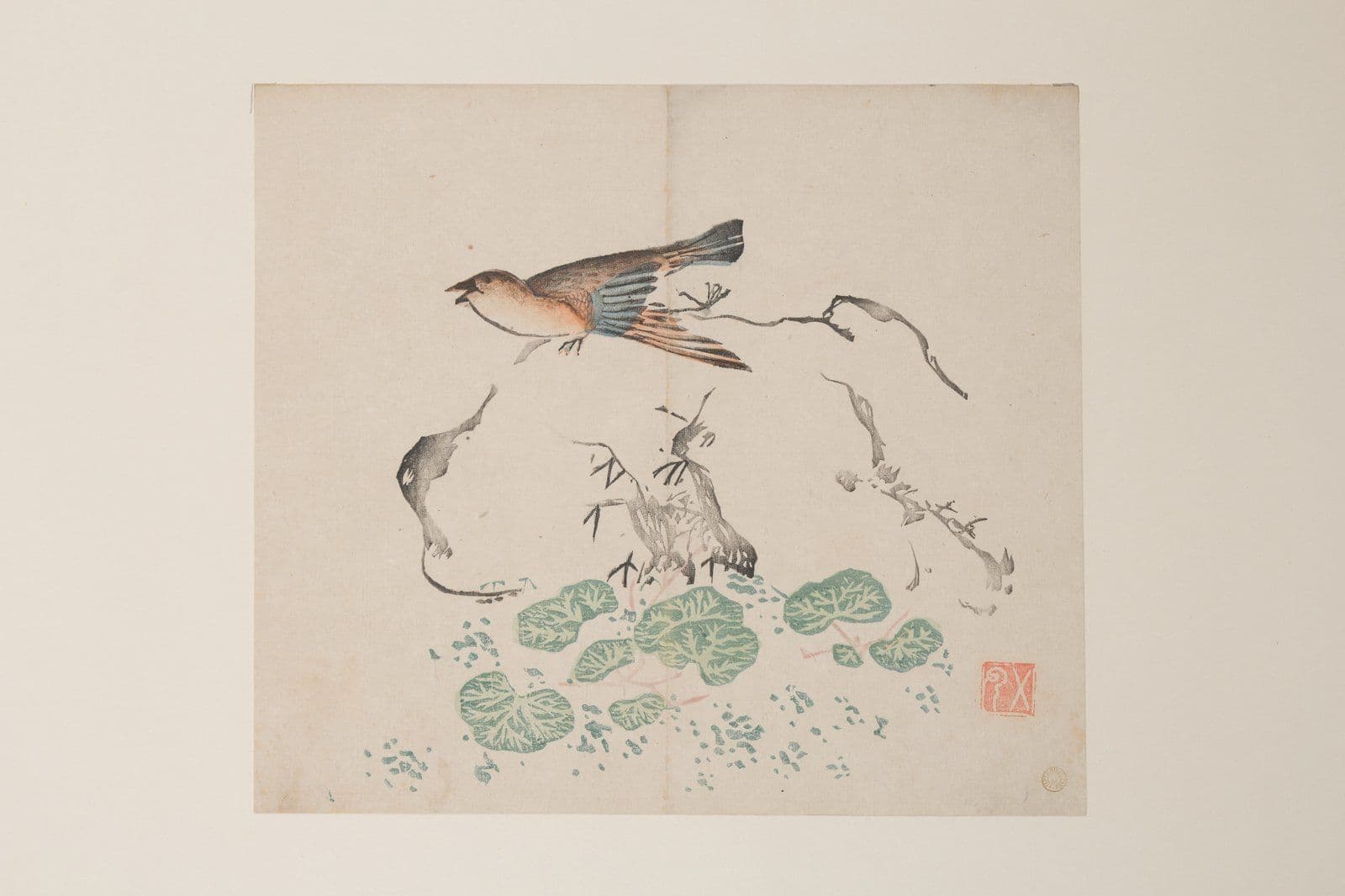
An original print is one where the matrix — the woodblock, the copper plate, the lithographic stone, the silk screen — is itself the work. Nothing is being copied. The image exists first in the block, and the printed sheet is the only form in which anyone can see it. China has one of the deepest original-print traditions anywhere; the multi-block colour method perfected in the seventeenth century built a picture from dozens of separately inked and separately registered blocks. Our guide to collecting Chinese woodblock prints covers how that tradition is catalogued and compared.
A reproduction print starts from a finished painting. The painting is photographed or scanned, colour-matched, and printed. No matrix, no press-work by the artist, and — critically — an original that continues to exist somewhere else.
Both are worth owning. They are not worth the same, they are not collected the same way, and a seller who lets you believe you are buying the first when you are buying the second has misrepresented the object. Kiln & Ink sells reproduction editions, and says so plainly: what arrives is an archival print of a painting by a twentieth-century master, not a sheet pulled from a block by the artist's hand.
Giclée: a process, not a grade
Giclée entered the vocabulary in the early 1990s as a deliberately French-sounding coinage for fine-art inkjet printing — from gicler, to squirt. It caught on because "inkjet print" sounded like an office memo.
The word describes a method. It certifies nothing. There is no standards body, no minimum specification, and no bar to calling a poster run off a desktop machine a giclée. What separates a print worth framing from one that will disappoint you in four years is three specifics, and you should ask about all three.
Ink. Pigment inks, not dye. Pigment particles sit as ground or encapsulated colour and resist light; dyes are dissolved colourants and fade comparatively fast. Any serious printer will name the ink set.
Substrate. For Chinese subjects the two defensible choices are 100% cotton rag and xuan paper — the traditional bark-and-straw sheet the originals were painted on. Both are acid-free and both age predictably. A brightened, optically-whitened stock will yellow unevenly around the mount line.
Colour management. A profiled workflow, and ideally a stated reference: what was the print matched against — the painting itself, a museum transparency, or a publisher's file of unknown ancestry?
Lightfastness ratings quoted by ink and paper manufacturers assume framing behind glazing and out of direct sun. They are laboratory figures, not promises about a south-facing wall. Our guide to framing Chinese art prints covers the glazing and mounting decisions that do most of the work here.
How edition size behaves — and what it does not tell you
Small editions are scarcer than large ones. That is arithmetic, and it is where the useful part ends.
For original prints by artists with an established market, edition size is one input among several — the artist's overall standing, how sought that particular image is, condition, the period of the career it comes from, and the quality of the individual impression. A large edition of a famous image routinely trades above a tiny edition of a forgettable one.
For reproduction editions the number is best read as a factual statement about how many sheets exist, and nothing more. Treat any seller who presents edition size as a forecast with suspicion — that is a sales argument dressed as market analysis, and it is made most often about objects with no established resale market at all.
The honest version is simpler. Buy a reproduction edition because you want to look at that image every day, at a size and on a surface that does the painting justice, at a price that lets you own work after Qi Baishi rather than only read about him. If that is the transaction you are making, the edition number is a detail. If it is not, no edition number will rescue it.
If you are working out where a first few hundred dollars does the most good, starting a Chinese art collection on a budget covers allocation across categories.
What a Certificate of Authenticity must state
Most certificates are decorative. A useful one is a description precise enough that a stranger could match the certificate to the sheet twenty years from now. It should carry:
- The title of the image and the artist of the source work
- The source work itself — where the original is, or was, and what was captured
- The process: ink type, printer, substrate named specifically
- The edition size and this impression's number, matching the pencil mark on the sheet
- The number of proofs issued outside the numbered run
- The date of issue
- The issuer's legal identity and address — a company that can be found, not a logo
- A statement that the edition is closed and the files or plates retired
Three red flags are worth naming. A certificate saying a work is "certified authentic" without describing what was certified is language, not information. A valuation printed on the certificate is a marketing figure — independent appraisal is a separate professional act, and our guide to valuation and appraisal explains why the two should never come from the same party. And a certificate with no traceable issuer is worth exactly what the issuer is worth, which in that case is nothing.
Common questions
Does a lower edition number make a print more valuable?
Not in any way you can rely on. On modern printing the sheets in an edition are produced in one operation and numbered afterwards, so a low number carries no information about quality or sequence. Some buyers pay a small premium for single digits out of preference, and some issuers price them accordingly, but that is a taste in the market rather than a property of the object. Condition, the image itself, and the integrity of the issuer matter enormously more.
What is the difference between a giclée and a poster?
Process and materials, not appearance at first glance. A giclée in the sense the term is meant to carry is printed with pigment inks onto an acid-free substrate under a managed colour workflow; a poster is typically offset-printed with dye-based inks on coated wood-pulp stock. Because the word is unregulated, the label alone settles nothing — ask what ink, what paper, and what the print was matched against.
Should I buy a reproduction print as an investment?
No. Reproduction editions do not have an established secondary market, and buying one on the expectation of resale means relying on a market that does not exist. Buy it for the wall. Allocating money towards works that actually trade is a different exercise, and it starts with original works and auction records rather than with editions.
How can I check that an edition is genuinely limited?
You cannot verify it independently, which is precisely why the issuer's identity is the thing you are really buying. Look for a named legal entity with a findable address, a certificate that states proof counts as well as edition size, and a written commitment that the edition is closed. An issuer who has traded under the same name for years and can tell you what happened to the files is the strongest assurance available.
What does "archival" mean on a print description?
It is a claim about longevity under specified display conditions and, like giclée, it is unregulated. In practice it should mean an acid-free, lignin-free substrate and pigment inks with published lightfastness data. Ask for the specifics; a supplier who cannot name the paper and the ink is describing an aspiration.
Further reading
- Collecting Chinese woodblock prints — the original-print tradition, and how impressions are compared.
- How to frame Chinese art prints — glazing, mounts, and the mistakes that shorten a print's life.
- Starting a Chinese art collection on a budget — where the first few hundred dollars does the most work.
- How Chinese art is valued and appraised — what an appraisal is, and who should be performing it.
Browse the collection
What Kiln & Ink issues is paper: limited-edition archival giclée reproductions of the twentieth-century Chinese ink masters, printed on xuan paper or museum-grade cotton rag, hand-numbered, and sent with a Certificate of Authenticity stating the edition size and this impression's place in it. Prices run from roughly $300 to $1,200.
Explore Further