Published August 19, 2026
A collector's guide to Li Kuchan: his years with Qi Baishi, how the xieyi brushwork is built, what drives his market, and how to spot a copy.
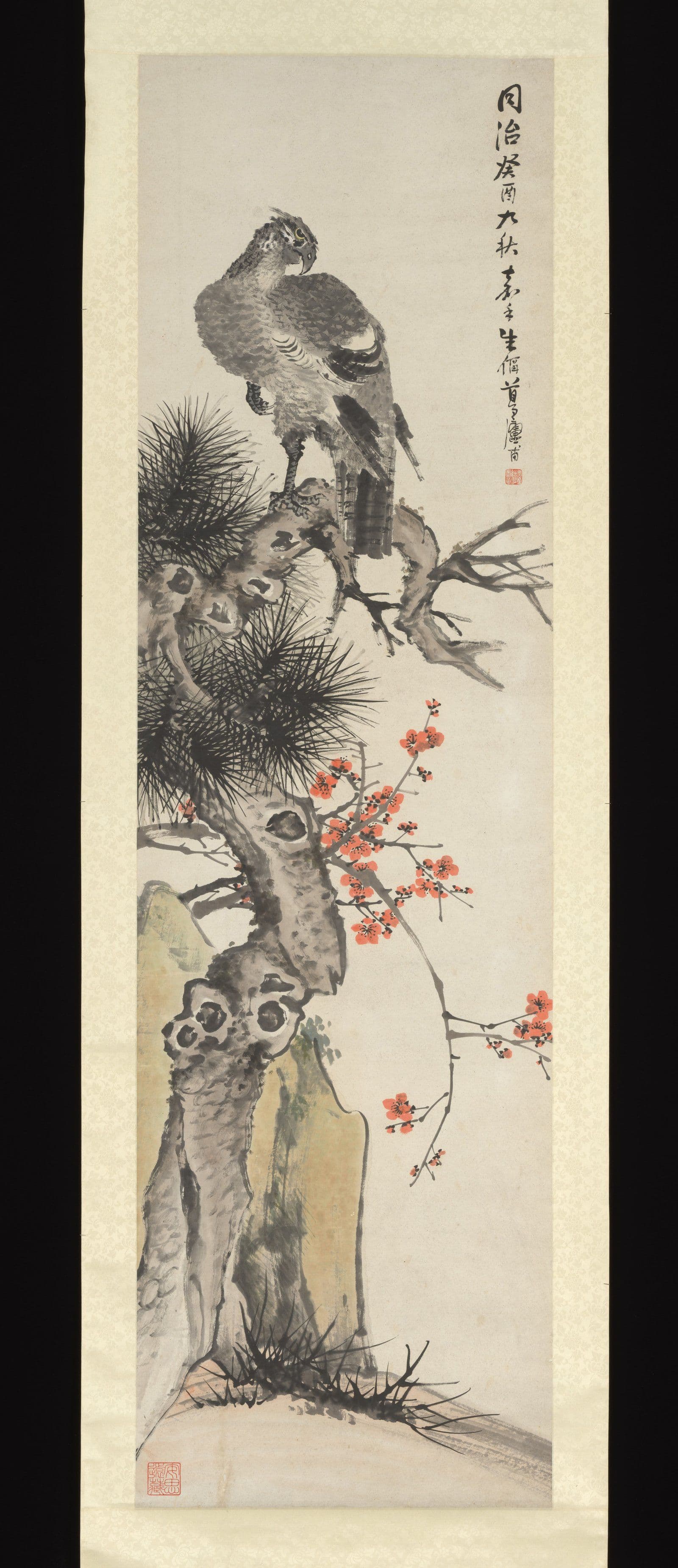
In the best of Li Kuchan's eagles the bird is built from perhaps a dozen strokes. A broad wedge of wet black lays in the back and the folded wing in one pass. The beak is two hooked marks. The eye is a hard angular shape set in a pale socket — not a bird's eye as an ornithologist would draw it, but a look. Everything else on the sheet is rock, pine, and empty paper.
That economy is the whole problem for a collector. Work this reduced is easy to imitate at a glance and very hard to imitate at close range, which is why Li Kuchan is among the most heavily forged of the twentieth-century ink painters. This guide covers who he was, how the brushwork is built, where the market sits, and what to examine before buying.
From Gaotang to Qi Baishi's studio
Li Kuchan was born in 1899 into a farming family in Gaotang County, in western Shandong, and given the name Li Ying. He arrived in Beijing as a young man with no money and enrolled to study art, supporting himself by pulling a rickshaw at night — a detail repeated so often in accounts of his life that it has become shorthand for his character, and one he never seems to have minded.
He trained first in Western painting, working in oils at the national art school in Beijing. The turn to ink came through Qi Baishi, whose studio he entered in the 1920s and to whom he remained attached for the rest of the older man's life. Qi accepted him as a formal disciple, and Li Kuchan became one of the small number of students through whom Qi Baishi's late manner passed into the next generation. Our collector's guide to Qi Baishi sets out the teacher's side of that relationship.
The name he is known by dates from those student years. Ku is bitterness or hardship; chan is Chan Buddhism — the meditative school the West knows through its Japanese name, Zen — and also, in painting, an entire lineage of abbreviated, intuitive brushwork running back through the Ming eccentrics. It described both his circumstances and his ambitions, and he kept it.
He spent most of his working life teaching in Beijing, ultimately at the Central Academy of Fine Arts. Like nearly every artist of his generation he was persecuted during the Cultural Revolution and worked little in those years; the paintings that carry his fullest powers come before that period and after it, in a late flourishing in his seventies and early eighties. He died in 1983.
How the brushwork is built
Li Kuchan works in xieyi — the freehand mode, where the brush is loaded and committed and nothing can be corrected afterwards. Our guide to Chinese bird-and-flower painting covers the genre he worked in; what follows is what distinguishes his hand inside it.
Scale of stroke. He paints large. A single stroke may be several inches wide, laid with the side of a big soft brush rather than its tip, and it has to carry tonal variation from end to end — dense black at the loaded edge running to grey where the ink runs out. A forger who paints small strokes and joins them produces a shape with the right silhouette and the wrong construction.
Pressure and speed. The strokes are fast but not hurried, and they stop. Look at where a wing meets the body: in an authentic passage there is a decision, a change of direction taken at full speed. Copies tend to slow at exactly those junctions, because the copyist is reading a shape rather than making a movement.
Ink behaviour on raw paper. He worked on unsized paper, where ink spreads into the fibre and every hesitation blooms. The characteristic Li Kuchan surface has soft haloes around the wet strokes, and the halo is asymmetric — heavier where the brush lingered. Even, uniform bleeding usually indicates a slower hand.
The eagles specifically. The birds are blunt, square-shouldered and hostile-looking, closer to Bada Shanren's contemptuous birds of the seventeenth century than to anything naturalistic. That ancestry is deliberate and worth knowing, because the resemblance is a matter of attitude rather than of copying. We look at the subject in detail in Li Kuchan's eagle paintings.
Lotus is his other principal subject: broad wet leaves in flat washes, stems drawn as single upward strokes with calligraphic pressure, and flowers left almost bare. The lotus works are where his calligraphy training shows most plainly.
Where the market sits, and what moves it
Li Kuchan's market is centred in mainland China, where the modern ink painters trade, and it is comparatively thin outside it. Prices are driven by a short list of factors worth understanding before looking at any individual lot:
- Subject. Eagles lead. Lotus follows. Bamboo, rocks and minor studies trail well behind, and small pieces made as gifts sit lower again.
- Scale. He was a large-format painter and the market rewards that. A big hanging scroll and a modest album leaf are different categories of object, not the same thing at different sizes.
- Period. Mature work, and especially the work of his final decade, is what serious buyers pursue.
- Inscription. A long inscription, a date, and a named dedicatee all add — both because they are harder to fake convincingly and because they anchor the work in a history.
- Provenance. Anything traceable to the family, to the academy, or to a documented early collection carries weight, for the obvious reason.
Specific prices move too quickly to quote usefully, and any figure worth acting on should be looked up in the auction record rather than read in a guide. What is stable is the ranking above.
Before you buy
Seals and signature are where most examinations begin and few should end. Li Kuchan's seals are well published, and a forger with access to the same publications can have a convincing seal cut. Our step-by-step guide to identifying an artist's seal explains how to read one properly, including the point that a correct impression proves considerably less than an incorrect one disproves.
Look instead at the paper, the mounting, and the ink's behaviour in the fibre. Ask what the work's history is, and accept "unknown" only if the price reflects it. For anything above a modest sum, condition and authentication opinions should come from someone with no interest in the sale.
Common questions
How can I tell an authentic Li Kuchan from a reproduction?
At the object level it is usually straightforward. An original sits in the paper: the ink has penetrated the fibre and left soft irregular haloes, and the sheet shows slight cockling where wet strokes dried. A printed reproduction has ink sitting on the surface as an even film, no penetration, and under magnification a regular dot or droplet structure. The difficult cases are not prints but hand-painted copies, and those are decided on stroke behaviour — speed, pressure change, and what happens at the junctions — not on subject or seal.
What do edition numbers mean if the work is a print?
They record how many impressions the issuer declares exist and which one you hold: 12/95 is the twelfth sheet of a stated ninety-five. On modern printing the number carries no information about quality, since the whole run is produced in one operation. For a reproduction of a Li Kuchan painting the number is a factual statement about how many sheets exist in that run, not a claim about the painting, and it should always come with a certificate naming the source work.
Was Li Kuchan really a student of Qi Baishi?
Yes, and formally so. He entered Qi Baishi's circle in the 1920s and was among his most prominent disciples, carrying the older painter's freehand manner forward while developing a heavier, more aggressive brush of his own. The relationship is well documented and is the standard starting point for placing him within the twentieth-century lineage.
Why are his birds so unfriendly?
Because the tradition he drew on made them that way. The abbreviated bird-and-rock subject reaches him through Bada Shanren, the Ming imperial descendant whose birds glare out of the paper with what is usually read as political contempt. Li Kuchan inherited the attitude along with the brush method, and in his hands the glare became a signature.
Is his work still being forged?
Extensively. His manner is reductive enough to invite imitation and his market is strong enough to reward it, which is the combination that produces forgery at volume. Treat unprovenanced works with the caution that implies, and expect to pay for expertise on anything significant.
Further reading
- Li Kuchan's eagle paintings — the signature subject, examined stroke by stroke.
- A collector's guide to Qi Baishi — the teacher, and the manner Li Kuchan inherited.
- Chinese bird-and-flower painting — the genre and its conventions.
- How to identify a Chinese artist's seal — reading seal script, and what a seal can and cannot prove.
Browse the collection
Li Kuchan is on the Kiln & Ink roster: his page lists the works currently available, including Eagle. These are limited-edition archival giclée reproductions on xuan paper or museum-grade cotton rag, hand-numbered and issued with a Certificate of Authenticity, at roughly $300 to $1,200.
Explore Further