Published October 28, 2024
Ink bamboo painting explained: what stalk, node and leaf strokes reveal about the hand that made them, why Wen Tong set the standard, and how to judge one.
For fifteen centuries, Chinese painters have returned, again and again, to the same subject: bamboo. Not the tropical bamboo of Southeast Asia, lush and sprawling, but the upright, segmented bamboo of central China — a plant that grows straight, bends without breaking, and remains green through the harshest winter. In a culture where painting is inseparable from moral philosophy, bamboo became the supreme test of both the brush and the character behind it.
The tradition of ink bamboo painting — mozhu (墨竹) — is unique in the history of world art. No other civilisation has elevated a single botanical subject to such philosophical and aesthetic heights, or devoted such sustained intellectual energy to its depiction. To understand why is to understand something essential about Chinese culture itself.
The Four Gentlemen
Bamboo holds pride of place among the “Four Gentlemen” of Chinese painting — bamboo, orchid, plum blossom, and chrysanthemum. Each plant embodies a Confucian virtue: the orchid represents refinement, the plum blossom resilience, and the chrysanthemum loyalty in adversity. Bamboo stands for integrity. Its hollow stem symbolises humility and openness to learning. Its segmented growth represents steady moral progress. Its ability to bend in storms without snapping embodies the Confucian ideal of flexibility grounded in principle.
These are not merely literary metaphors. For centuries, the ability to paint bamboo well was considered direct evidence of a scholar's moral cultivation. The Song dynasty poet and painter Su Shi argued that one must “have bamboo in one's breast” before attempting to paint it — meaning that the painter must first internalise the virtues bamboo represents, and only then can the brush express them authentically.
The Technical Challenge
Painting bamboo in ink is deceptively demanding. The subject appears simple — a stalk, a few branches, a cluster of leaves — but each element requires a distinct brush technique, and the relationship between them must feel organic rather than constructed.
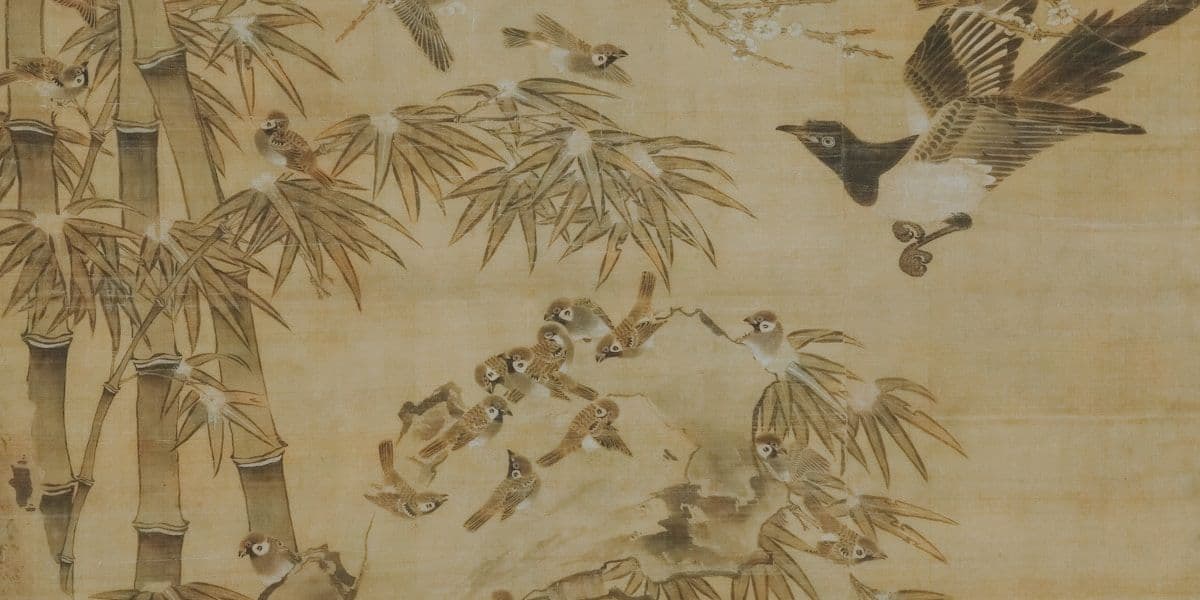
The stalk is painted with the brush held vertically, using firm, upward strokes that pause briefly at each node. The segments must appear to grow naturally, each one slightly different in length and thickness. The branches spring from the nodes at precise angles — too regular and the bamboo looks mechanical, too random and it loses its structural logic.
The leaves are the most demanding element. Each leaf is a single stroke, painted with a fully loaded brush brought down at an angle and lifted with a flick. The ink must be fresh and the movement confident — hesitation produces a dead, shapeless mark. Master painters can suggest a cluster of twenty leaves in five or six strokes, each one distinct in angle and weight, the whole composition reading as a coherent spray of foliage rather than a collection of separate marks.
Wen Tong and the Origin of Ink Bamboo
The tradition of monochrome ink bamboo is conventionally traced to the Northern Song painter Wen Tong (1018–1079), a scholar-official who reportedly spent years observing bamboo groves near his country estate. Wen Tong's innovation was to paint bamboo entirely in ink, without colour, using the tonal range of the brush — from wet black to dry grey — to convey depth, light, and movement.
His cousin Su Shi, one of China's greatest poets, championed Wen Tong's approach and elevated ink bamboo painting from a decorative exercise to a philosophical act. In Su Shi's formulation, the bamboo painting reveals the painter's inner state as surely as a poem reveals the poet's. This idea — that painting is a form of self-expression rather than mere representation — would shape Chinese art theory for the next thousand years.
Bamboo in Contemporary Practice
Today, ink bamboo remains a living tradition. Contemporary Chinese painters continue to study the classical models — Wen Tong, Zheng Xie, Wu Changshuo — while bringing their own sensibility to a subject that, precisely because it is so well-known, offers no place to hide technical weakness or artistic insincerity.
For collectors, a bamboo painting is both an entry point and a connoisseurship test. The subject is accessible — everyone recognises bamboo — but the quality of execution varies enormously. Look for confident, unhesitating brushwork. Look for variety in ink tone, from rich black to pale silver-grey. Look for the sense that the bamboo is growing off the paper, not merely placed on it. A fine ink bamboo painting, like the plant itself, should appear effortless while being anything but.
From the Kiln & Ink collection: Flower Basket with Dragonfly, an archival giclée edition after Wu Changshuo, hand-numbered on xuan paper with a certificate of authenticity.
Explore Further