Published May 10, 2026
Yongzheng reign marks (1723–1735) sit at the apex of Qing imperial porcelain. Four visual tells separate authentic Yongzheng pieces from later homages.
Yongzheng Reign Marks (1723-1735): The Apex of Imperial Refinement
When you set a Yongzheng-mark bowl beside a Kangxi piece from twenty years earlier, the difference is immediate but oddly hard to name. Walls are thinner. Glaze meets foot rim with no break, no bead of pooled excess. The cobalt under the glaze sits a half-shade cooler. The six characters on the base are written with a calm, slightly elongated hand that looks almost mechanical until you compare it with later Qianlong marks and realise no other reign quite matches it.
This article gives you four visual tells that most working dealers and curators rely on when they pick up a piece and check the base. None of them require reading Chinese, and none require expensive equipment. Together they let you separate authentic Yongzheng-mark-and-period wares from the larger pool of later homages that respectfully borrow Yongzheng's signature.
Why Yongzheng wares matter to a serious collector
The Yongzheng reign was short — twelve full years, from 1723 to 1735 — and the emperor himself was a workaholic micro-manager who took a direct interest in what came out of the Imperial Kiln at Jingdezhen. The combination is unusual in Chinese ceramic history: a brief window with intense imperial attention, supervised by some of the most capable kiln administrators on record.
Two names come up repeatedly in the period sources. Nian Xiyao oversaw the Imperial Kiln from the mid-1720s and brought a technical-administrative discipline. Tang Ying, who joined as deputy in 1728 and continued well into the Qianlong reign, is widely credited with the next leap in technical refinement — body, glaze, palette, and form all advanced under his hand. The pieces that survive from these years are the reason connoisseurs talk about Yongzheng porcelain as the technical apex of the High Qing.
The market consequence: genuine Yongzheng-mark-and-period imperial wares are rare and consistently expensive. The market consequence after that: there are a great many later pieces, especially from the late 19th century and the Republic period, that bear Yongzheng marks. Most are not deceptive — Chinese kilns honoured earlier reigns by openly re-using their marks as homage, a long-standing tradition. But you still want to know which is which before you write the cheque.
The four visual tells
Every authentication starts somewhere. For Yongzheng, four characteristics together make a strong case. No single one is conclusive on its own — but together they're hard to fake all at once.
Tell 1 — The cobalt is paler and quieter than Kangxi
Hold a Yongzheng underglaze-blue mark next to an authentic Kangxi mark and the colour is the first thing you notice. Kangxi blue runs vivid, sometimes almost violet, with strong tonal range from light wash to dense saturation. Yongzheng blue is calmer: a softer, slightly greyish blue with less dramatic contrast. It reads as restrained.
This isn't a mistake or a degradation. It's a deliberate refinement. The Imperial Kiln in the Yongzheng period worked with carefully refined cobalt and applied it more thinly, producing the cleaner, more even tone that suits the period's overall aesthetic of calm precision. If the mark on a piece in front of you reads as bold, electric, or splashy, that piece is probably Kangxi or earlier — or a later imitator who used cheaper cobalt without realising the period signal it sent.
For more on how cobalt's appearance shifts across reigns — and what happens when iron-red enamel takes its place — see our piece on iron-red and underglaze-blue marks.
Tell 2 — The calligraphy is even, upright, and slightly elongated
The most common Yongzheng mark is a six-character regular-script (kaishu) inscription, usually arranged in two vertical columns of three characters, often inside a double circle. The text reads, top to bottom and right to left:
Da Qing Yongzheng Nian Zhi (大清雍正年製) — "Made in the Yongzheng era of the Great Qing."
The way those characters sit on the base is part of the period signature. Yongzheng kaishu marks are written with a tighter, more disciplined hand than Kangxi marks. Strokes are even in width. Characters tend slightly toward elongation rather than the squarish proportions seen on Kangxi pieces. The brush touches down and lifts cleanly; you don't see the looseness of a kiln painter racing through a stack of bases.
There are also seal-script (zhuanshu) versions in the Yongzheng era, often in iron-red enamel inside a square cartouche. These appear especially on enamelled pieces. Seal-script marks become much more dominant under Qianlong, but their first sustained imperial use as a mark style belongs to this reign.
Tell 3 — The double circle is precise and unhurried
When the mark sits inside a double circle (the most common Yongzheng convention), look at the circles themselves. The Yongzheng version is:
Concentric and even — the inner and outer circles are close to perfectly parallel, with consistent gap between them
Drawn with a steady hand — no wobble, no overshoot at the closure
Sized to fit the characters comfortably — characters don't crowd the inner circle or float lonely inside it
This sounds finicky. It is. The double circle on Yongzheng pieces was drawn by experienced kiln decorators using fine brushes and steady wrists, and the result is visibly different from rushed circles on lesser wares. Late Qing and Republic-period homages often get the characters right but draw circles that are slightly oval, uneven in spacing, or noticeably wobbly at closure. Once you've seen a few authentic examples, the difference becomes hard to unsee.
Tell 4 — Body and glaze: thin, white, tight-fitting
The fourth tell is not on the mark itself but on the piece around it. Yongzheng imperial wares were made from a refined paste, fired hard, and finished with a glaze that fits the body so tightly the transition between glazed surface and bare biscuit at the foot is almost a single plane.
Practical things to look for at the foot:
| Feature | Yongzheng tendency ||---|---|| Foot rim profile | Smooth, even, often slightly bevelled — the so-called "knife-edge" profile || Foot ring colour | Clean white biscuit, fine grained, no orange iron speckling typical of coarser wares || Glaze-to-foot transition | Tight, almost imperceptible step; little or no glaze pooling above the foot || Wall thickness | Thinner than comparable Kangxi pieces of the same form || Overall weight | Often noticeably lighter in hand than expected |
Once you've handled a few authentic Yongzheng-mark-and-period bowls or dishes, the lightness alone becomes a useful first impression. Heavy, thick-walled pieces with rough foot rings and orange-spotted biscuit are very rarely period — those are characteristic of later commercial or export wares borrowing the mark.
How Yongzheng wares look against neighbouring reigns
The four tells make most sense when you can hold the period in your mind alongside its neighbours. Yongzheng sits between Kangxi (1662-1722) and Qianlong (1736-1795) — both also long-running reigns with much larger surviving outputs.
| Reign | Cobalt blue tone | Typical mark style | Body ||---|---|---|---|| Kangxi | Vivid, range from pale to deep, sometimes violet | 6-char kaishu, often in double circle (later in reign) | Robust, fairly thick walls || Yongzheng | Pale, calm, even, slightly greyish | 6-char kaishu in double circle (most common); 6-char zhuanshu in square cartouche on enamels | Thin, refined, light || Qianlong | Soft sky-blue, more uniform | 6-char zhuanshu in square cartouche dominant; kaishu still occurs | Variable — early reign refined, later more uneven |
For a side-by-side visual reference of all eleven Qing reign marks ordered chronologically, the Qing dynasty reign marks chart is a fast lookup. To work back into the preceding reign, the Kangxi reign marks guide covers the visual cues that the Yongzheng kiln deliberately moved away from.
Famille rose, monochromes, and Ru-imitations: what survived
A note on category, because Yongzheng wares are not all blue-and-white. The reign's most celebrated production includes:
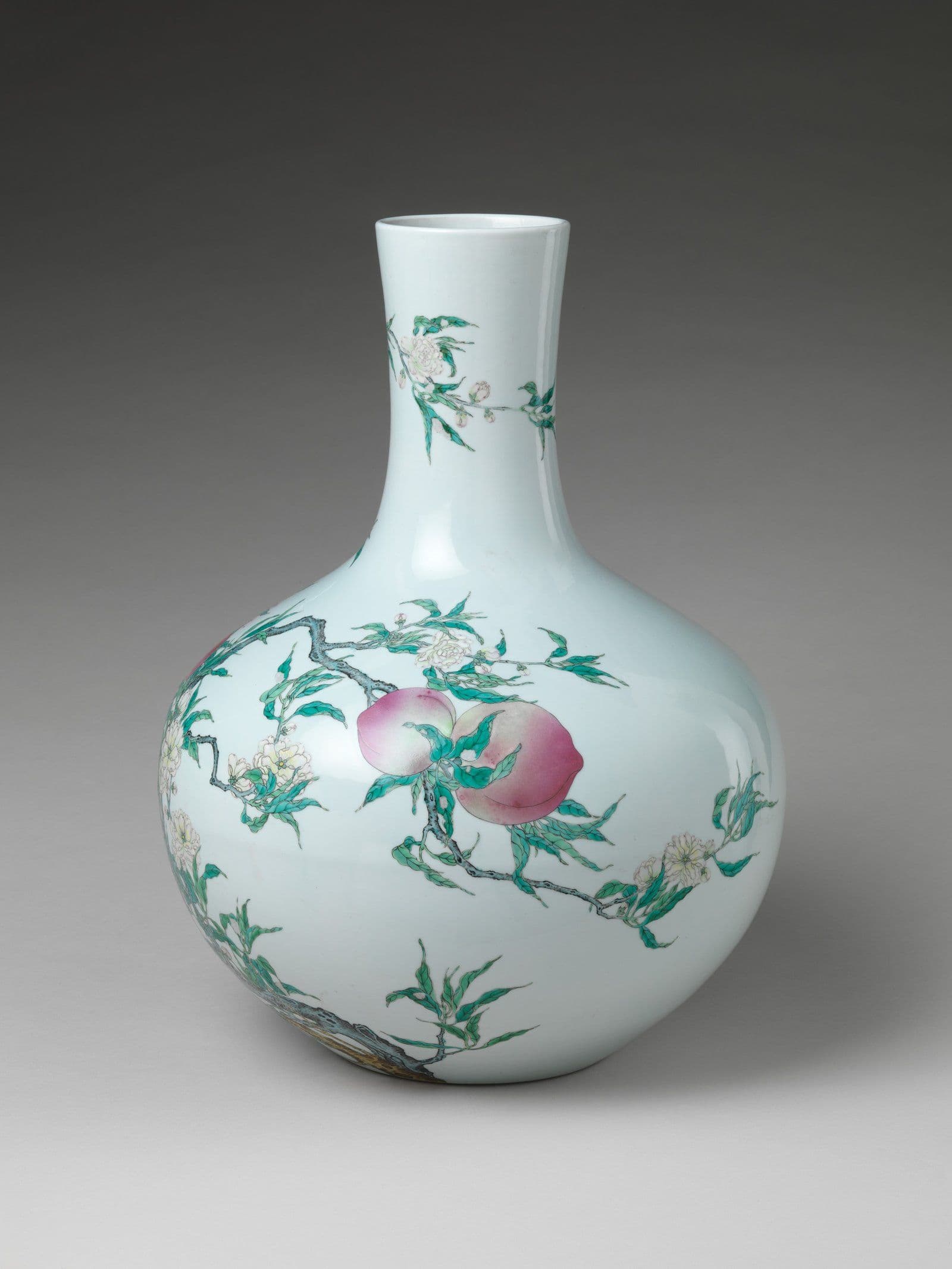
Refined famille rose (fencai) enamels, with the soft pinks introduced via European missionaries refined into a Chinese palette of striking subtlety
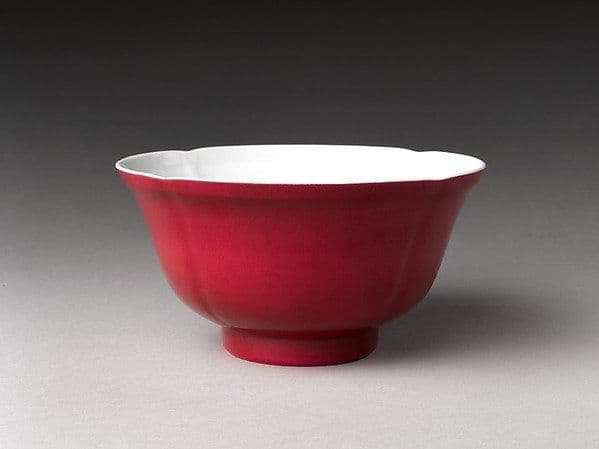
Monochrome glazes — particularly imitation Song-dynasty Ru and Ge wares — produced at standards that arguably surpass the originals technically
Doucai (contrasting-colour) revivals, drawing on Chenghua-period precedents (the Chenghua doucai tradition is a story of its own, treated separately in the cluster)
Yellow, peach-bloom, lime-green, and other monochromes, often unmarked or marked discreetly
On enamelled and monochrome pieces, the mark may be in iron-red rather than underglaze blue, and the layout sometimes shifts to a square or rectangular cartouche. The four tells above still apply: the brushwork, body, and foot rim characteristics carry across decoration types. A Yongzheng-period enamelled bowl with an iron-red mark should still feel light, fit tightly, and show the disciplined hand of a skilled imperial-kiln decorator.
What to do when you suspect a piece is later
The honest answer for any single suspect piece is: get a second opinion before money changes hands. The 8-checkpoint framework in the spotting fake porcelain marks guide is what dealers walk through, and it's a good discipline even on pieces you only suspect mildly.
Three quick gut checks before you escalate:
Does the mark feel right next to the body? A crisp, careful mark on a coarse, heavy body is a red flag. Period imperial pieces are consistent in quality from rim to base.
Are the circles wobbly? This is the single fastest later-period tell on Yongzheng-mark wares.
Does the cobalt feel "too bold"? Many late Qing and Republic-period homages used vivid cobalt and missed the muted Yongzheng signature entirely.
None of these are conclusive on their own. Together they give you a working impression in thirty seconds.
Common questions
Why is the Yongzheng reign so short, and what does that mean for collectors?
Yongzheng reigned twelve full years, the shortest of the three High Qing reigns. The total output of imperial wares was correspondingly small, and an unusually high proportion of what survived has stayed in major museum collections in Beijing, Taipei, and a handful of Western institutions. The pieces that come to market — through old estates, deaccessioned holdings, and family collections in Hong Kong and Taiwan — therefore tend to be expensive and scrutinised closely. For a collector, this means strong provenance papers and conservative attribution language matter more here than for many other reigns.
Are Yongzheng marks ever found on later pieces, and is that always forgery?
Yes, frequently — and not always as forgery. Chinese kilns have a long tradition of "apocryphal" marks, where a later piece honours an admired earlier reign by bearing its mark openly, with no intent to deceive contemporaries who knew the conventions. Late Qing and Republic-period potters often used Yongzheng marks on pieces that were clearly understood at the time as homages. Whether a particular piece is honest homage or deliberate forgery depends on context, period of production, and intent — and the line is sometimes genuinely blurry.
What's the difference between Yongzheng kaishu marks and zhuanshu marks?
Kaishu is regular script — the standard upright form Chinese readers learn first. Yongzheng kaishu marks are six characters in two columns of three, usually inside a double circle, in underglaze blue. Zhuanshu is seal script — older, more geometric, with rounded archaic strokes. Yongzheng zhuanshu marks are also six characters but laid out as three columns of two, usually inside a square cartouche, often in iron-red enamel. Kaishu is more common in the Yongzheng era; zhuanshu becomes dominant under Qianlong. Both are legitimate period marks; the layout and script alone don't tell you the piece is or isn't Yongzheng.
How does the foot rim help when the mark is unclear or worn?
When a mark is illegible, scuffed, or absent entirely, the foot rim becomes the single most useful dating clue. Yongzheng feet tend to be smooth, fine-grained, and slightly bevelled at the edge — the so-called knife-edge profile. The biscuit is clean white with little iron speckling. The glaze meets the bare foot in an almost-imperceptible transition with little pooling above. Heavy, rough, orange-spotted feet on a piece with a Yongzheng mark are a strong indicator of later production, regardless of how convincing the characters look.
Should I trust auction-house attributions like "Yongzheng mark and period" vs "Yongzheng mark"?
Auction houses use a careful vocabulary. "Yongzheng mark and period" means the cataloguer believes both the mark and the piece itself are Yongzheng-era. "Yongzheng mark" or "bearing a Yongzheng mark" means only the mark style is Yongzheng — the piece itself may be later. The price difference between the two language tiers is usually significant, often an order of magnitude. Read the catalogue language carefully, and when in doubt, request the condition report and any technical analysis the house has on file.
Further reading
Apocryphal Marks on Chinese Porcelain — when a later piece honestly bears an earlier reign's mark, and how to read the convention.
Chinese Porcelain Studio Marks and Hall Marks — the imperial residence and studio marks beyond reign marks, several of which appear on Yongzheng-period imperial commissions.
Republic-Period Porcelain Marks (Minguo) — the most-prolific era for Yongzheng-style homage pieces in circulation today.
Reading Chinese Porcelain Marks Tutorial — a non-Chinese-reader's path to identifying 95% of marks character by character.
Browse our Chinese porcelain
Modern hand-painted homages in the Yongzheng tradition — refined glazes, careful brushwork, and honestly described marks — sit alongside other dynasties in our Chinese porcelain collection.
Explore Further