Published April 25, 2026
After his eyesight failed, Zhang Daqian invented pocai — splashed colour and ink. How to date the late period, read the technique, and understand its record auction prices.
Zhang Daqian was already in his sixties — internationally famous, comfortably wealthy, and at the top of the classical Chinese painting world — when his eyesight began to fail and he reinvented his style entirely. The result, splashed-ink (泼墨) and splashed-colour (泼彩), pushed Chinese painting into territory closer to Pollock or Rothko than to Tang Yin. It also produced some of the most expensive Chinese paintings of the twentieth century.
The first sixty years
Zhang Daqian (1899–1983) was the most technically virtuosic painter of his generation. By the time he was forty he had mastered every classical Chinese style — Song landscapes, Ming literati works, Qing-dynasty bird-and-flower painting. He was also one of the most celebrated forgers in Chinese history; his copies of Shitao were so accurate that several major museums bought them as originals before the truth came out in the 1960s.
This is important context. The splashed-ink works are not the breakthrough of someone who couldn't paint classically. They are the breakthrough of someone who had already done everything classical Chinese painting had to offer, and who at sixty had to invent something new because his eyes could no longer manage the fine work.
The diabetic eye and the accidental innovation
Zhang developed diabetic retinopathy in the late 1950s. He was painting in São Paulo at the time — exiled, by choice, from a Communist mainland and a Nationalist Taiwan that had both become unwelcoming. Fine brushwork became literally impossible. He could no longer paint a leaf vein.
His response was to lay paper flat, soak large areas with water, and pour ink onto the wet surface. The ink moved as it wanted to — pooling, bleeding, granulating into mountainous shapes. Zhang then directed the flow with the brush, the paper edge, and (notoriously) by tilting the table.
The first splashed-ink works look like accidents. Most of them were. But Zhang quickly learned the new medium had its own logic: the ink granulation behaved like distant peaks; the bleeding edges read as mist; the negative space read as water. He had stumbled onto a way of painting Chinese landscape without painting any of its details.
Why this matters in art history
Splashed-ink Chinese landscape, as Zhang practised it from about 1965 onward, is one of the few twentieth-century Chinese inventions that maps cleanly onto Western abstract expressionism. The dates align — Zhang is doing this at the same moment Helen Frankenthaler is staining canvas in New York. The effects are similar — pooling, edge-finding, the surrender of the artist's hand to the material.
But Zhang's splashed ink remains legible as Chinese landscape. There are mountains, even when the mountains are only a darker zone of bleed. There are clouds, even when the clouds are only the edge of a stain. The viewer is doing more interpretive work than in a classical painting, but the genre conventions are intact.
That legibility is what separates Zhang's splashed ink from pure abstraction. It is also what makes the works so expensive at auction: they read both as twentieth-century innovation and as continuous with a thousand years of Chinese landscape painting. Collectors get both at once.
How to read a Zhang splash
Three things to look for:
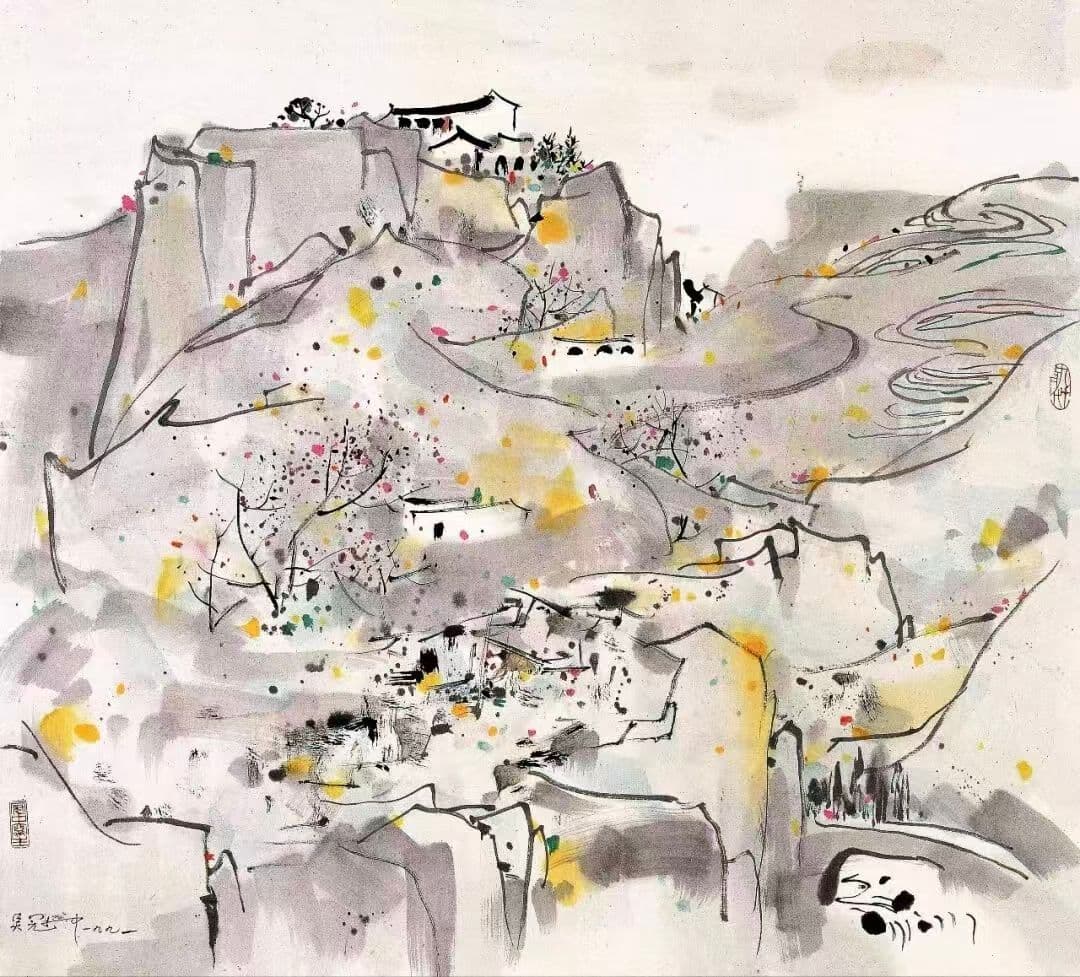
First, the inflection points. Zhang almost always pulls the ink wash into a recognisable feature at the painting's pressure points — a single architectural line where a temple should be, a sliver of pure white where the moon should be, a vertical accent that reads as a pine. The more abstract the rest of the painting, the more these touches matter.
Second, the granulation. Real Zhang splashed ink has a pebbly, almost geological texture in the dark passages, caused by the ink particles settling into the wet paper. Reproductions and forgeries often miss this — they reproduce the shape but not the surface.
Third, the seal placement. Zhang signed and sealed his late works carefully, often using the placement to establish a foreground that the splashed ink hadn't created. The seal is part of the composition, not just authentication.
Living with a splashed-ink work
These are paintings that need space. The compositions are large, the gestures are wide, the legibility is built around scale. A Zhang splashed-ink print works on a long wall, alone, at viewing distance of two or three metres. In the right room it is one of the most extraordinary things twentieth-century painting produced.
Zhang Daqian prints in the Kiln & Ink collection are hand-numbered giclée reproductions on archival rice paper, faithful to the splashed-ink and splashed-colour palette of the late masterworks.
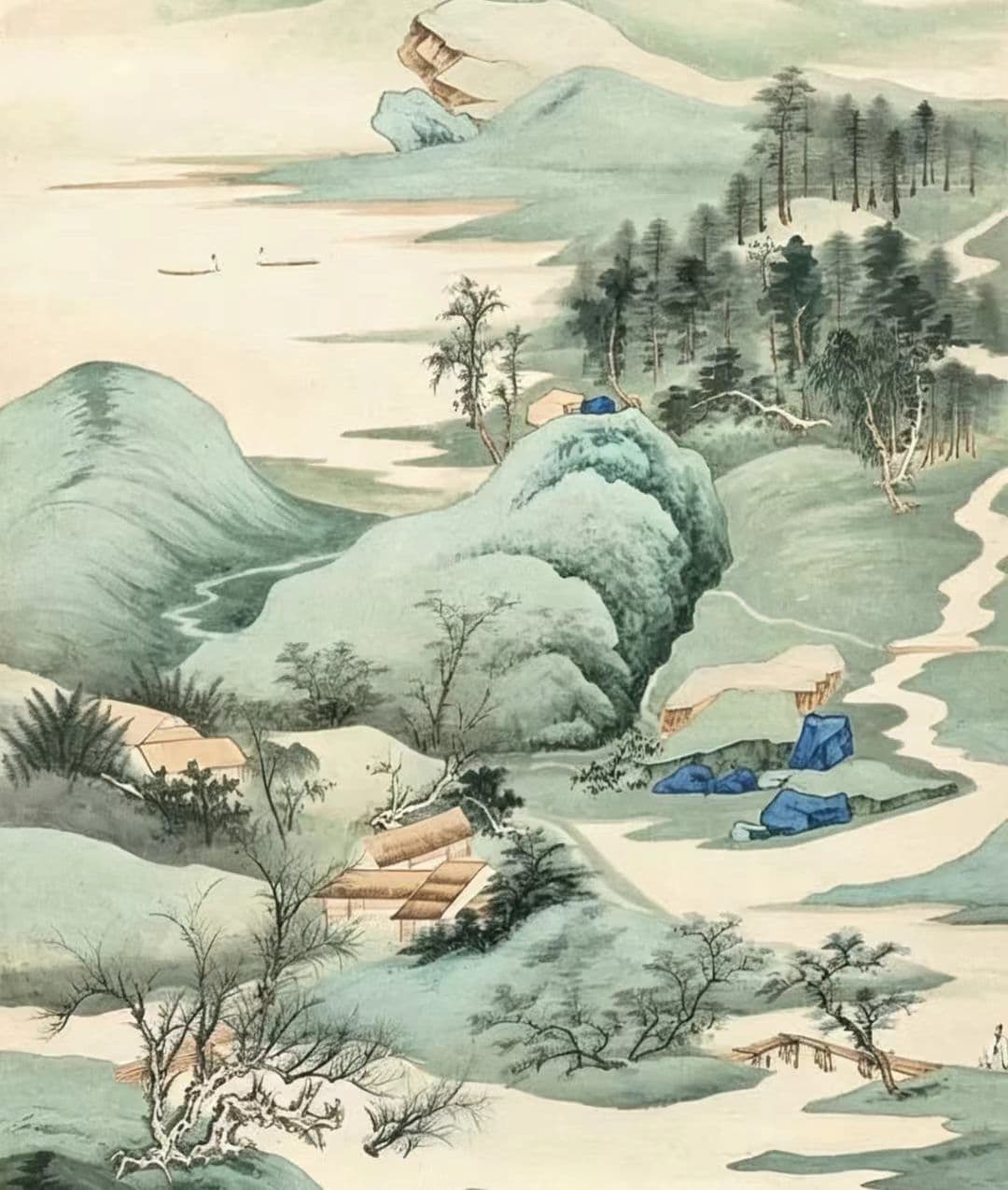
From the Kiln & Ink collection: Blue and Green Landscape, an archival giclée edition after Zhang Daqian, hand-numbered on xuan paper with a certificate of authenticity.
Explore Further