Published April 22, 2026
Wu Guanzhong (1919–2010) is the painter who proved Chinese ink could absorb Cézanne, Klee, and Mondrian without losing itself. The result is the most internationally recognised vocabulary of late-twentieth-century Chinese painting — and one of the most accessible bodies of work for Western collectors entering Chinese art.
Wu Guanzhong is the painter who proved Chinese ink could absorb Cézanne, Klee, and Mondrian without losing itself. The result is the most internationally recognised vocabulary of late-twentieth-century Chinese painting — and one of the most accessible bodies of work for Western collectors entering Chinese art.
A long detour through Paris
Wu was born in 1919 in Yixing, Jiangsu, into a family of farmers. He studied at the Hangzhou National Art School under Lin Fengmian (whose own work bridges similar territory), then went to Paris on a government scholarship in 1947 and stayed until 1950. He saw the Cézanne retrospective at the Orangerie, studied at the École Nationale Supérieure des Beaux-Arts, and absorbed the structural formalism that defined mid-century European modernism.
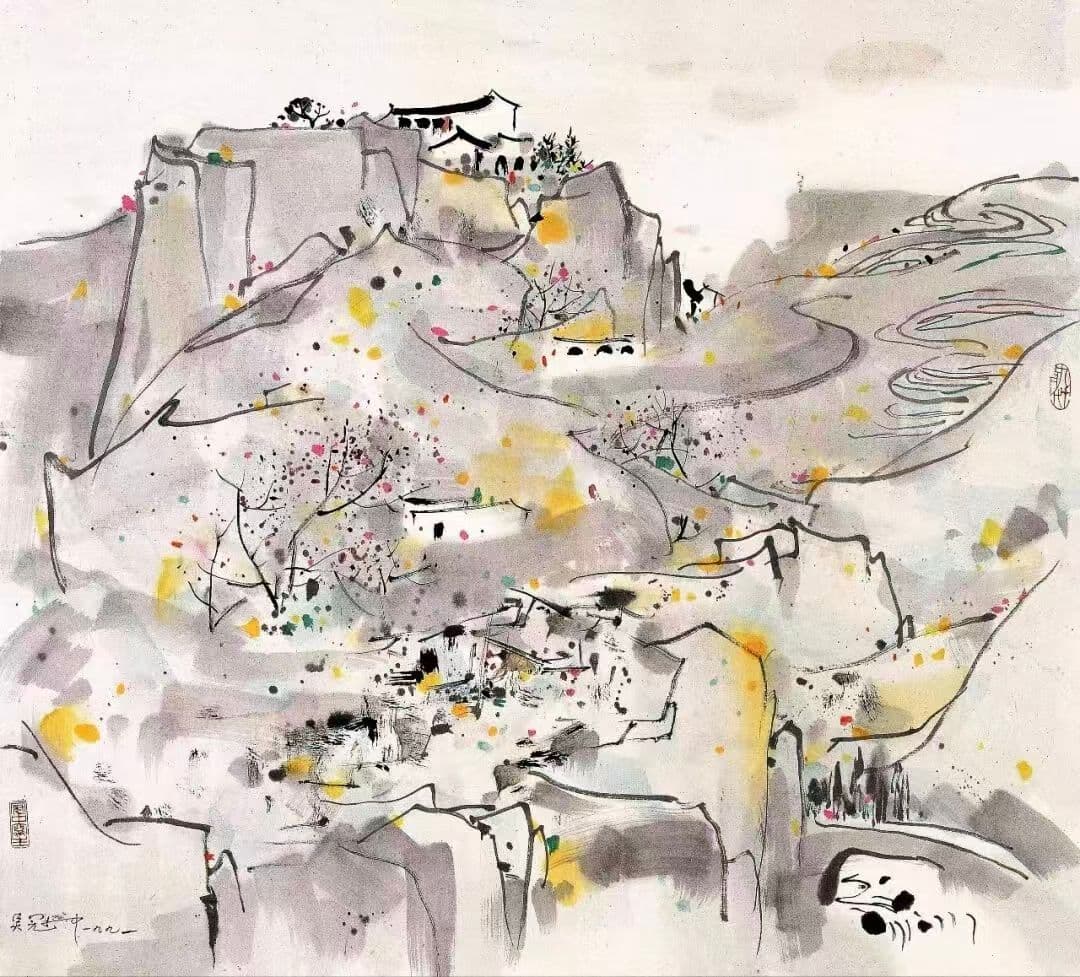
He then chose to come back to China — a decision he debated for years. By the time he was producing mature work, in the 1970s and 1980s, he had developed a vocabulary that was unmistakably both modernist and Chinese: thin black lines on white paper, accents of pure colour, abstracted village rooftops, near-Mondrian compositions, executed with brush and ink.
The Jiangnan village as visual problem
Wu's signature subject is the Jiangnan village — the whitewashed walls and black-tile roofs of the water towns south of the Yangtze. It is a real place, but in Wu's hands it becomes a composition: rectangles of white wall, lines of black eaves, dots of figures in the streets, all reduced to an almost-Klee-like grid.
This is where the Western training shows most clearly. Wu sees the village the way a Cubist sees a guitar — as an arrangement of planes. But he renders the planes with calligraphic brushwork, on rice paper, in ink. The technique is Chinese; the structural seeing is Western. That combination is what makes the work feel new in both traditions.
The rule about colour
Wu's most copied trick is the sparing use of pure colour — a single red dot, a yellow door, a blue boat — against a black-and-white field. He spoke about this directly: colour in his work is meant to function the way punctuation functions in writing. It marks the rhythm. Too much of it and the painting becomes decorative; none of it and the painting feels too austere.
Look closely at any mature Wu and you will find the colour accents are placed at compositional pressure points — the corner where two architectural lines meet, the eye of a figure, the apex of a triangle of rooflines. The colour is structural, not symbolic.
Why this work travels
Western collectors approaching Chinese painting often struggle with the codes — the seal-script signatures, the symbolic readings, the encyclopedic literary references that classical Chinese painting assumes. Wu Guanzhong's work has almost none of that. It is legible to anyone who has spent twenty minutes in front of a Mondrian.
That accessibility is why Wu has set Chinese painting auction records repeatedly since the 2010s. His major works regularly sell for tens of millions of dollars at Sotheby's and Christie's Hong Kong, and his prints — including ours — are bought as much by Western architects and designers as by Chinese collectors. He is, in 2026, probably the most globally fluent Chinese painter of the twentieth century.
Living with a Wu
Wu's work rewards modern interiors. Black, white, accents of colour, rectangular composition — it sits comfortably next to mid-century furniture, in spare gallery walls, against concrete. It is one of the few Chinese ink masters whose works look entirely at home in a Brooklyn loft or a Bauhaus restoration, without ever feeling like an Asian-themed accent piece.
That fluency is by design. Wu spent fifty years engineering it. The prints in the Kiln & Ink collection are hand-numbered giclée reproductions on archival rice paper, faithful to Wu's own colour choices and brushwork.
From the Kiln & Ink collection: A Small View of Jiangnan, an archival giclée edition after Wu Guanzhong, hand-numbered on xuan paper with a certificate of authenticity.
Explore Further