Published May 25, 2026
The two main mark colors on Chinese porcelain — and what each tells you about period, technique, and authenticity. Iron red appeared in Yongzheng's era; underglaze blue dates back to Yuan. Learn to read both.
Iron Red vs Underglaze Blue Marks: Identification Differences Explained
When you flip a piece of Chinese porcelain over and look at the reign mark, the first thing you'll notice is its color — most likely deep blue (underglaze cobalt) or bright red (iron red overglaze). These two colors are not just aesthetic choices — each carries dating implications, technical signatures, and authentication clues.
This guide explains both, when each was used, and how to read them in conjunction with the rest of the piece.
The two main mark technologies
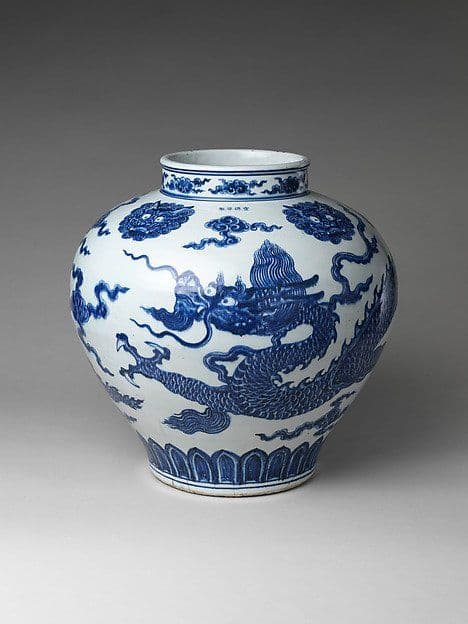
Underglaze blue (青花款 Qing Hua Kuan)
How it's applied:
The biscuit (unfired, unglazed clay body) is allowed to dry
A brush dipped in cobalt-iron oxide pigment paints the mark on the bare clay
Clear glaze is applied over the entire piece
The piece is fired in a single high-temperature firing (~1280-1320°C)
The cobalt fuses with the glaze, sealed permanently inside
Visual signature:
Mark appears slightly muted and "drowned" beneath the glaze — there's a depth quality
Cobalt may show tonal variation within strokes where pigment pooled
Heavy strokes can show "iron rust spots" (Ming Xuande) where cobalt impurities concentrated
Color: deep sapphire to violet-blue depending on cobalt source
When used:
All marked Ming reigns — Yongle, Xuande, Chenghua, etc. (with rare exceptions)
Most Qing reigns — Shunzhi, Kangxi, Yongzheng, Qianlong (typical), Jiaqing onward
Default for blue-and-white decorated pieces — the mark color matches the decoration
Iron red (矾红款 Fan Hong Kuan)
How it's applied:
The piece is fully glazed and fired (white-glazed body)
After the high-fire is complete, iron red pigment (iron oxide + alum binder) is painted ON TOP of the fired glaze
The piece is fired a second time at low temperature (~700-800°C) to fix the enamel
Visual signature:
Mark sits on the surface of the glaze rather than inside it
Slight raised relief — runs your fingernail across and you can feel it
Color: bright orange-red to deep crimson-red, more opaque than underglaze blue
May show slight haloing where iron oxidized at the edge during low-fire
Doesn't have the "drowned" depth quality
When used:
Yongzheng famille rose pieces (1723-35) — iron red mark introduction becomes routine
Qianlong falangcai and high-end commissions (1736-95)
Daoguang Shen De Tang marks (1821-50) — iron red 4-char square cartouche
Tongzhi Ti He Dian marks (1862-74)
Most Cixi-era hall marks (Da Ya Zhai etc.)
Most 20th-century commercial marks (Republic period studios)
Era timeline: when did iron red marks become common?
| Period | Iron red mark prevalence | Notes ||---|---|---|| Ming all | Very rare | Some Wanli iron red marks exist but exceptional || Shunzhi-Kangxi | Rare | Mostly underglaze blue || Yongzheng | Routine for famille rose | Iron red mark era begins || Qianlong | Common for enameled pieces | Iron red on falangcai standard || Jiaqing-Daoguang | Common for hall marks | Underglaze blue still standard for blue-and-white || Tongzhi-Guangxu | Very common | Imperial famille rose iron red dominant || Republic | Standard for studio marks | Underglaze blue declining || Modern | Standard for everything | Both used freely |
Key dating rule: Iron red mark on a "Kangxi" piece is a yellow flag. Kangxi pieces overwhelmingly used underglaze blue marks. Iron red Kangxi marks exist but are rare exceptions; if you see one, scrutinize the piece extra carefully.
Key dating rule: Underglaze blue mark on a Republic-period piece is unusual but possible — most Republic studios used iron red, but some traditionalists kept the underglaze blue convention.
How material choice maps to mark color
The mark color often (not always) matches the dominant decoration technique:
| Decoration type | Typical mark color | Reasoning ||---|---|---|| Blue-and-white (underglaze blue) | Underglaze blue | Same firing, same pigment palette || Famille verte (overglaze enamels) | Iron red | Mark applied with overglaze enamels || Famille rose (overglaze) | Iron red | Same || Falangcai (imperial enamels) | Iron red, sometimes blue enamel | High-end || Monochrome glazes (sang-de-boeuf, jihong) | Often incised; sometimes iron red | Can't paint underglaze on monochrome glaze || Doucai (overglaze + underglaze) | Underglaze blue | Mark applied during underglaze stage || Sweet white (tianbai) | Incised in body, sometimes underglaze blue | Pre-glaze marking |
Authentication implications
Iron red is harder to fake convincingly
Authentic iron red has subtle properties forgers struggle to match:
Surface relief — period iron red sits in a slight raised line you can feel
Edge oxidation halo — micro-orange tint at stroke edges from the second firing
Texture under magnification — particulate structure, not smooth like modern enamels
Modern industrial reds are typically flat sprayed enamel with no relief and no edge halo. Use raking light + fingernail test.
Underglaze blue is harder to fake CONVINCINGLY but easier to fake POORLY
The underglaze blue technique is simpler — anyone with cobalt and clay can paint a mark and fire. So forgeries are common. But getting the brushwork, cobalt tonal quality, and glaze appearance right requires period-trained skills that most forgers don't have. Failures are typically in:
Flat industrial cobalt (no tonal variation)
Modern uniform glaze (no orange-peel texture)
Mechanical brushwork (no calligraphic confidence)
The cobalt source paper trail
Underglaze blue cobalt sources changed across centuries — knowledgeable collectors use this to date:
| Period | Cobalt source | Visual signature ||---|---|---|| Yuan-Ming early | Persian "Su Ma Li 苏麻离" | Deep blue with iron-rust spots || Ming Chenghua | Domestic "Pinghua 平花" | Soft pale blue-grey || Ming Jiajing-Wanli | Central Asian "Hui-qing 回青" | Bright purple-toned blue || Late Wanli onward | Mostly domestic Yunnan | Less vivid, more grey || Kangxi | Mixed Persian + Yunnan | Rich sapphire, tonal variation || Yongzheng-Qianlong | Domestic predominant | Refined, more uniform || Modern | Industrial cobalt oxide | Completely flat, no variation |
You don't need to memorize this — but knowing that cobalt color varies by period helps you spot anachronistic combinations (e.g., a "Xuande" piece with modern flat blue).
Can a piece have BOTH colors?
Yes, in two scenarios:
1. Apocryphal under reign marks
A piece may bear an iron red Yongzheng reign mark + underglaze blue Chenghua reign mark in different positions — common on some doucai pieces where the doucai decoration includes the apocryphal mark and the iron red identifies the actual production reign.
2. Hall mark + reign mark combinations
Some imperial pieces have a base reign mark in iron red + a hall mark elsewhere (sometimes on the inside of the foot rim). These are typically very high-grade commissions.
Quick visual diagnostic
When you first look at a mark, ask:
Is it blue or red? → Filter by mark technology era
Does it sit IN the glaze or ON the glaze? (run fingernail across it) → Confirms underglaze vs overglaze
Is the color uniformly flat or tonally varied? → Period vs modern indicator
Do the strokes have raised relief (red) or muted depth (blue)? → Confirms technique
Common questions
Why is iron red sometimes called "矾红"?
矾 (fan) means "alum" — the binder used to bond iron oxide to the glaze surface during the second low-fire. The full name 矾红 literally means "alum red." Some older literature uses 抹红 (mo hong, "rubbed red") for the same technique.
Are there other mark colors besides red and blue?
Yes, but rare:
Black marks on some Yongzheng pieces (manganese-iron pigment)
Sepia/iron gold on some monochromes
Underglaze copper red (釉里红 You Li Hong) — extremely rare for marks; mostly seen as decoration
Gold marks on imperial Cixi-era and Republic pieces
What's "incised" mark and how is it different?
An incised mark (刻款) is carved into the clay body before glazing, then covered by glaze. You can feel it as a recess rather than a raised line. Common on monochrome glaze pieces (sang-de-boeuf, apple green) where you can't paint a mark under the colored glaze. Period dating is the same as painted marks of the era.
Do iron red marks fade over time?
Less than you'd think. Authentic iron red enamel is chemically stable — the iron oxide doesn't photodegrade. Apparent fading on antique pieces is usually surface wear from cleaning over centuries, not pigment fade.
Are some marks ONLY iron red?
The Hongxian (居仁堂) Republic-period mark and the Cixi 大雅斋 mark are essentially always iron red — finding either in underglaze blue is a strong forgery signal.
Further reading
Chinese Porcelain Marks: A 2026 Identification Guide — master overview
Qing Dynasty Reign Marks Chart — color used per reign
Chinese Porcelain Studio & Hall Marks — many in iron red
How to Spot Fake Chinese Porcelain Marks — color anachronism is a major fake signal
Browse our authenticated pieces
Chinese porcelain collection → — both underglaze blue and iron red mark styles, all faithfully reproduced.
Explore Further