Published April 21, 2026
Modern Chinese pottery and porcelain marks by period: Republic-era signatures, PRC factory codes of the 1950s-80s, and post-2000 studio marks.
Twentieth- and twenty-first-century Chinese porcelain marks are a distinct category, not just a continuation of the Qing tradition. The conventions changed substantially across three eras — the Republic of China (1912–1949), the early People's Republic (1949–1980), and the post-reform era (1980–present). Each era has its own mark conventions, its own diagnostic problems, and its own collecting market.
Republic of China (1912–1949)
Republican-era porcelain marks shifted decisively from reign marks to artist signatures. The imperial kilns at Jingdezhen continued operating under private ownership, and the master decorators — many of whom had served the Qing court — began signing their own work in red enamel or underglaze blue, with one or two seal marks alongside.
The most collected Republican signature group is the Eight Friends of Zhushan (珠山八友), a circle of Jingdezhen master decorators active from the 1920s through the 1940s. Their signed pieces routinely sell for $20,000–$200,000 at auction today. Their marks include both the artist's name (often a literary alias) and a poetic seal.
Some Republican-era pieces still carry reign marks — usually Qianlong or Kangxi as historical references — but with the addition of an artist signature elsewhere on the piece. This is a hybrid form. The reign mark is decorative; the signature is authenticating.
Hall marks continued through the Republican era. The most prestigious is 居仁堂 (Yuan Shikai's short-lived imperial studio in 1916), but many private studios produced hall-marked porcelain. These are collected today as Republic-era hall ware.
Early PRC (1949–1980)
After 1949 the kilns at Jingdezhen were nationalised and reorganised into ten state-run factories, identified by numbered codes — the most famous is the Number 4 factory (景德镇市第四瓷厂). Pieces from this era often carry factory codes rather than artist signatures, marked in red enamel as 景德镇制 ("Made in Jingdezhen") or 中国景德镇 ("China Jingdezhen") with a small numerical or character code.
Two specific PRC marks are now collected for nostalgic value: the 文革 (Cultural Revolution) period marks, often featuring slogans like 为人民服务 ("Serve the People") in red enamel, and the export marks of the 1960s–1970s, which typically read 中国 ("China") or MADE IN CHINA in capitalised English. These pieces are not high-grade porcelain by historical standards but command increasing collector interest as historical documents.
Post-reform (1980–present)
The post-1980 market saw the return of artist studio marks. Master decorators at Jingdezhen — recognised as 中国工艺美术大师 (China Master of Arts and Crafts) — began signing work in their own names again. These signatures are typically accompanied by two seals (a name seal and an alias seal) and sometimes a date colophon.
The major living masters' work routinely sells in the $5,000–$50,000 range per piece at Hong Kong and mainland auctions. As with Republic-era artist marks, the signature is the primary authenticator — a piece signed by a recognised master is collected as that master's work, regardless of whether it was technically thrown by an apprentice in his studio.
Reproduction porcelain — pieces openly produced in 1980s–2010s Jingdezhen as reign-mark Kangxi or Qianlong reproductions — became commercial-grade decorative ware in this era. Some were intentionally produced as study pieces for museums and collectors; many were sold as decorative reproductions and have since entered the secondary market as ambiguously dated pieces.
Diagnostics for modern marks
Three quick checks for placing a modern Chinese porcelain mark:
Glaze and body. Modern Jingdezhen porcelain bodies are markedly whiter and denser than any pre-1900 production. The clay refinement crossed a threshold around 1950 — pieces from after that point are visibly cleaner in body and glaze than any genuine Qing-era work.
Painting style. Republic-era painting still uses traditional brush-loaded pigment with visible weight variation. PRC-era painting often uses standardised printed-pattern decoration with uniform application. Post-2000 master work returned to the brush-loaded tradition. The stroke quality is the give-away.
Mark execution. Republic-era artist signatures are written with calligraphic confidence — they are real signatures by trained calligraphers. PRC-era factory marks are evenly stamped or block-printed. Post-2000 master marks are again calligraphic, often with characteristic studio seal styles.
Why this matters for the broader Chinese collecting market
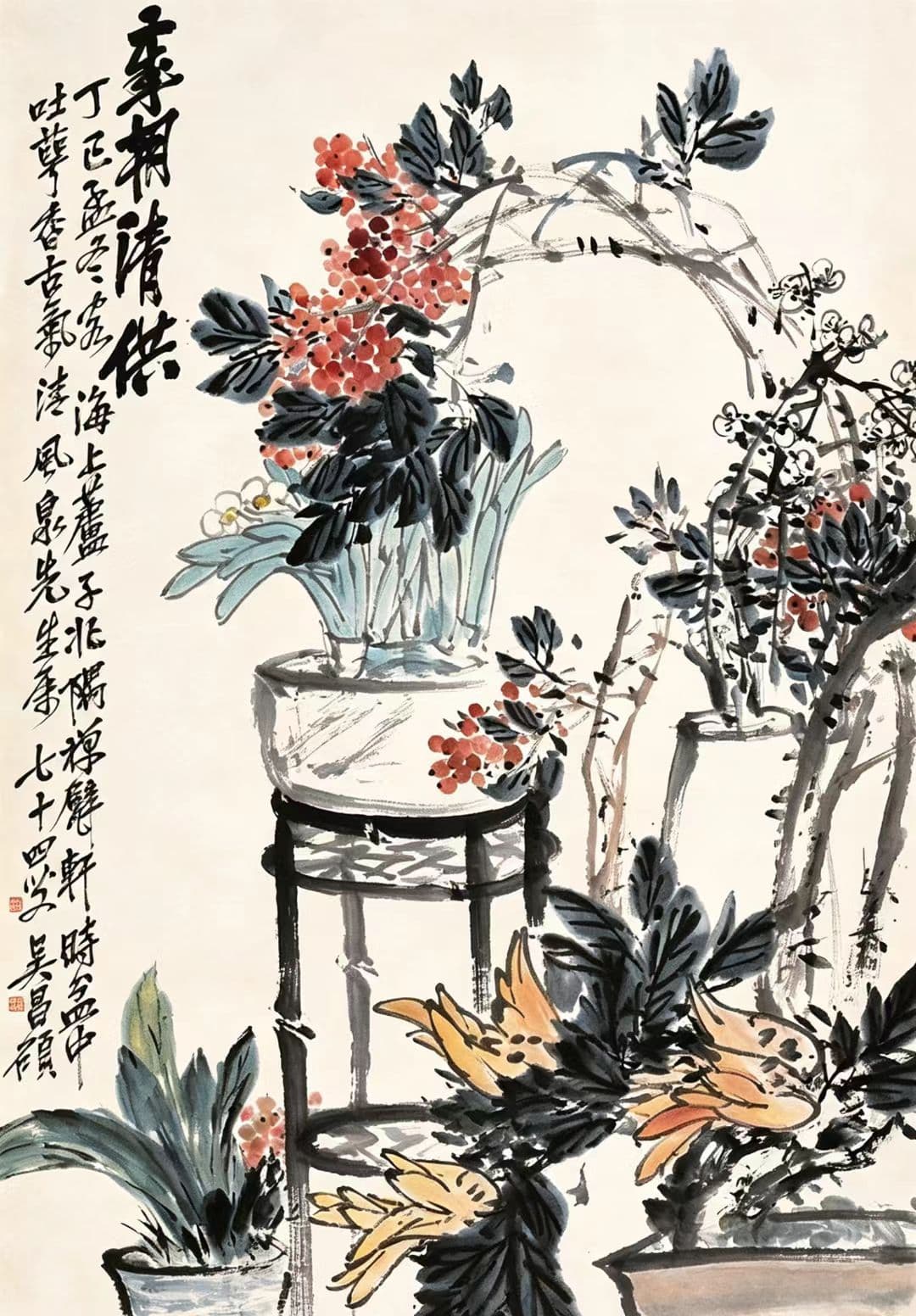
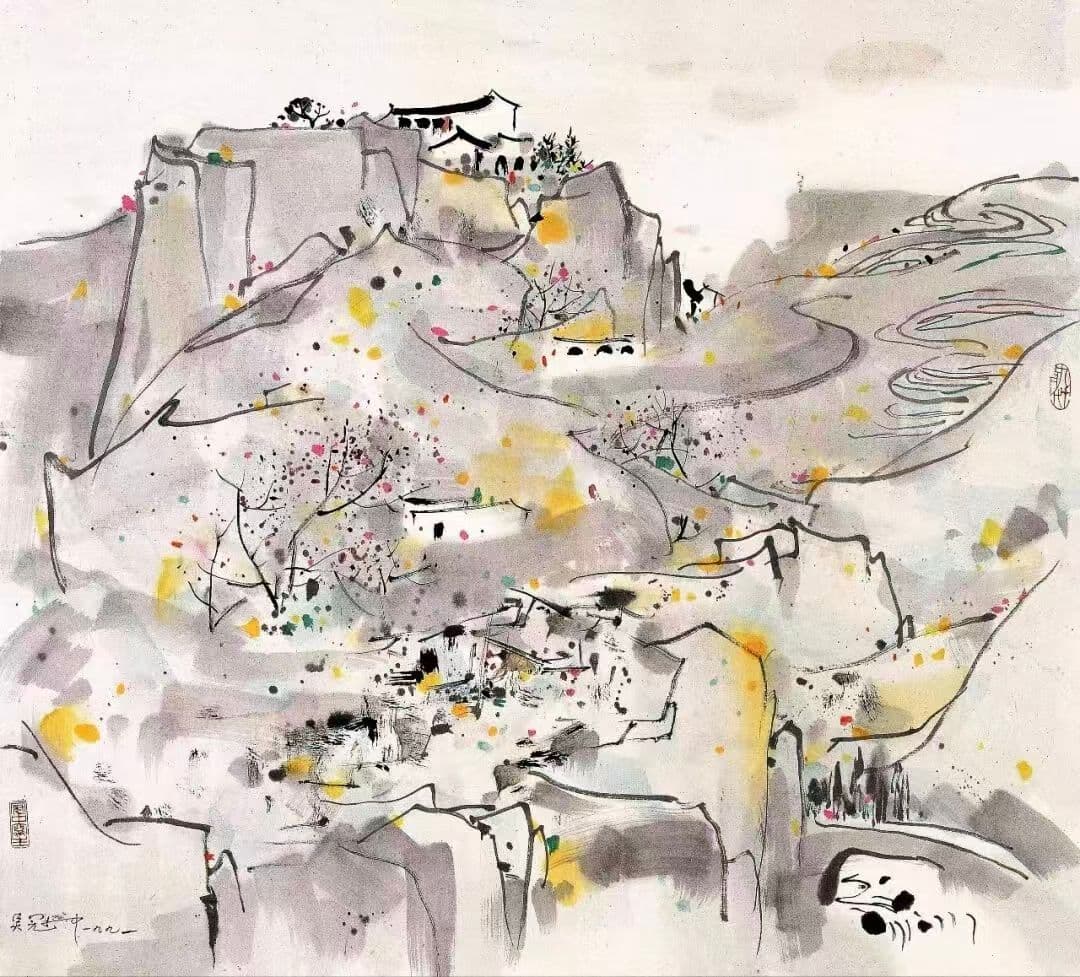
Modern Chinese porcelain has become its own collecting category, not just a footnote to imperial porcelain. The Republic-era and post-2000 master signatures sit alongside twentieth-century Chinese ink painting in collector portfolios — the same buyers who acquire a Qi Baishi print from this period are increasingly buying signed Republic-era porcelain panels by the Eight Friends of Zhushan.
If you are starting in modern Chinese material culture and want to understand the signature and seal conventions that bridge porcelain and painting, the most efficient education is to spend time with a few signed twentieth-century ink paintings. The seal scripts are the same; the calligraphic conventions are the same; the studio-name traditions are the same. The Kiln & Ink collection of master prints is one entry point.
From the Kiln & Ink collection: Gourd, an archival giclée edition after Qi Baishi, hand-numbered on xuan paper with a certificate of authenticity.
Explore Further