Published September 22, 2024
A practical guide to the first work: how to choose one, what to read about it once it arrives, where to hang it, and what a single piece realistically does to a room.
Most people who end up living with Chinese art did not plan to. They were not collecting anything. They saw one thing — a landscape, a pair of shrimp, a line of calligraphy — and it stayed with them for a week. That is the ordinary way in, and it is a better one than deciding in advance to become a collector.
What follows is what the first piece actually does, and what to do about it. No investment case, because there isn't a credible one to make at this price level; the argument for a first work is that you will look at it several thousand times.
One piece does more than five
A single work in an otherwise plain room is doing something a group cannot: it has nowhere to hide and nothing to be compared against. Your eye returns to it because there is no competition, and the returning is where the change happens — you start noticing the light on it at different hours, and the room reorganises itself around that one point of attention.
Groups work differently. Three works on a wall become a pattern, and the eye reads the pattern instead of the pictures. That is a fine thing to build toward, but it is the wrong place to start. Buy one. Live with it for a season before you buy the second.
How to choose the first one
Buy the thing that stops you, not the thing that impresses you. The impressive work is usually the one with the most recognisable name attached, and recognisability wears off in about a month. The work that stopped you will still be doing it a year later, and you will not be able to fully explain why — which is the point.
Two practical filters. First, look at the piece at the size you will actually hang it: a composition that reads beautifully as a thumbnail can be thin at a metre wide, and a dense landscape can be unreadable at thirty centimetres. Second, check what is in the empty space. In Chinese ink painting the unpainted paper is a compositional element, not leftover; if the emptiness feels arbitrary rather than held, the work will not sustain repeated looking.
The learning is half of it
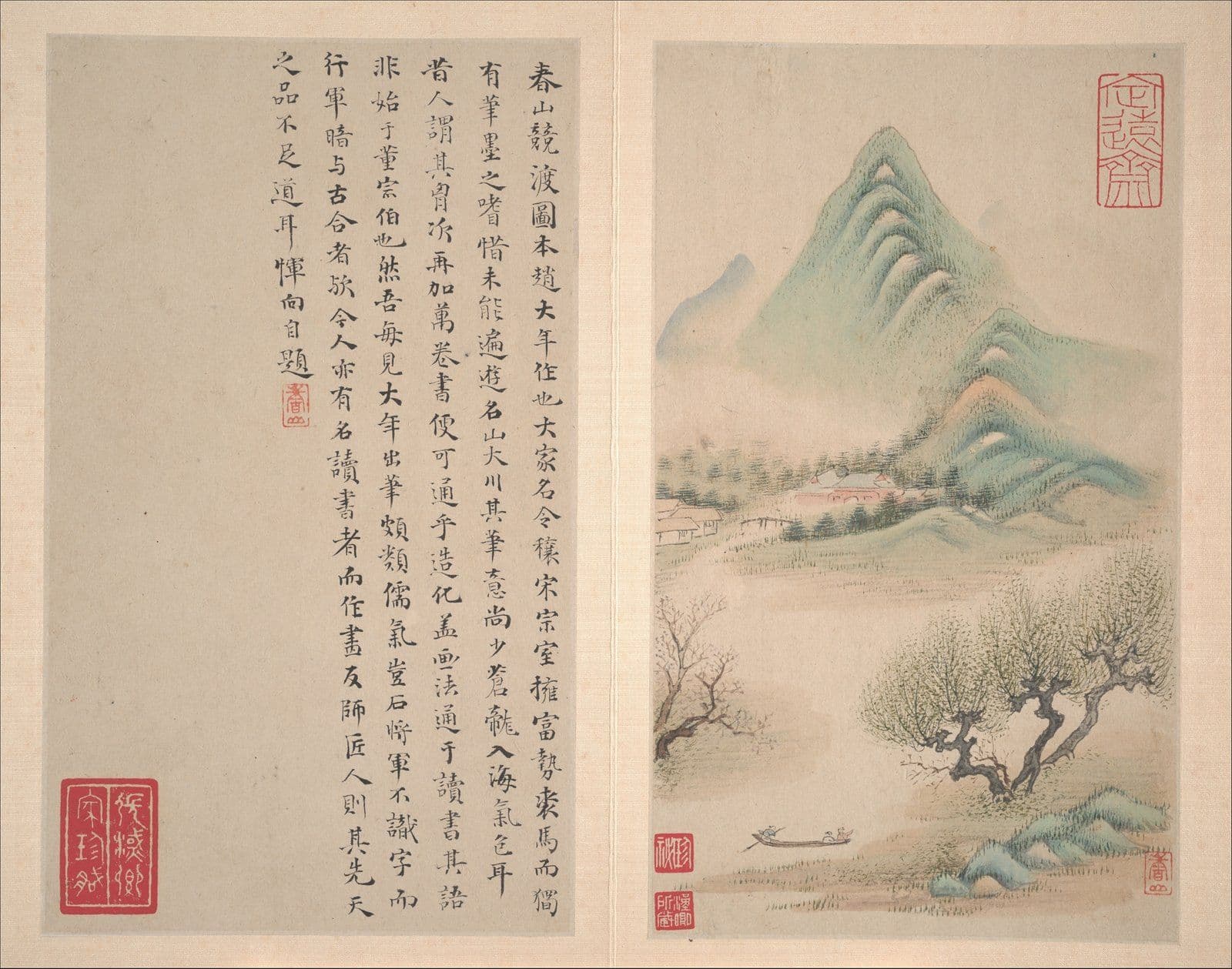
Once a work is on the wall, the reading starts, and this is the part people underestimate. A Chinese painting carries more legible information than most Western pictures of the same date: the inscription usually names the occasion, the dedicatee, or the season; the cyclical date fixes the year; the seals record both the artist and, often, later owners. None of that requires reading Chinese fluently — it requires knowing which parts of the picture carry information.
Then the brushwork. Ink-load variation, the speed of a stroke, where the brush was lifted — these are visible once you know to look for them, and they are the same features specialists use to separate a hand from an imitation of it. A month of looking at one work teaches more about this than a year of looking at reproductions in books, because you can go back to the same picture in different light.
Where it goes
Works on paper have real requirements and they are not onerous. Keep the piece out of direct sun; frame it behind UV-filtering glazing with acid-free matting; avoid exterior walls that swing in temperature, and avoid the wall above a radiator. Stability matters more than hitting an exact humidity target — a room that stays roughly steady across the year is kinder to paper than one that cycles between extremes, even if the average looks fine on paper.
Height is the other thing people get wrong. Hang the centre of the image at eye level for a standing adult, which in most rooms is lower than instinct suggests. If the work is meant to be seen from a sofa, lower it again.
Browse the collection
For the works themselves, Kiln & Ink issues limited-edition archival giclée reproductions of the twentieth-century Chinese ink masters — fifteen artists, printed on rice paper, hand-numbered, and supplied with a Certificate of Authenticity. Editions run from about $300 to $1,200, which is the price level this article assumes throughout.
If you would rather start from an artist than from an image, Qi Baishi is the usual first door: the subjects are legible without any background in Chinese painting, and the brushwork is unusually easy to read for a beginner.
Explore Further