Published April 13, 2026
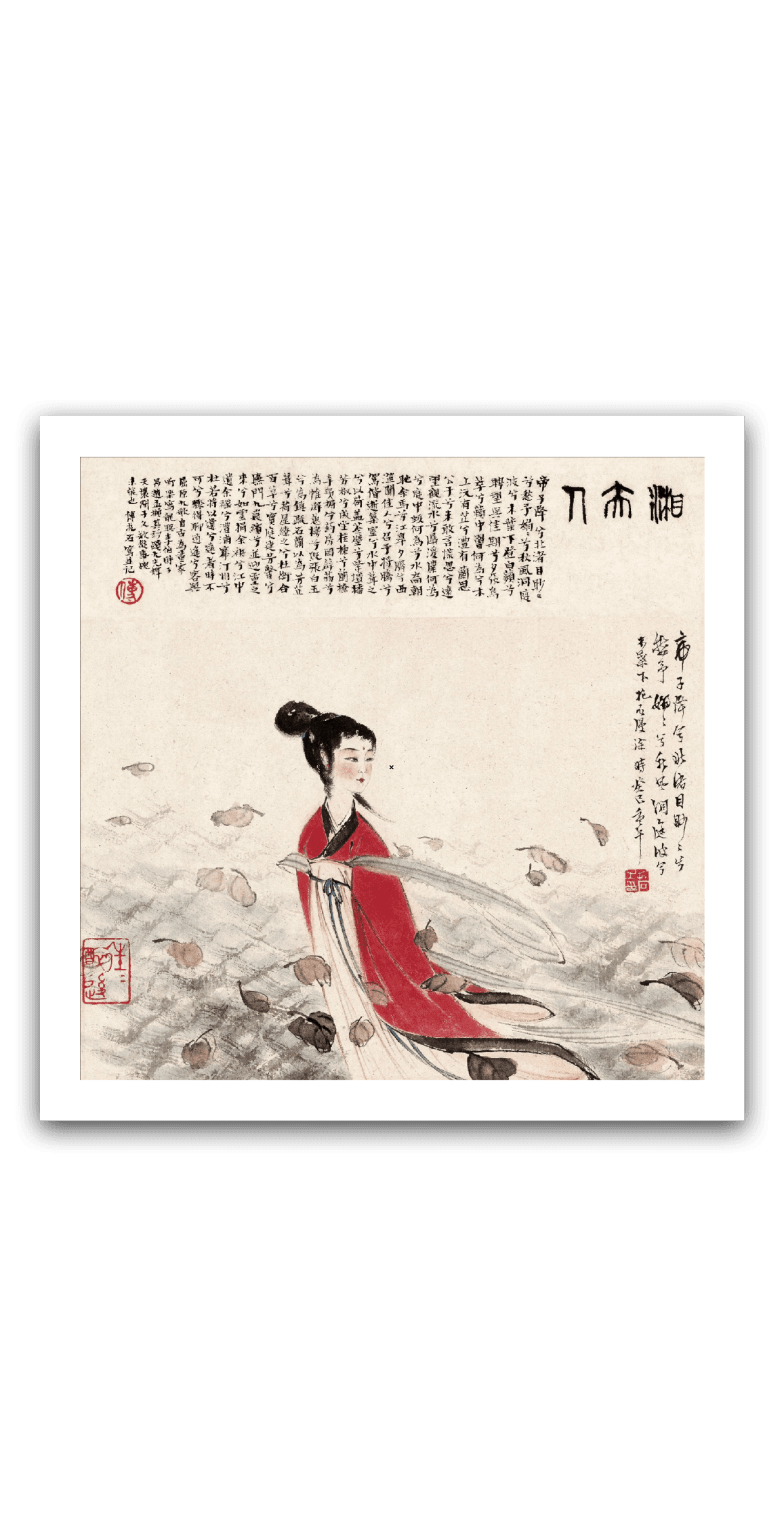
In 1943, as Japanese forces advanced into Hunan — the ancient land of Chu — Fu Baoshi and his wife sat together in Chongqing and painted The Lady of the Xiang, inspired by Qu Yuan's immortal verse. The result is one of the most emotionally charged figure paintings in modern Chinese art.
In the autumn of 1943, Japanese forces were pushing deeper into Hunan province — the ancient heartland of the Chu kingdom, the land of Qu Yuan, the place where Chinese poetry arguably began. Fu Baoshi, living in wartime exile in the mountain city of Chongqing, felt the news as a personal wound. Hunan was not merely a province under occupation; it was the spiritual homeland of the literary tradition he had devoted his life to studying.
He sat down with his wife and painted The Lady of the Xiang, taking his subject from Qu Yuan's Nine Songs — a cycle of shamanistic hymns written more than two thousand years earlier. The Lady of the Xiang, or Xiang Jun, is a river goddess: beautiful, unattainable, drifting through autumn mists while her lover waits on a distant shore. In Qu Yuan's verse, she is a figure of longing. In Fu Baoshi's painting, she becomes something more: a symbol of everything that war threatens to destroy.
Qu Yuan and the Nine Songs
The Nine Songs (Jiu Ge) have been a subject for Chinese painters since at least the Song dynasty, but few artists returned to them as obsessively as Fu Baoshi. He painted the Xiang River goddesses dozens of times across his career — each version exploring a different emotional register, a different relationship between figure and landscape.
The 1943 version is widely regarded as the finest. The war gave the ancient text an urgency it had not possessed in peacetime. When Qu Yuan wrote of leaves falling on Dongting Lake, Fu heard not just poetry but elegy — for the land, for the culture, for the thousands of lives being consumed by the conflict.
Figure and Landscape United
What distinguishes Fu Baoshi's figure paintings from those of his contemporaries is his refusal to separate the human form from its environment. In The Lady of the Xiang, the goddess does not stand in the landscape; she is of it. Her flowing robes echo the movement of the autumn wind. Her hair dissolves into the mist. The boundary between woman and water, between silk and cloud, is deliberately ambiguous.
This is achieved through Fu's characteristic handling of ink: dry-brush strokes for the figure's robes and hair, wet washes for the surrounding atmosphere, and between them a zone of deliberate uncertainty where the two techniques merge. The viewer's eye cannot quite determine where the goddess ends and the river begins. That ambiguity is the painting's deepest meaning — the goddess belongs to the landscape as surely as the poet belongs to his tradition.
The Baoshi Cun Meets the Figure Tradition
Fu Baoshi is best known for his landscapes, but his figure paintings represent an equally important contribution to modern Chinese art. In The Lady of the Xiang, he applies his invented texture stroke — the Baoshi Cun — not to mountains but to autumn leaves, creating a swirling canopy of red and gold that frames the goddess below.
The colour palette is restrained but telling. Subtle washes of mineral pigment — malachite green, ochre, and a faint blush of vermilion — are laid over the ink foundation. The overall effect is of warmth seen through mist: autumn in its last flush of beauty before winter arrives.
Provenance and Significance
This edition, sourced from a private Hong Kong collection and accompanied by a certificate authenticated by the Art Research Institute, represents one of Fu Baoshi's most important figure painting subjects. The Xiang River goddess theme spans his entire career, but the 1943 wartime version carries an emotional weight that later iterations, painted in peacetime, cannot quite match.
At 50 × 50 cm, the work is unusually large for a figure painting of this period, suggesting that Fu considered it a major statement rather than a casual study. Mounted on silk scroll in the traditional manner and executed on handmade xuan paper, it preserves the intimate viewing experience that Chinese painting demands: unroll, contemplate, and listen for the autumn wind that still moves through its surface.
From the Kiln & Ink collection: The Lady of the Xiang, an archival giclée edition after Fu Baoshi, hand-numbered on xuan paper with a certificate of authenticity.
Explore Further