Published April 5, 2026
Ink wash painting distills 1,500 years of Chinese visual philosophy into the smallest possible vocabulary — black ink, white paper, single brushstrokes. This is how to look at it: what the strokes do, why so much of the painting is empty, and how to start a collection without making the common beginner mistakes.
Ink wash painting — 水墨画 in Chinese, sumi-e in its Japanese variant — is the most distilled visual tradition in the world. Black ink, white paper, often a single brush, almost always silent in tone. To Western eyes trained on oil painting and watercolour, the first encounter can feel sparse to the point of nothingness. Once you can read the strokes, the same paintings reveal as among the most information-dense images ever made. This is a primer for the first encounter.
The philosophy in one sentence
The traditional Chinese painter tries to capture the spirit (神 shén) of the subject through the smallest necessary number of brushstrokes. Every stroke is committed in real time — the paper absorbs ink immediately and there is no opportunity to correct. The aesthetic ideal is 笔简意足: "few brushstrokes, complete meaning."
This is the opposite of Western academic painting, where progressive layers build form. In ink wash, every stroke must already contain its final shape — there is no second pass.
What the strokes do
There are six categories of ink wash strokes a beginner can learn to recognise. Working through these once unlocks the entire tradition.
Outline (勾): a confident contour stroke that defines the edge of a form. Used for figures, branches, rocks. Painted with a fine brush and sharp ink.
Wash (染): a broad, loaded brush spreading ink across an area. Used for atmospheric effects, mist, water, sky. The wash is what gives ink wash its name.
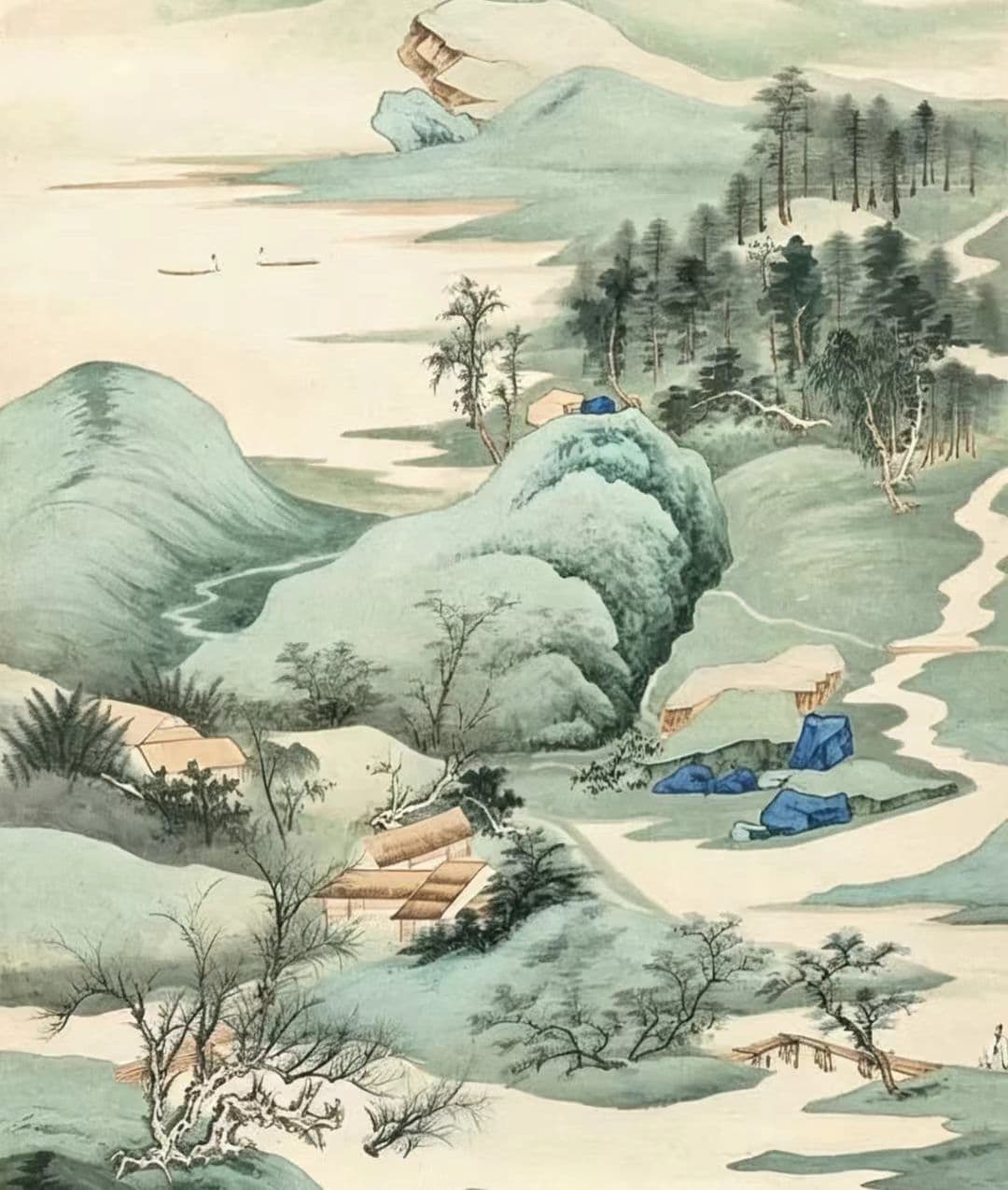
Texture (皴 cūn): short, repeated strokes that build surface texture. Most associated with landscape painting — different schools developed signature texture strokes (Mi Fei's "raindrop" strokes, Fan Kuan's "axe-cut" strokes). The texture stroke is what reads as "this is a rock" or "this is bark".
Dot (点): small accent strokes that punctuate. Often used for distant figures, leaves, moss on rocks. A landscape with dots reads as inhabited even when no figures are explicitly painted.
Drag (擦): a dry, scratchy stroke produced by a half-loaded brush. Used for textures of bark, water, dry rock. Gives a different surface quality from the wet wash.
Flying white (飞白): a partial-coverage stroke where the brush is moving fast enough that the ink does not fully load onto the paper. Visible white streaks within the stroke. Most associated with calligraphy and with Wu Changshuo's painting.
Why the empty space is the painting
Most ink wash paintings are 60–80% empty white paper. This is not a limitation; it is the active visual material of the painting. Western viewers often see this as "unfinished" or "sketch-like" but in the Chinese tradition the empty space is doing the same work the painted areas are — defining mountains by what is not painted, suggesting water by what is not drawn, structuring the painting by negative shape.
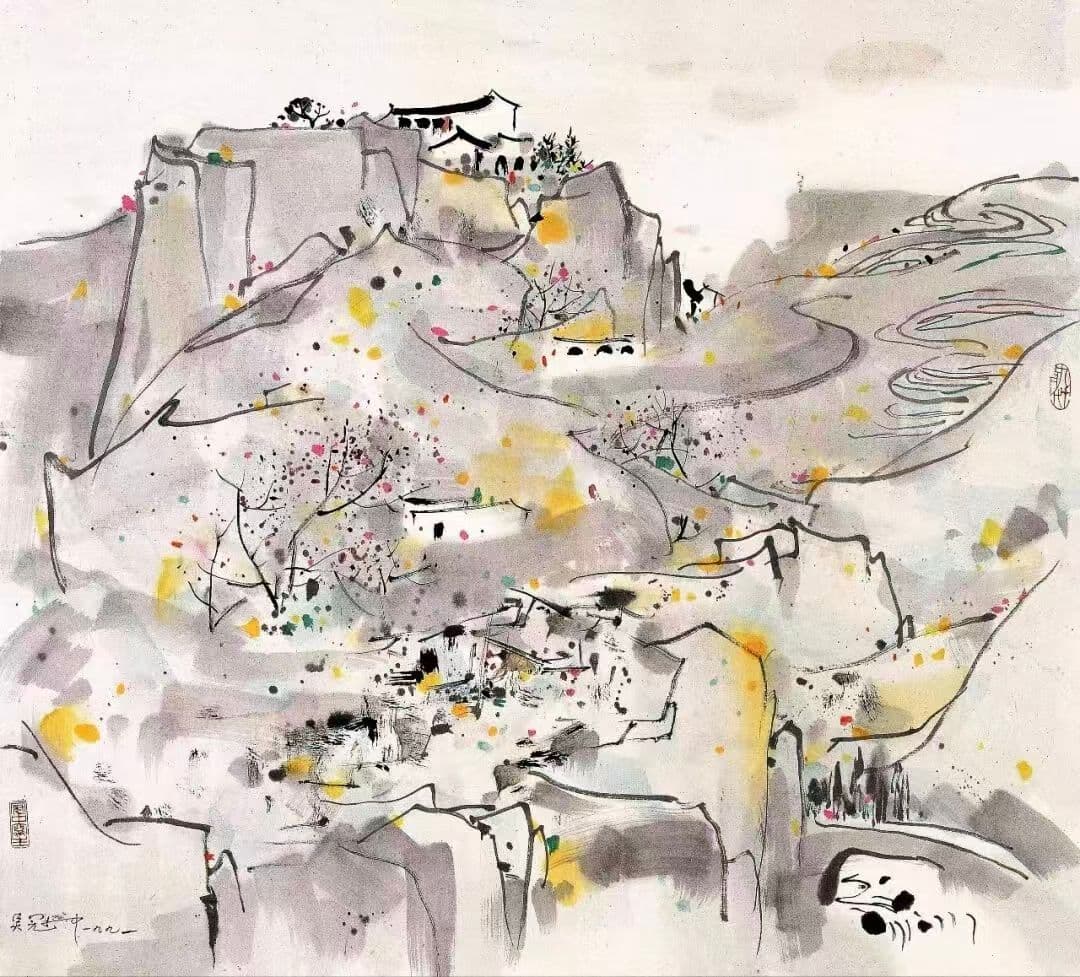
This is one of the harder lessons for new collectors. Once it lands, the same paintings transform. Look at any major Wu Guanzhong landscape and you will notice that the white passages between his black-line villages are not blank background — they are positive shapes carrying their own weight. The painting is a balance of two figures, ink and paper, neither subordinate to the other.
How to start collecting
Three practical steps for a Western collector starting in ink wash:
First, see real works in person. Western museums with strong Chinese collections include the British Museum (London), the Metropolitan Museum (New York), the Freer-Sackler (Washington), the Asian Art Museum (San Francisco), and the Musée Guimet (Paris). Spend a few hours with the twentieth-century rooms specifically — they will calibrate your eye for the period that is most actively collected today.
Second, start with prints, not originals. Hand-numbered limited-edition giclée reproductions of major twentieth-century masters cost far less than originals — ours run from about $300 to $1,200. They reproduce the brushwork at a quality where the diagnostic features (stroke types, ink-load variation, seal placement) are all readable. Living with three or four prints for a year teaches you to look at ink wash in a way no museum visit can — you see the same paintings in different light, in different moods, in your own room.
Third, only after a year do you start looking at originals. Originals trade at $50,000 and up for major twentieth-century masters; lesser-known names start around $5,000. By the time you are ready to step up, your eye will have been trained by living with reproductions, and you will be able to evaluate originals on their own terms rather than starting from zero.
Common beginner mistakes
Three traps:
Mistake one: choosing by subject rather than brushwork. New collectors often pick paintings because they like the subject — a horse, a flower, a landscape. The subject matters less than how the subject is painted. Two paintings of the same subject by different painters can be entirely different works; two paintings of different subjects by the same painter often share an underlying brush vocabulary that links them.
Mistake two: over-decorating with too many ink wash works. A single ink wash painting commands a wall. Two facing each other on opposite walls work. Five in a row begins to read as wallpaper. The discipline of empty space the paintings themselves practise should extend to how they are hung — give each one room.
Mistake three: framing too tightly. Ink wash on rice paper benefits from generous matting and a loose frame profile. Tightly cropped, heavy frames suffocate the work. Conservation framing with UV-filtering glass and acid-free matting is essential — budget $200–$500 per piece for framing alongside the print itself.
Where to start
If you are starting a serious encounter with ink wash, the easiest entry is a print of a clearly-readable twentieth-century master — Qi Baishi for figurative work (his shrimps and lotus paintings), Wu Guanzhong for abstracted landscape, Lin Fengmian for figure painting. Each of these painters has been covered in our Journal articles in detail, and each has a distinct stroke vocabulary that rewards the kind of slow, repeated looking that ink wash requires.
The Kiln & Ink collection is built specifically for this kind of beginning. Fifteen masters; works ranging from about $300 to $1,200; archival giclée on rice paper that reproduces the brushwork at near-original fidelity; signed COA with every print. Pick one, live with it for a quarter, then pick the second.
From the Kiln & Ink collection: Flower Basket with Dragonfly, an archival giclée edition after Wu Changshuo, hand-numbered on xuan paper with a certificate of authenticity.
Explore Further