Published April 13, 2026
In October 1960, Fu Baoshi completed Pagoda Shadow and Bell Chime during a historic 23,000-li sketching tour across China. Inspired by Yan'an's iconic Pagoda Hill, this masterwork blends the misty Loess Plateau with ancient poetic verse — a landmark where traditional Chinese art meets modern patriotic spirit.
In the spring of 1960, Fu Baoshi embarked on what would become one of the most celebrated artistic pilgrimages in modern Chinese history. Together with a group of Jiangsu province painters, he set out on a 23,000-li sketching tour that wound through six provinces and some of China's most storied landscapes. The journey was both physical and ideological — an effort to reconcile the ancient practice of “searching for mountains” with the new China's call for art rooted in lived experience.
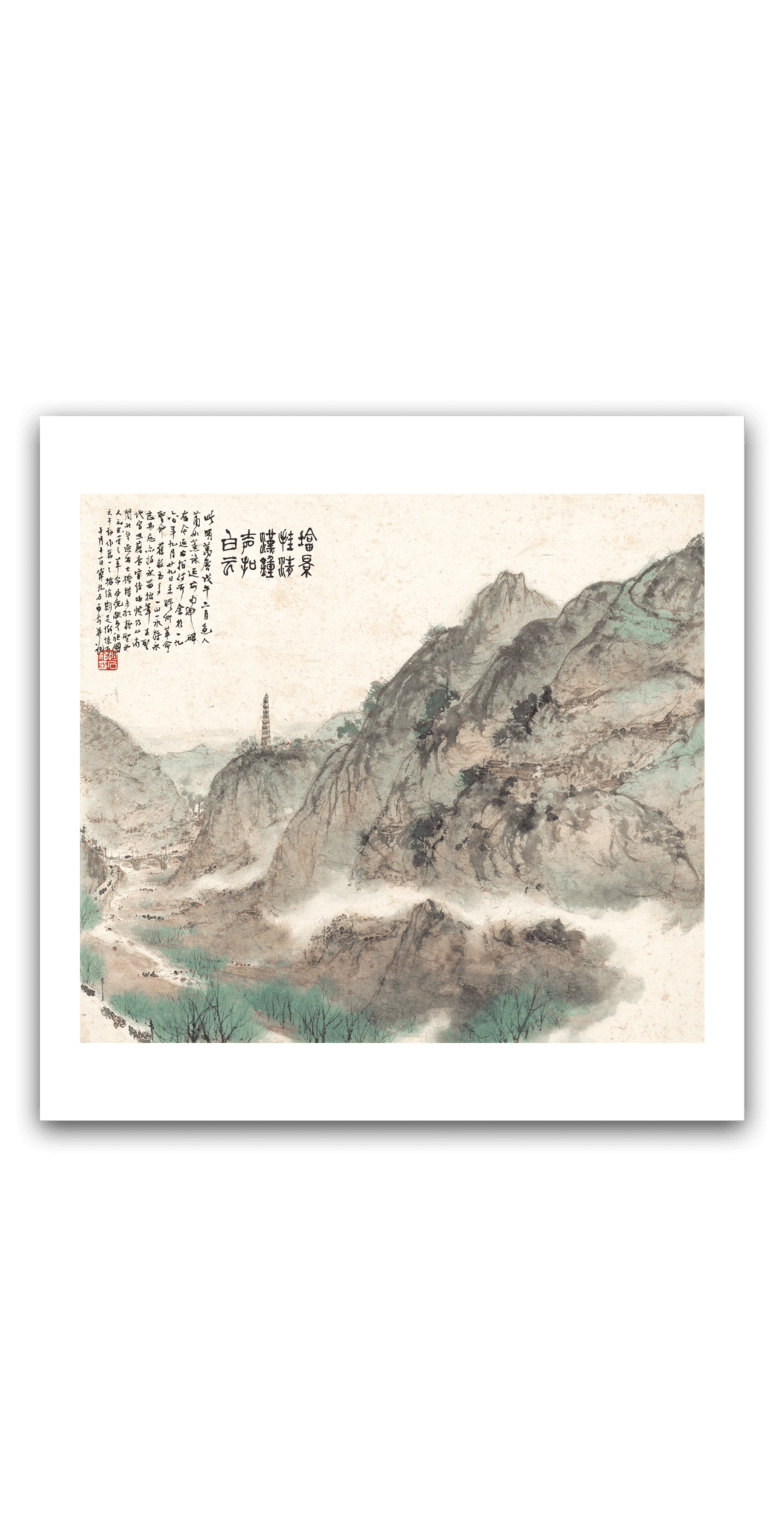
It was in Yan'an, the revolutionary heartland, that Fu Baoshi painted Pagoda Shadow and Bell Chime — a work that would come to embody the entire expedition's ambition. The pagoda on Baota Hill, perched above the confluence of the Yan River and the Du Li River, had been an emblem of revolutionary China since the 1930s. Fu saw something else in it: a subject where landscape tradition and contemporary meaning could meet without contradiction.
The Loess Plateau Through Ink and Mist
What strikes the viewer first is the atmosphere. The pagoda does not dominate the composition — it emerges from it, barely distinguishable from the mountain ridges that cradle it. Fu Baoshi deploys his signature “scattered brush” technique to build the Loess Plateau in layers of wet and dry ink, creating a landscape that seems to breathe with moisture and light.
The mist is not decorative. In classical Chinese aesthetics, mist represents the boundary between the visible and the imagined, between what can be painted and what must be felt. Fu understood this instinctively. His Yan'an is not a topographical record but a state of mind — a place where history dissolves into poetry.
Technique: The Baoshi Cun in Full Flight
The painting is a masterclass in Fu Baoshi's invented texture stroke, the Baoshi Cun (抱石皴). Where traditional Chinese painters relied on codified texture strokes passed down through centuries — the axe-cut stroke, the hemp-fibre stroke, the raindrop stroke — Fu broke with convention entirely. His brush moves in rapid, overlapping arcs, building form through accumulated energy rather than descriptive outline.
In Pagoda Shadow and Bell Chime, this technique reaches a particular intensity. The mountain slopes are rendered in bold, moist strokes that blur the boundary between rock and cloud. Light ink washes create the hazy distance, while concentrated dark ink anchors the foreground. The pagoda itself is drawn with restrained precision — a still point amid the storm of brushwork that surrounds it.
A Poetic Title, a Political Moment
The title itself — Pagoda Shadow and Bell Chime — draws on the classical Chinese literary device of invoking sound and shadow rather than substance. We do not see the bell; we hear it. We do not see the pagoda clearly; we sense its shadow. This is pure literati aesthetics, and yet the subject is Yan'an, the birthplace of revolutionary China.
Fu Baoshi managed what very few artists of his generation could: he served the political moment without betraying his artistic inheritance. The painting is simultaneously a tribute to the revolutionary landscape and a continuation of the thousand-year tradition of shanshui painting. That dual achievement is what makes it a landmark work.
Collecting Significance
Works from Fu Baoshi's 1960 sketching tour are among the most sought-after in the modern Chinese art market. They represent a rare convergence: an artist at the height of his powers, working from direct observation rather than studio imagination, producing paintings that are both historically significant and aesthetically supreme.
This edition, reproduced on traditional xuan paper and mounted on silk scroll in the classical manner, preserves the materiality of the original. At 30 × 28 cm, it is an intimate work — meant to be unrolled and contemplated in private, as the best Chinese paintings have always been.
From the Kiln & Ink collection: Bell Chimes by Pagoda Shadow, an archival giclée edition after Fu Baoshi, hand-numbered on xuan paper with a certificate of authenticity.
Explore Further