Published April 13, 2026
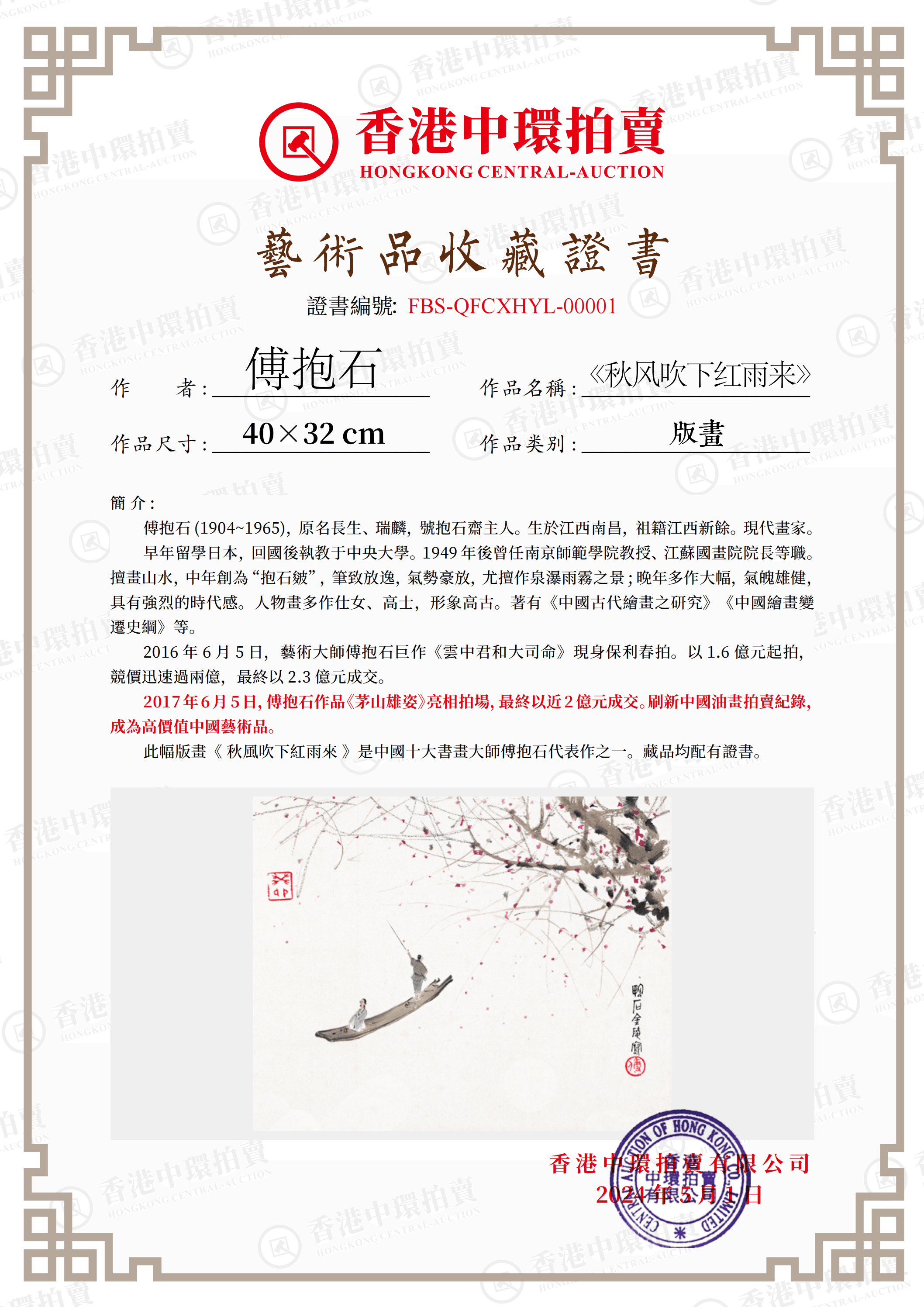
Painted in 1962, Autumn Wind Brings Red Petals Falling draws its title from Shi Tao, the Qing dynasty master whom Fu Baoshi revered above all others. Loose, vigorous brushwork sends crimson leaves spiralling through mist-soaked mountains — a supreme example of Fu's ability to fuse ancient poetry with modern brushwork.
There is a line by the seventeenth-century painter-monk Shi Tao that haunted Fu Baoshi throughout his career: a single verse about autumn wind scattering red petals across a mountainside. Shi Tao wrote it in passing, in one of his many colophons. Fu Baoshi turned it into the title of a painting — and, in doing so, created one of the defining images of the literati tradition in modern Chinese art.
Painted in 1962, Autumn Wind Brings Red Petals Falling belongs to Fu Baoshi's mature period, when his command of ink, composition, and poetic allusion had reached its fullest expression. The painting does not depict a specific place. It depicts a feeling — the particular melancholy and exhilaration of autumn in the mountains, when the first cold wind strips colour from the trees and sends it spiralling downward.
Shi Tao: The Master Behind the Master
To understand this painting, one must first understand Fu Baoshi's relationship with Shi Tao (1642–1707). As a young scholar, Fu wrote his doctoral thesis on Shi Tao's chronology — a work of such meticulous scholarship that it remains a standard reference today. But his engagement with Shi Tao was never merely academic. He saw in the Qing master a kindred spirit: an artist who rejected rigid convention, who believed that painting must arise from personal experience rather than the copying of ancient models.
Shi Tao's famous dictum — “the method of no method is the supreme method” — became the philosophical foundation of Fu Baoshi's entire practice. In Autumn Wind, we see this principle made visible: the brushwork appears spontaneous, almost reckless, yet every stroke lands with absolute conviction.
Ink, Colour, and the Falling Leaf
The technical achievement of this painting lies in its handling of colour within the ink-wash tradition. Chinese landscape painting is overwhelmingly monochrome — ink and water on paper. When colour appears, it must be justified by the subject and handled with extreme restraint, or the work collapses into illustration.
Fu Baoshi understood this perfectly. The red in Autumn Wind is not applied as flat colour but is woven into the ink structure of the painting. Leaves appear as scattered touches of vermilion and cinnabar, caught mid-flight against the grey-green wash of the mountains. The effect is of colour emerging from within the landscape rather than being imposed upon it.
The mist — always the mist in Fu Baoshi — is rendered in diluted ink washes that bleed softly into the paper. It is this controlled wetness, this willingness to let the medium behave unpredictably, that gives the painting its atmosphere of living movement.
The Literati Spirit in Modern China
What makes this painting remarkable within Fu Baoshi's oeuvre is its pure commitment to the literati ideal. Unlike his Yan'an subjects or his collaborative political works, Autumn Wind has no ideological programme. It is a painting about autumn, about poetry, about the relationship between a modern artist and his ancient predecessors. It belongs to the tradition of “painting from poetry” (shi yi hua) that stretches back to Wang Wei in the Tang dynasty.
For collectors, this purity of intention is significant. Works that transcend their historical moment — that speak to universal themes through culturally specific means — tend to appreciate most steadily over time. Autumn Wind Brings Red Petals Falling is precisely such a work: timeless in subject, revolutionary in technique, and unmistakably the hand of a master at the peak of his powers.
From the Kiln & Ink collection: Autumn Wind Brings Red Petals Falling, an archival giclée edition after Fu Baoshi, hand-numbered on xuan paper with a certificate of authenticity.
Explore Further